
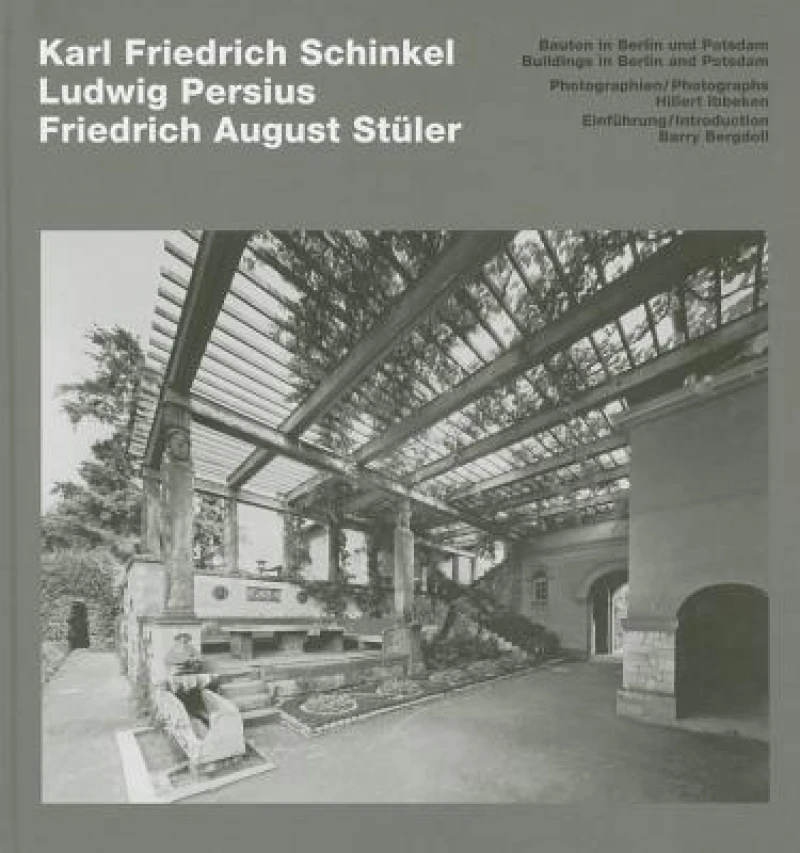
Schinkel, Persius, Stuler - Buildings in Berlin and Potsdam
Book Details
Format
Hardback or Cased Book
ISBN-10
3936681724
ISBN-13
9783936681727
Publisher
Edition Axel Menges
Imprint
Edition Axel Menges
Country of Manufacture
DE
Country of Publication
GB
Publication Date
Jun 18th, 2013
Print length
144 Pages
Weight
1,342 grams
Dimensions
30.20 x 28.60 x 1.70 cms
Product Classification:
Individual architects & architectural firms
Ksh 3,150.00
Temporarily out of stock, due soon
0 in stock
Delivery Location
Delivery fee: Select location
Secure
Quality
Fast
Text in English & German. This book is a synopsis, a summary of the books also published by Edition Axel Menges about the Prussian architects Karl Friedrich Schinkel (1781-1841), Ludwig Persius (1803-1845) and Friedrich August Stüler (1800-1865), but it covers only the works of these architects in Berlin and Potsdam. The three books mentioned above are subtitled 'The architectural work today'; in other words, they are exclusively about buildings that still exist. This is also true of the present selection. The question whether this selection and limitation to Berlin and Potsdam is representative of the work of the three architects can clearly be answered in the affirmative. For Persius this question does not even arise, because during his short life he worked almost exclusively in Potsdam and its immediate vicinity -- he was the 'King's architect'. Stüler's work is found in a region extending from Cologne on the Rhine to Masuria, with some important buildings in Stockholm and Budapest as well. About a quarter of his works can be found in Potsdam and Berlin, where Stüler, too, was the 'King's architect'. The truly gigantic lifework of Schinkel extends from Aachen to St Petersburg. Berlin and Potsdam have about a third of his works. It can be confidently said, however, that those who know the works of Schinkel, Persius and Stüler in Berlin and Potsdam also know the architect's work as a whole in each case. Since the pictures assembled here were taken between 1998 and 2005, they themselves have already become somewhat historical.
It can be said that those who know he works of Karl Friedrich Schinkel (1781–1841), Ludwig Persius (1803–1845) and Friedrich August Stüler (1800–1865) in Berlin and Potsdam also know the architects’ work as a whole in each case. The truly gigantic lifework of Schinkel extends from Aachen to St. Petersburg; Berlin and Potsdam have about a third of his work. During his short life Persius worked almost exclusively in Potsdam and its intimate vicinity; he was the King’s architect. Stüler’s work is found in a region extending from Cologne on the Rhine to Masuria, with some important buildings in Stockholm and Budapest as well. About a quarter of his work can be found in Potsdam and Berlin where Stüler too was the King’s architect.
Text in English & German. This book is a synopsis, a summary of the books also published by Edition Axel Menges about the Prussian architects Karl Friedrich Schinkel (1781-1841), Ludwig Persius (1803-1845) and Friedrich August Stüler (1800-1865), but it covers only the works of these architects in Berlin and Potsdam. The three books mentioned above are subtitled ''The architectural work today''; in other words, they are exclusively about buildings that still exist. This is also true of the present selection. The question whether this selection and limitation to Berlin and Potsdam is representative of the work of the three architects can clearly be answered in the affirmative. For Persius this question does not even arise, because during his short life he worked almost exclusively in Potsdam and its immediate vicinity -- he was the ''King''s architect''. Stüler''s work is found in a region extending from Cologne on the Rhine to Masuria, with some important buildings in Stockholm and Budapest as well. About a quarter of his works can be found in Potsdam and Berlin, where Stüler, too, was the ''King''s architect''. The truly gigantic lifework of Schinkel extends from Aachen to St Petersburg. Berlin and Potsdam have about a third of his works. It can be confidently said, however, that those who know the works of Schinkel, Persius and Stüler in Berlin and Potsdam also know the architect''s work as a whole in each case. Since the pictures assembled here were taken between 1998 and 2005, they themselves have already become somewhat historical.
Text in English & German. This book is a synopsis, a summary of the books also published by Edition Axel Menges about the Prussian architects Karl Friedrich Schinkel (1781-1841), Ludwig Persius (1803-1845) and Friedrich August Stüler (1800-1865), but it covers only the works of these architects in Berlin and Potsdam. The three books mentioned above are subtitled 'The architectural work today'; in other words, they are exclusively about buildings that still exist. This is also true of the present selection. The question whether this selection and limitation to Berlin and Potsdam is representative of the work of the three architects can clearly be answered in the affirmative. For Persius this question does not even arise, because during his short life he worked almost exclusively in Potsdam and its immediate vicinity -- he was the 'King's architect'. Stüler's work is found in a region extending from Cologne on the Rhine to Masuria, with some important buildings in Stockholm and Budapest as well. About a quarter of his works can be found in Potsdam and Berlin, where Stüler, too, was the 'King's architect'. The truly gigantic lifework of Schinkel extends from Aachen to St Petersburg. Berlin and Potsdam have about a third of his works. It can be confidently said, however, that those who know the works of Schinkel, Persius and Stüler in Berlin and Potsdam also know the architect's work as a whole in each case. Since the pictures assembled here were taken between 1998 and 2005, they themselves have already become somewhat historical.
Get Schinkel, Persius, Stuler - Buildings in Berlin and Potsdam by at the best price and quality guaranteed only at Werezi Africa's largest book ecommerce store. The book was published by Edition Axel Menges and it has pages.

