
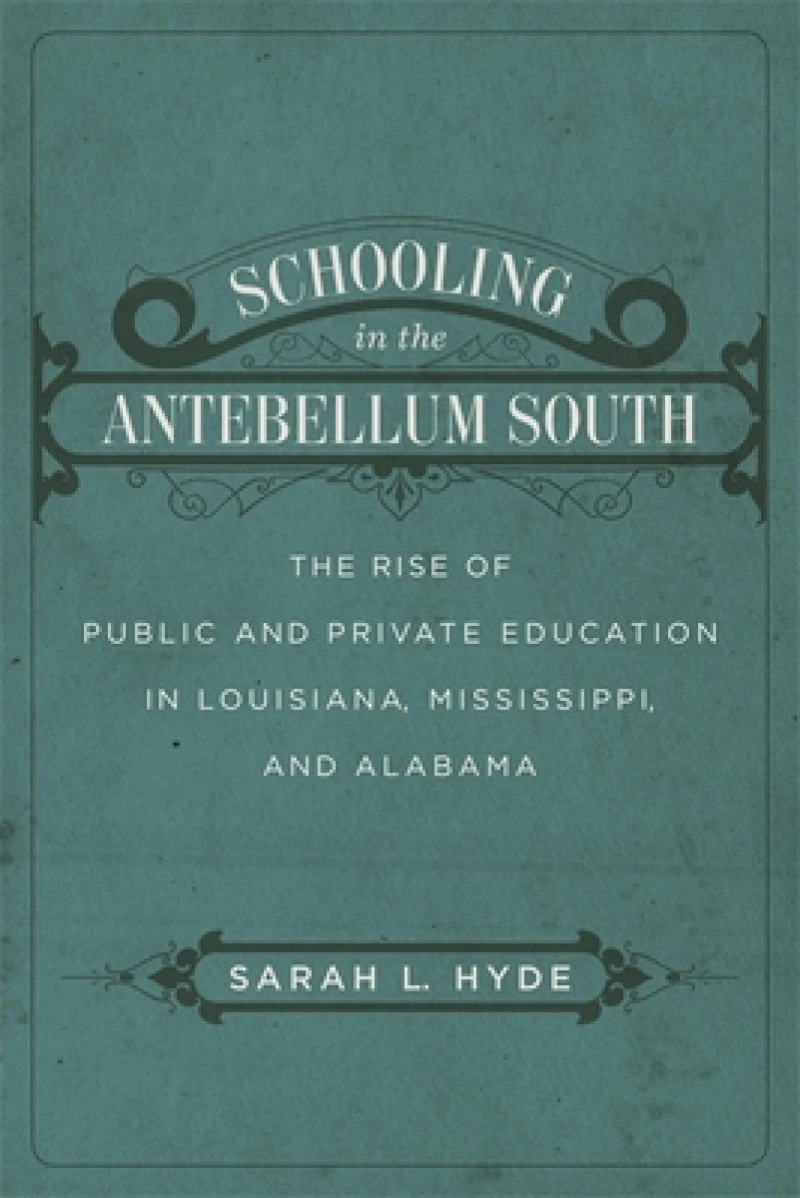
Schooling in the Antebellum South : The Rise of Public and Private Education in Louisiana, Mississippi, and Alabama
Book Details
Format
Hardback or Cased Book
ISBN-10
0807164208
ISBN-13
9780807164204
Publisher
Louisiana State University Press
Imprint
Louisiana State University Press
Country of Manufacture
US
Country of Publication
GB
Publication Date
Oct 19th, 2016
Print length
240 Pages
Weight
500 grams
Dimensions
16.40 x 23.60 x 2.40 cms
Ksh 6,700.00
Temporarily out of stock, due soon
0 in stock
Delivery Location
Delivery fee: Select location
Secure
Quality
Fast
Analyses educational development in the Gulf South before the Civil War, not only revealing a thriving private and public education system, but also offering insight into the worldview and aspirations of the people inhabiting the region.
In Schooling in the Antebellum South, Sarah L. Hyde analyzes educational development in the Gulf South before the Civil War, not only revealing a thriving private and public education system, but also offering insight into the worldview and aspirations of the people inhabiting the region. While historians have tended to emphasize that much of the antebellum South had no public school system and offered education only to elites in private institutions, Hyde's work suggests a different pattern of development in Louisiana, Mississippi, and Alabama, where citizens actually worked to extend schooling across the region. As a result, students learned in a variety of settings- in their own homes with a family member or hired tutor, at private or parochial schools, and in public free schools. Regardless of the venue, Hyde shows that the ubiquity of learning in the region proves how highly southerners valued education.
As early as the 1820s and 1830s, legislators in these states sought to increase access to education for less wealthy residents through financial assistance to private schools. Urban governments in the region were the first to acquiesce to voters' demands, establishing public schools in New Orleans, Natchez, and Mobile. The success of these schools led residents in rural areas to lobby their local legislatures for similar opportunities. Despite an economic downturn in the late 1830s that limited legislative appropriations for education, the economic recovery of the 1840s ushered in a new era of educational progress.
The return of prosperity, Hyde suggests, coincided with the maturation of Jacksonian democracy- a political philosophy that led southerners to demand access to privileges formerly reserved for the elite, including schooling. Hyde explains that while Jacksonian ideology inspired voters to lobby for schools, the value southerners placed on learning was rooted in republicanism: they believed a representative democracy needed an educated populace to survive. Consequently, by 1860 all three states had established statewide public school systems. Schooling in the Antebellum South successfully challenges the conventional wisdom that an elitist educational system prevailed in the South and adds historical depth to an understanding of the value placed on public schooling in the region.
As early as the 1820s and 1830s, legislators in these states sought to increase access to education for less wealthy residents through financial assistance to private schools. Urban governments in the region were the first to acquiesce to voters' demands, establishing public schools in New Orleans, Natchez, and Mobile. The success of these schools led residents in rural areas to lobby their local legislatures for similar opportunities. Despite an economic downturn in the late 1830s that limited legislative appropriations for education, the economic recovery of the 1840s ushered in a new era of educational progress.
The return of prosperity, Hyde suggests, coincided with the maturation of Jacksonian democracy- a political philosophy that led southerners to demand access to privileges formerly reserved for the elite, including schooling. Hyde explains that while Jacksonian ideology inspired voters to lobby for schools, the value southerners placed on learning was rooted in republicanism: they believed a representative democracy needed an educated populace to survive. Consequently, by 1860 all three states had established statewide public school systems. Schooling in the Antebellum South successfully challenges the conventional wisdom that an elitist educational system prevailed in the South and adds historical depth to an understanding of the value placed on public schooling in the region.
Get Schooling in the Antebellum South by at the best price and quality guaranteed only at Werezi Africa's largest book ecommerce store. The book was published by Louisiana State University Press and it has pages.

