
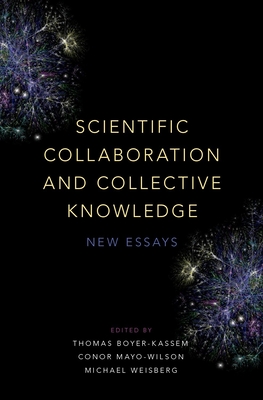
Scientific Collaboration and Collective Knowledge : New Essays
Book Details
Format
Hardback
ISBN-10
0190680539
ISBN-13
9780190680534
Publisher
Oxford University Press Inc
Imprint
Oxford University Press Inc
Country of Manufacture
US
Country of Publication
GB
Publication Date
Dec 21st, 2017
Print length
240 Pages
Weight
458 grams
Dimensions
15.70 x 23.60 x 2.30 cms
Product Classification:
Philosophy: epistemology & theory of knowledgePhilosophy of science
KSh 19,800.00
Temporarily out of stock, due soon
0 in stock
Delivery Location
Delivery fee: Select location
Secure
Quality
Fast
Current scientific research almost always requires collaboration among several (if not several hundred) specialized researchers. When scientists co-author a journal article, who deserves credit for discoveries or blame for errors? How should scientific institutions promote fruitful collaborations among scientists? In this book, leading philosophers of science address these critical questions.
Descartes once argued that, with sufficient effort and skill, a single scientist could uncover fundamental truths about our world. Contemporary science proves the limits of this claim. From synthesizing the human genome to predicting the effects of climate change, some current scientific research requires the collaboration of hundreds (if not thousands) of scientists with various specializations. Additionally, the majority of published scientific research is now co-authored, including more than 80% of articles in the natural sciences, meaning small collaborative teams have become the norm in science. This volume is the first to address critical philosophical questions regarding how collective scientific research could be organized differently and how it should be organized. For example, should scientists be required to share knowledge with competing research teams? How can universities and grant-giving institutions promote successful collaborations? When hundreds of researchers contribute to a discovery, how should credit be assigned - and can minorities expect a fair share? When collaborative work contains significant errors or fraudulent data, who deserves blame? In this collection of essays, leading philosophers of science address these critical questions, among others. Their work extends current philosophical research on the social structure of science and contributes to the growing, interdisciplinary field of social epistemology. The volume''s strength lies in the diversity of its authors'' methodologies. Employing detailed case studies of scientific practice, mathematical models of scientific communities, and rigorous conceptual analysis, contributors to this volume study scientific groups of all kinds, including small labs, peer-review boards, and large international collaborations like those in climate science and particle physics.
Get Scientific Collaboration and Collective Knowledge by Conor Mayo-Wilson at the best price and quality guaranteed only at Werezi Africa's largest book ecommerce store. The book was published by Oxford University Press Inc and it has 240 pages.
Customers Who Bought This Also Bought

A Treatise of Human Nature
KSh 2,700.00

Critique of Pure Reason
KSh 3,400.00

Sensuous Knowledge
KSh 4,500.00

Critique of Pure Reason, Abridged
KSh 3,600.00
Sharing Thoughts
KSh 17,000.00

The Critique of Pure Reason
KSh 6,450.00

Critique of Pure Reason
KSh 7,250.00

An Inquiry Into Meaning and Truth
KSh 3,750.00

Intelligence and Spirit
KSh 5,750.00

The Social Construction of What?
KSh 5,200.00

Discourse on Method and Related Writings
KSh 2,000.00

Beyond Good and Evil
KSh 2,000.00
