
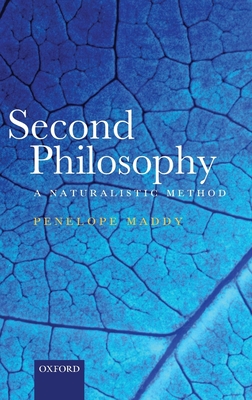
Second Philosophy : A Naturalistic Method
Book Details
Format
Hardback
ISBN-10
0199273669
ISBN-13
9780199273669
Publisher
Oxford University Press
Imprint
Oxford University Press
Country of Manufacture
GB
Country of Publication
GB
Publication Date
Apr 19th, 2007
Print length
462 Pages
Weight
848 grams
Dimensions
16.40 x 24.20 x 3.50 cms
Product Classification:
Philosophy: metaphysics & ontologyPhilosophy of mathematicsPhilosophy of science
KSh 10,000.00
Currently unavailable
0 in stock
Delivery Location
Delivery fee: Select location
Secure
Quality
Fast
Proposes an austere form of naturalism called 'Second Philosophy'. This book, using the persona of an idealized inquirer, constructs a second-philosophical line of thought which is practised in reflections on the ground of logical truth, the methodology, ontology and epistemology of mathematics, and general prospects for metaphysics naturalized.
Many philosophers these days consider themselves naturalists, but it''s doubtful any two of them intend the same position by the term. In this book, Penelope Maddy describes and practises a particularly austere form of naturalism called ''Second Philosophy''. Without a definitive criterion for what counts as ''science'' and what doesn''t, Second Philosophy can''t be specified directly - ''trust only the methods of science!'' or some such thing - so Maddy proceeds instead by illustrating the behaviours of an idealized inquirer she calls the ''Second Philosopher''. This Second Philosopher begins from perceptual common sense and progresses from there to systematic observation, active experimentation, theory formation and testing, working all the while to assess, correct and improve her methods as she goes. Second Philosophy is then the result of the Second Philosopher''s investigations.Maddy delineates the Second Philosopher''s approach by tracing her reactions to various familiar skeptical and transcendental views (Descartes, Kant, Carnap, late Putnam, van Fraassen), comparing her methods to those of other self-described naturalists (especially Quine), and examining a prominent contemporary debate (between disquotationalists and correspondence theorists in the theory of truth) to extract a properly second-philosophical line of thought. She then undertakes to practise Second Philosophy in her reflections on the ground of logical truth, the methodology, ontology and epistemology of mathematics, and the general prospects for metaphysics naturalized.
Get Second Philosophy by Penelope Maddy at the best price and quality guaranteed only at Werezi Africa's largest book ecommerce store. The book was published by Oxford University Press and it has 462 pages.
Customers Who Bought This Also Bought

Neville Goddard
KSh 5,850.00

Groundwork for the Metaphysics of Morals
KSh 2,000.00

The Sovereignty of Good
KSh 5,400.00

The Life Of The Mind
KSh 3,950.00

Groundwork for the Metaphysics of Morals – With an Updated Translation, Introduction, and Notes
KSh 1,950.00

De Anima (On the Soul)
KSh 2,350.00

Kant: The Metaphysics of Morals
KSh 5,300.00

Prolegomena to Any Future Metaphysics
KSh 2,700.00

An Inquiry Into Meaning and Truth
KSh 3,750.00
Hegel''s Inversion of Philosophy
KSh 17,100.00

Duns Scotus: Philosophical Writings
KSh 4,150.00

Metaphysics as a Guide to Morals
KSh 2,700.00
More by Penelope Maddy

Philosophical Uses of Categoricity Arguments
KSh 10,000.00

Philosophical Uses of Categoricity Arguments
KSh 3,250.00

Realism in Mathematics
KSh 9,900.00

A Plea for Natural Philosophy
KSh 11,700.00
Naturalism in Mathematics
KSh 10,550.00

The Logical Must
KSh 12,450.00

Defending the Axioms
KSh 15,800.00
Second Philosophy
KSh 9,300.00

What do Philosophers Do?
KSh 7,750.00

The Logical Must
KSh 6,500.00
