
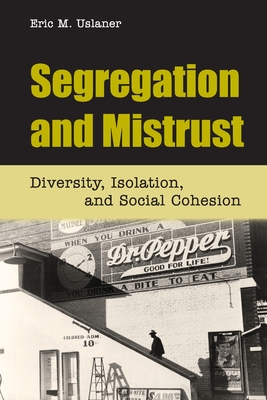
Segregation and Mistrust : Diversity, Isolation, and Social Cohesion
Book Details
Format
Paperback / softback
ISBN-10
0521151635
ISBN-13
9780521151634
Publisher
Cambridge University Press
Imprint
Cambridge University Press
Country of Manufacture
GB
Country of Publication
GB
Publication Date
Sep 17th, 2012
Print length
284 Pages
Weight
394 grams
Dimensions
15.70 x 22.50 x 1.60 cms
KSh 5,050.00
Currently unavailable
0 in stock
Delivery Location
Delivery fee: Select location
Secure
Quality
Fast
Generalized trust – faith in people you do not know – is a value that leads to many positive outcomes for a society. Yet many now worry that an increasingly diverse society is a threat to trust and altruism. Eric M. Uslaner argues that it is segregation not diversity that makes people less trusting.
Generalized trust – faith in people you do not know who are likely to be different from you – is a value that leads to many positive outcomes for a society. Yet some scholars now argue that trust is lower when we are surrounded by people who are different from us. Eric M. Uslaner challenges this view and argues that residential segregation, rather than diversity, leads to lower levels of trust. Integrated and diverse neighborhoods will lead to higher levels of trust, but only if people also have diverse social networks. Professor Uslaner examines the theoretical and measurement differences between segregation and diversity and summarizes results on how integrated neighborhoods with diverse social networks increase trust in the United States, Canada, the United Kingdom, Sweden and Australia. He also shows how different immigration and integration policies toward minorities shape both social ties and trust.
Get Segregation and Mistrust by Eric M. Uslaner at the best price and quality guaranteed only at Werezi Africa's largest book ecommerce store. The book was published by Cambridge University Press and it has 284 pages.
Customers Who Bought This Also Bought
More
KSh 3,050.00

Pimp: The Story Of My Life
KSh 2,000.00

Courage To Be Disliked
KSh 2,350.00
Modern Classics Road To Wigan Pier
KSh 1,800.00

Want
KSh 2,000.00

How Civil Wars Start
KSh 2,000.00

Your House Will Pay
KSh 1,600.00

Winners Take All
KSh 2,350.00
Staying True to You
KSh 2,700.00

Debatable Land
KSh 3,950.00

Lost Girls
KSh 2,000.00

Right to Sex
KSh 2,000.00
More by Eric M. Uslaner
Corruption, Inequality, and the Rule of Law
KSh 7,450.00

The Historical Roots of Corruption
KSh 12,050.00
Corruption, Inequality, and the Rule of Law
KSh 20,500.00
National Identity and Partisan Polarization
KSh 9,900.00
The Moral Foundations of Trust
KSh 14,750.00
The Moral Foundations of Trust
KSh 6,000.00

The Decline of Comity in Congress
KSh 6,650.00

The Historical Roots of Corruption
KSh 4,650.00
