
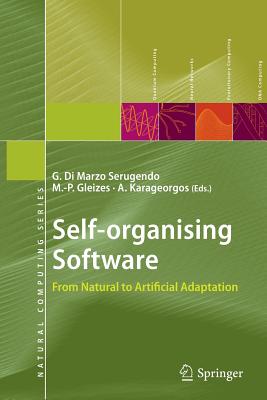
Self-organising Software : From Natural to Artificial Adaptation
Book Details
Format
Paperback / softback
Book Series
Natural Computing Series
ISBN-10
3642270522
ISBN-13
9783642270529
Publisher
Springer-Verlag Berlin and Heidelberg GmbH & Co. KG
Imprint
Springer-Verlag Berlin and Heidelberg GmbH & Co. K
Country of Manufacture
DE
Country of Publication
GB
Publication Date
Nov 27th, 2013
Print length
462 Pages
Weight
734 grams
Dimensions
24.40 x 17.10 x 2.60 cms
Product Classification:
Artificial intelligenceArtificial intelligence (AI)
KSh 16,200.00
Currently unavailable
0 in stock
Delivery Location
Delivery fee: Select location
Secure
Quality
Fast
Finally, the book presents diverse applications of self-organising software, such as constraint satisfaction, trust management, image recognition and networking.The book will be of interest to researchers working on emergent phenomena and adaptive systems.
Self-organisation, self-regulation, self-repair and self-maintenance are promising conceptual approaches for dealing with complex distributed interactive software and information-handling systems. Self-organising applications dynamically change their functionality and structure without direct user intervention, responding to changes in requirements and the environment. This is the first book to offer an integrated view of self-organisation technologies applied to distributed systems, particularly focusing on multiagent systems. The editors developed this integrated book with three aims: to explain self-organisation concepts and principles, using clear definitions and a strong theoretical background; to examine how self-organising behaviour can be modelled, analysed and systematically engineered into agent behaviour; and to assess the types of problems that can be solved using self-organising multiagent systems. The book comprises chapters covering all three dimensions, synthesising up-to-date research work and the latest technologies and applications. The book offers dedicated chapters on concepts such as self-organisation, emergence in natural systems, software agents, stigmergy, gossip, cooperation and immune systems. The book then explains how to engineer artificial self-organising software, in particular it examines methodologies and middleware infrastructures. Finally, the book presents diverse applications of self-organising software, such as constraint satisfaction, trust management, image recognition and networking. The book will be of interest to researchers working on emergent phenomena and adaptive systems. It will also be suitable for use as a graduate textbook, with chapter summaries and exercises, and an accompanying website that includes teaching slides, exercise solutions and research project outlines. Self-organisation, self-regulation, self-repair and self-maintenance are promising conceptual approaches for dealing with complex distributed interactive software and information-handling systems. Self-organising applications dynamically change their functionality and structure without direct user intervention, responding to changes in requirements and the environment. This is the first book to offer an integrated view of self-organisation technologies applied to distributed systems, particularly focusing on multiagent systems. The editors developed this integrated book with three aims: to explain self-organisation concepts and principles, using clear definitions and a strong theoretical background; to examine how self-organising behaviour can be modelled, analysed and systematically engineered into agent behaviour; and to assess the types of problems that can be solved using self-organising multiagent systems. The book comprises chapters covering all three dimensions, synthesising up-to-date research work and the latest technologies and applications. The book offers dedicated chapters on concepts such as self-organisation, emergence in natural systems, software agents, stigmergy, gossip, cooperation and immune systems. The book then explains how to engineer artificial self-organising software, in particular it examines methodologies and middleware infrastructures. Finally, the book presents diverse applications of self-organising software, such as constraint satisfaction, trust management, image recognition and networking. The book will be of interest to researchers working on emergent phenomena and adaptive systems. It will also be suitable for use as a graduate textbook, with chapter summaries and exercises, and an accompanying website that includes teaching slides, exercise solutions and research project outlines.
Get Self-organising Software by Anthony Karageorgos at the best price and quality guaranteed only at Werezi Africa's largest book ecommerce store. The book was published by Springer-Verlag Berlin and Heidelberg GmbH & Co. KG and it has 462 pages.
Customers Who Bought This Also Bought

Magnifica Humanitas
KSh 1,500.00

Nexus
KSh 2,350.00

The Thinking Machine
KSh 2,350.00

The Reverse Centaur's Guide to Life After AI
KSh 3,050.00

The MANIAC
KSh 2,000.00
Thinking With Machines: The Brave New World of AI
KSh 4,300.00
Prediction Machines
KSh 3,950.00

Confident AI
KSh 3,050.00

Responsible AI
KSh 6,400.00

Empire of AI
KSh 4,500.00

The MANIAC
KSh 2,700.00

Data Management, Analytics and Innovation
KSh 32,400.00
