
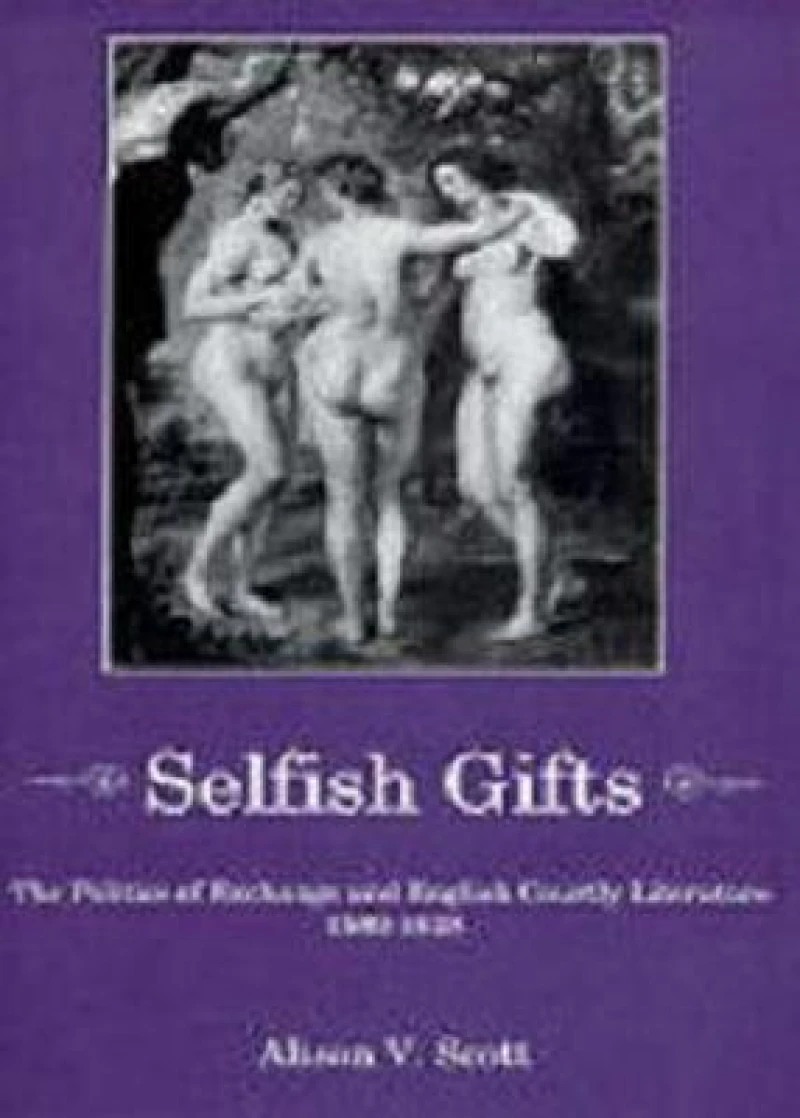
Selfish Gifts : The Politics of Exchange and English Courtly Literarture, 1580-1628
Book Details
Format
Hardback or Cased Book
ISBN-10
1611473187
ISBN-13
9781611473186
Publisher
Fairleigh Dickinson University Press
Imprint
Fairleigh Dickinson University Press
Country of Manufacture
US
Country of Publication
GB
Publication Date
Dec 1st, 2005
Print length
303 Pages
Weight
606 grams
Dimensions
24.50 x 16.80 x 2.20 cms
Product Classification:
Literary reference works
Ksh 16,200.00
Werezi Extended Catalogue
0 in stock
Delivery Location
Delivery fee: Select location
Secure
Quality
Fast
Engaging with a wide range of texts on gift-theory, extending from Senecas De Beneficiis to Derridas Given Time, Selfish Gifts examines the importance of gift ethics and the rhetoric of honorable giving to the literature of late Elizabeth and early Stuart England. It demonstrates that the ideal of the freely given and disinterested gift shaped the language of early modern clientage, along with literary representations of patrons and patronage systems during this period. Selfish Gifts examines how early modern clients moved quickly and strategically to assimilate the language of competition and equality, characteristic of an emerging market economy, within their existing discourses of gift exchange, in order to maximize the rewards they might induce from an increasingly diverse group of patrons. To give is to exercise power and thus, as numerous modern gift-theorists and anthropologists elucidate, the gift is implicitly self-interested even as it derives value from appearing altruistic; nowhere is this paradox more significant than in a patronage economy such as that which shaped literary production in early modern England. In pursuing that paradox and its implications, Selfish Gifts highlights crucial connections and cultural tensions between political and sexual giving, between 'giving' truth and flattery, between the sovereignty and subjection of gift donor/recipient, and between strategic and so-called 'sacrificial' giving. Those tensions are examined in the context of the latter years of Elizabeth Is rule, through the contrasting reign of James I and up to the early Caroline period. Selfish Gifts demonstrates the prominence of the gift ideal in Renaissance England and suggests the disturbing social and political consequences for those who give contrary to that ideal by bestowing self-interested gifts, by refusing to give, or by giving egotistically. The book establishes the centrality of gift theory to the discourses of patronage, friendship, and sovereignty, sugg
Engaging with a wide range of texts on gift-theory, extending from Senecas De Beneficiis to Derridas Given Time, Selfish Gifts examines the importance of gift ethics and the rhetoric of honorable giving to the literature of late Elizabeth and early Stuart England. It demonstrates that the ideal of the freely given and disinterested gift shaped the language of early modern clientage, along with literary representations of patrons and patronage systems during this period. Selfish Gifts examines how early modern clients moved quickly and strategically to assimilate the language of competition and equality, characteristic of an emerging market economy, within their existing discourses of gift exchange, in order to maximize the rewards they might induce from an increasingly diverse group of patrons. To give is to exercise power and thus, as numerous modern gift-theorists and anthropologists elucidate, the gift is implicitly self-interested even as it derives value from appearing altruistic; nowhere is this paradox more significant than in a patronage economy such as that which shaped literary production in early modern England. In pursuing that paradox and its implications, Selfish Gifts highlights crucial connections and cultural tensions between political and sexual giving, between ''giving'' truth and flattery, between the sovereignty and subjection of gift donor/recipient, and between strategic and so-called ''sacrificial'' giving. Those tensions are examined in the context of the latter years of Elizabeth Is rule, through the contrasting reign of James I and up to the early Caroline period. Selfish Gifts demonstrates the prominence of the gift ideal in Renaissance England and suggests the disturbing social and political consequences for those who give contrary to that ideal by bestowing self-interested gifts, by refusing to give, or by giving egotistically. The book establishes the centrality of gift theory to the discourses of patronage, friendship, and sovereignty, sugg
Get Selfish Gifts by at the best price and quality guaranteed only at Werezi Africa's largest book ecommerce store. The book was published by Fairleigh Dickinson University Press and it has pages.

