
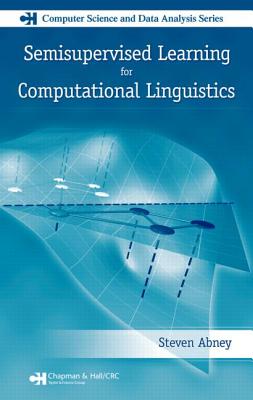
Semisupervised Learning for Computational Linguistics
by
Steven Abney
Book Details
Format
Hardback
ISBN-10
1584885599
ISBN-13
9781584885597
Publisher
Taylor & Francis Inc
Imprint
Chapman & Hall/CRC
Country of Manufacture
US
Country of Publication
GB
Publication Date
Sep 17th, 2007
Print length
322 Pages
Weight
612 grams
Dimensions
24.30 x 16.10 x 2.30 cms
Product Classification:
Computational linguistics
KSh 33,850.00
Currently unavailable
0 in stock
Delivery Location
Delivery fee: Select location
Secure
Quality
Fast
Provides a broad treatment of the theory and linguistic applications of semisupervised methods. This book discusses natural language processing methods, such as self-training and co-training. It focuses on machine learning techniques, including the boundary-oriented methods of perceptrons, boosting, SVMs, and the null-category noise model.
The rapid advancement in the theoretical understanding of statistical and machine learning methods for semisupervised learning has made it difficult for nonspecialists to keep up to date in the field. Providing a broad, accessible treatment of the theory as well as linguistic applications, Semisupervised Learning for Computational Linguistics offers self-contained coverage of semisupervised methods that includes background material on supervised and unsupervised learning.
The book presents a brief history of semisupervised learning and its place in the spectrum of learning methods before moving on to discuss well-known natural language processing methods, such as self-training and co-training. It then centers on machine learning techniques, including the boundary-oriented methods of perceptrons, boosting, support vector machines (SVMs), and the null-category noise model. In addition, the book covers clustering, the expectation-maximization (EM) algorithm, related generative methods, and agreement methods. It concludes with the graph-based method of label propagation as well as a detailed discussion of spectral methods.
Taking an intuitive approach to the material, this lucid book facilitates the application of semisupervised learning methods to natural language processing and provides the framework and motivation for a more systematic study of machine learning.
The book presents a brief history of semisupervised learning and its place in the spectrum of learning methods before moving on to discuss well-known natural language processing methods, such as self-training and co-training. It then centers on machine learning techniques, including the boundary-oriented methods of perceptrons, boosting, support vector machines (SVMs), and the null-category noise model. In addition, the book covers clustering, the expectation-maximization (EM) algorithm, related generative methods, and agreement methods. It concludes with the graph-based method of label propagation as well as a detailed discussion of spectral methods.
Taking an intuitive approach to the material, this lucid book facilitates the application of semisupervised learning methods to natural language processing and provides the framework and motivation for a more systematic study of machine learning.
Get Semisupervised Learning for Computational Linguistics by Steven Abney at the best price and quality guaranteed only at Werezi Africa's largest book ecommerce store. The book was published by Taylor & Francis Inc and it has 322 pages.
Customers Who Bought This Also Bought

Patterns in Language and Communication
KSh 18,800.00

Second Language Acquisition
KSh 7,550.00

Construction Grammar and Sociolinguistic Theory
KSh 20,450.00
A Computational Theory of Writing Systems
KSh 18,900.00
Semantic Interpretation and the Resolution of Ambiguity
KSh 7,600.00

Phraseology and Style in Subgenres of the Novel
KSh 21,600.00

A Course in Natural Language Processing
KSh 12,600.00

Deep Learning for Natural Language Processing
KSh 17,100.00

Corpora and Translation Education
KSh 23,400.00

Positionalities of Translation Studies
KSh 5,400.00

Humanities Data in R
KSh 16,200.00
Mathematical Linguistics
KSh 12,600.00
More by Steven Abney
More in This Genre
Patterns in Language and Communication
KSh 18,800.00
Second Language Acquisition
KSh 7,550.00
Construction Grammar and Sociolinguistic Theory
KSh 20,450.00
A Computational Theory of Writing Systems
KSh 18,900.00
Semantic Interpretation and the Resolution of Ambiguity
KSh 7,600.00
Phraseology and Style in Subgenres of the Novel
KSh 21,600.00
