
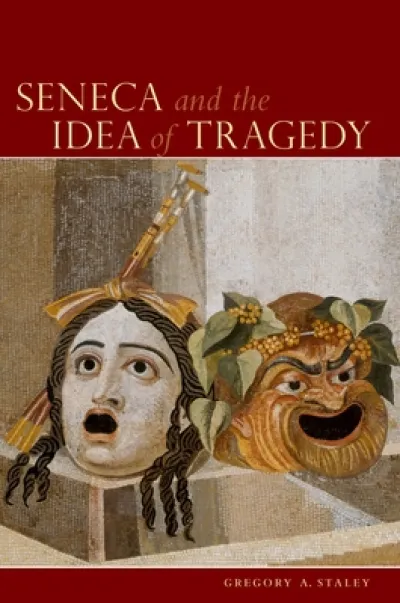
Seneca and the Idea of Tragedy
Book Details
Format
Hardback or Cased Book
ISBN-10
0195387430
ISBN-13
9780195387438
Publisher
Oxford University Press Inc
Imprint
Oxford University Press Inc
Country of Manufacture
GB
Country of Publication
GB
Publication Date
Jan 14th, 2010
Print length
200 Pages
Weight
446 grams
Dimensions
23.90 x 15.80 x 2.00 cms
Product Classification:
Literary studies: classical, early & medievalLiterary studies: plays & playwrights
Ksh 18,450.00
Manufactured on Demand
0 in stock
Delivery Location
Delivery fee: Select location
Secure
Quality
Fast
The question of why Seneca wrote tragedy has been debated at least since the 13th century. Since Seneca was a Stoic, critics have assumed that he must have written with the standard Stoic theory of literature as education in philosophy in mind. Seneca and the Idea of Tragedy argues instead that Seneca was influenced by Aristotle''s famous defense of tragedy against Plato''s critique. When Renaissance scholars applied Aristotle''s theory of tragedy to Seneca and found him to be a model tragedian, they were taking the correct approach, one which has since been discounted since Aristotle''s Poetics was presumed to have been unknown during Seneca''s lifetime. Staley shows that Aristotle''s ideas about poetry influenced the Stoics through channels other than the Poetics and that Aristotle''s idea of tragedy was adopted by Seneca in a Stoic guise.
As both a literary genre and a view of life, tragedy has from the very beginning spurred a dialogue between poetry and philosophy. Plato famously banned tragedians from his ideal community because he believed that their representations of vicious behavior could deform minds. Aristotle set out to answer Plato''s objections, arguing that fiction offers a faithful image of the truth and that it promotes emotional health through the mechanism of catharsis. Aristotle''s definition of tragedy actually had its greatest impact not on Greek tragedy itself but on later Latin literature, beginning with the tragedies of the Roman poet and Stoic philosopher Seneca (4 BC - AD 65). Scholarship over the last fifty years, however, has increasingly sought to identify in Seneca''s prose writings a Platonic poetics which is antagonistic toward tragedy and which might therefore explain why Seneca''s plays seem so often to present the failure of Stoicism. As Gregory Staley argues in this book, when Senecan tragedy fails to stage virtue we should see in this not the failure of Stoicism but a Stoic conception of tragedy as the right vehicle for imaging Seneca''s familiar world of madmen and fools. Senecan tragedy enacts Aristotle''s conception of the genre as a vivid image of the truth and treats tragedy as a natural venue in which to explore the human soul. Staley''s reading of Seneca''s plays draws on current scholarship about Stoicism as well as on the writings of Renaissance authors like Sir Philip Sidney, who borrowed from Seneca the word "idea" to designate what we would now label as a "theory" of tragedy. Seneca and the Idea of Tragedy will appeal broadly to students and scholars of classics, ancient philosophy, and English literature.
Get Seneca and the Idea of Tragedy by at the best price and quality guaranteed only at Werezi Africa's largest book ecommerce store. The book was published by Oxford University Press Inc and it has pages.

