
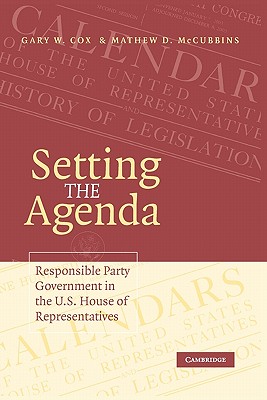
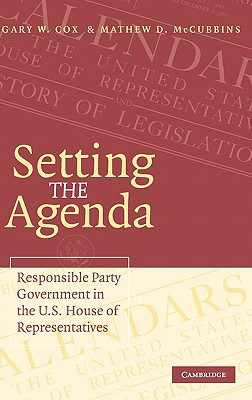
Setting the Agenda : Responsible Party Government in the U.S. House of Representatives
Book Details
Format
Paperback / softback
ISBN-10
0521619963
ISBN-13
9780521619967
Publisher
Cambridge University Press
Imprint
Cambridge University Press
Country of Manufacture
GB
Country of Publication
GB
Publication Date
Sep 12th, 2005
Print length
352 Pages
Weight
566 grams
Dimensions
15.70 x 23.30 x 2.40 cms
KSh 6,300.00
Currently unavailable
0 in stock
Delivery Location
Delivery fee: Select location
Secure
Quality
Fast
It advances our partisan theory and presents a series of empirical tests of that theory's predictions. The evidence in this book demonstrates that the majority party seizes agenda control at nearly every stage of the legislative process in order to prevent bills that the party dislikes from reaching the floor.
Scholars of the U.S. House disagree over the importance of political parties in organizing the legislative process. On the one hand, non-partisan theories stress how congressional organization serves members' non-partisan goals. On the other hand, partisan theories argue that the House is organized to serve the collective interests of the majority party. This book advances our partisan theory and presents a series of empirical tests of that theory's predictions (pitted against others). It considers why procedural cartels form, arguing that agenda power is naturally subject to cartelization in busy legislatures. It argues that the majority party has cartelized agenda power in the U.S. House since the adoption of Reed's rules in 1890. The evidence demonstrates that the majority party seizes agenda control at nearly every stage of the legislative process in order to prevent bills that the party dislikes from reaching the floor.
Get Setting the Agenda by Gary W. Cox, Mathew D. McCubbins at the best price and quality guaranteed only at Werezi Africa's largest book ecommerce store. The book was published by Cambridge University Press and it has 352 pages.
Customers Who Bought This Also Bought

Anti-Politics Machine
KSh 3,750.00

Covering Islam
KSh 2,350.00

Reinventing the Sheikhdom
KSh 4,500.00

Vulture Capitalism
KSh 2,000.00

Kissinger
KSh 4,600.00

Egypt on the Brink – From Nasser to the Muslim Brotherhood – Revised and Updated
KSh 2,700.00
Capitalism
KSh 1,900.00

The Impossible State – Islam, Politics, and Modernity`s Moral Predicament
KSh 5,050.00

Beyond Westminster in the Caribbean
KSh 4,150.00

The Other Saudis
KSh 5,150.00

Kenya
KSh 16,200.00

The Confederate Congress
KSh 6,450.00
More by Gary W. Cox, Mathew D. McCubbins
Elbridge Gerry''s Salamander
KSh 14,750.00
The Democratic Dilemma
KSh 17,800.00
Setting the Agenda
KSh 9,850.00
Legislative Leviathan
KSh 6,400.00

Marketing Sovereign Promises
KSh 18,700.00
Elbridge Gerry''s Salamander
KSh 5,000.00
Legislative Leviathan
KSh 14,750.00
The Logic of Delegation
KSh 5,350.00

Making Votes Count
KSh 6,950.00

The Efficient Secret
KSh 6,100.00
The Logic of Delegation
KSh 14,400.00

Making Votes Count
KSh 19,600.00
