
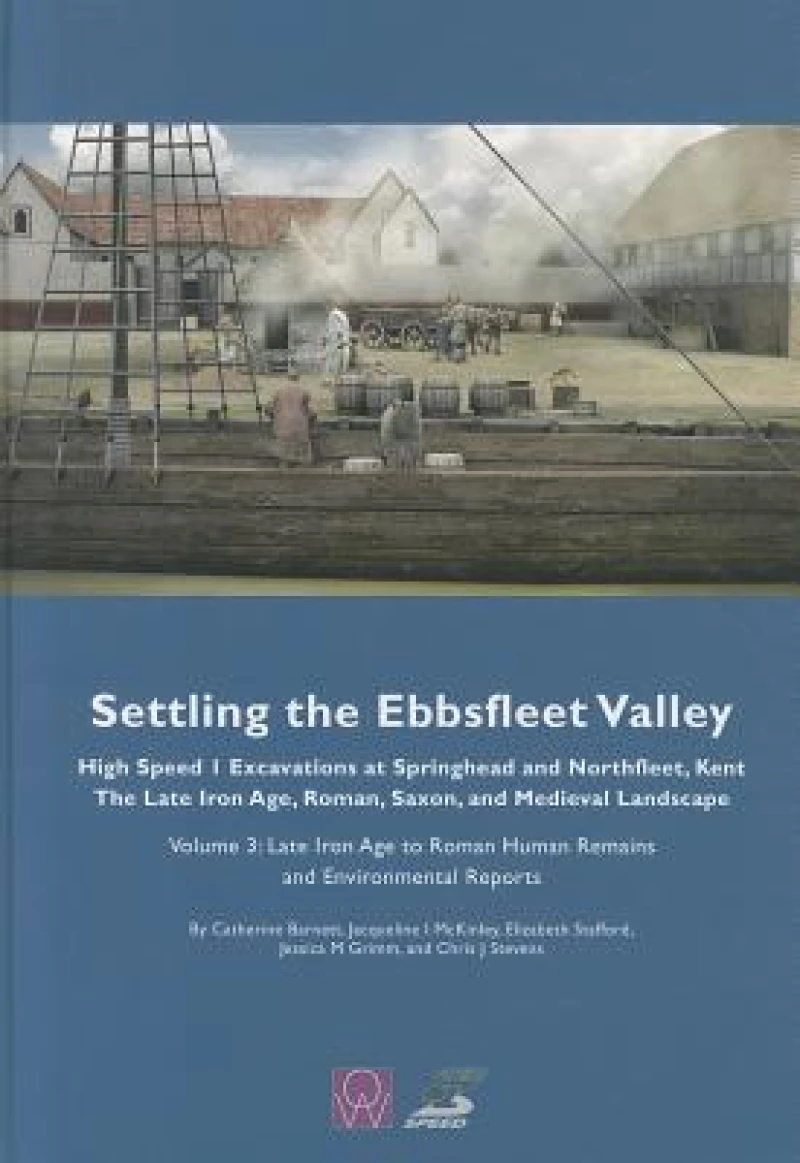
Settling the Ebbsfleet Valley: High Speed 1 Excavations at Springhead and Northfleet, Kent, the Late Iron Age, Roman, Saxon and Medieval Landscape, Volume 3 : Late Iron Age to Roman Human Remains and Environmental Reports
Book Details
Format
Hardback or Cased Book
Book Series
Oxford Wessex Archaeology Monograph
ISBN-10
0954597052
ISBN-13
9780954597054
Publisher
Oxford Archaeology
Imprint
Oxford Archaeology
Country of Manufacture
GB
Country of Publication
GB
Publication Date
Jul 1st, 2011
Print length
152 Pages
Weight
802 grams
Dimensions
20.00 x 14.00 x 2.00 cms
Ksh 7,000.00
Werezi Extended Catalogue
Delivery in 14 days
1 copies in stock
Delivery Location
Delivery fee: Select location
Delivery in 14 days
Secure
Quality
Fast
This volume presents specialist reports, and illustrations and tables, on the late Iron Age and Roman human bone, and faunal and environmental remains recovered during archaeological investigations in the Ebbsfleet valley, near Gravesend, Kent. It is the third part of a four volume publication on investigations at Springhead and Northfleet, undertaken in connection with engineering works for Section 2 of the Channel Tunnel Rail Link (CTRL), now High Speed 1 (HS1). The archaeological discoveries made during HS1 Section 2, which range in date from the late Iron Age to the medieval period, are reported in Volume 1. Specialist reports on the Iron Age and Roman artefacts are reported in Volume 2, while those on the Saxon and medieval artefacts, human bone, and faunal and environmental remains are reported in Volume 4; additional data is available via the website (http://owarch.co.uk/hs1/springhead-northfleet/). These reports have been prepared by the Oxford Wessex Archaeology Joint Venture in conjunction with Rail Link Engineering for Union Railways (North) Limited (URN). High Speed 1 is the new high-speed railway linking London mainline stations to the Channel Tunnel. Section 1 of HS1, running from the tunnel portal at Folkestone, passes through Kent to Pepper Hill near Gravesend, whilst Section 2 continues the line under the Thames at Swanscombe, and then runs through Essex and East London to London St Pancras. The massive engineering and construction project necessitated one of the largest programmes of archaeological works ever undertaken in Britain. Desk-based assessment was followed by extensive evaluation, comprising field walking, trial trenching, test pitting and borehole investigation. This allowed HS1’s impact on the finite archaeological resources along the route to be assessed and mitigated. Where archaeological sites could not be bypassed, or preserved in situ, excavations were undertaken in advance of construction. The principal archaeological work for Section 1 took place in 1998–2001, while that for Section 2, commissioned by URN, took place between September 2000 and March 2003. Construction work relating to Section 2 in the Ebbsfleet valley included HS1 itself, Ebbsfleet International Station and associated access roads, and a connecting line to the existing North Kent Line. Oxford Archaeology undertook detailed excavation and a watching brief on land south of Northfleet, centred on NGR 516413 174196, towards the north end of the valley, while Wessex Archaeology undertook detailed excavation, strip, map and sample excavation, evaluation and a watching brief on various sites around the south end of the valley, at Springhead, centred on NGR 618000 727500. Following completion of the HS1 programme of work in 2003, there have been further, sometimes extensive investigations within and adjacent to the Ebbsfleet valley, in advance of infrastructure works and housing and commercial developments. Although these have revealed Palaeolithic and other early prehistoric remains, as well as further discoveries of late Iron Age, Roman, and Saxon date, it is not anticipated that any major revisions will be required to what is presented in this publication. The four volumes of this publication comprise one of two separate archaeological studies reporting on the HS1 Section 2 excavations in the Ebbsfleet valley. The other publication, on ‘Prehistoric Ebbsfleet’, focuses on Palaeolithic, Mesolithic, Neolithic, Bronze Age and earlier Iron Age activity. The present publication, ‘Springhead and Northfleet’, concentrates on Roman and later activity, but also takes into account the late prehistoric origins of the Roman occupation of the area. The overlap with Prehistoric Ebbsfleet study, however, is slight as the most important later prehistoric remains – the late Iron Age ritual or ceremonial activity near the Ebbsfleet spring at Springhead – are outside the period covered by the Prehistoric Ebbsfleet study. The Springhead and Northfleet publication reports on three major excavations, as well as on minor excavations, evaluations and other investigations, both HS1 and non-HS1. The principal discoveries comprise late prehistoric, Roman, and Saxon features at Springhead, including a sanctuary complex within the Roman town of Vagniacis, and two mid-Saxon cemeteries to its east (site code: ARC SPH00); the Roman roadside settlement at Springhead Nursery (site codes: ARC SHN02 and WA 51724); and late prehistoric, Roman, and Saxon features at Northfleet, where a middle Saxon watermill was discovered immediately adjacent to the Northfleet Roman villa (site code: ARC EBB01). Investigations were also undertaken on the site of a Roman high status walled cemetery south-east of Springhead, first investigated between 1799 and 1802 (site codes ARC WCY02 and WA 52379). This publication also consider the results of excavations at two HS1 Section 1 sites, the Pepper Hill Roman cemetery which is associated with Vagniacis, and the rural settlement at West of Northumberland Bottom, to the east of Springhead. Finally, the results of earlier (as well as on-going) non-HS1 investigations and excavations undertaken by a variety of groups at both Springhead and Northfleet Roman villa, including work on the South Thameside Development Route 4, are considered. The detailed specialist reports in this volume of the Springhead and Northfleet publication cover the late Iron Age and Roman human bone and animal bone assemblages recovered during the reported excavations, as well as environmental remains and dating evidence relating to contemporary landscape, and subsistence and economy. The report on the human remains analyses the assemblage from Springhead, which comprises a single cremation burial and a minimum of 48 inhumation burials, and a single inhumation burial of a neonate from within the Northfleet villa complex. At Springhead, four of the inhumations were in a small cemetery on the south-western margin of the roadside settlement, the rest comprising small groups and singletons scattered across both the roadside and the settlement sanctuary site; in two cases dual burials were made within one grave. In addition, two contexts contained whole or partial skulls which appear to have been deliberately placed, while other bones had been redeposited in a variety of features, including a ‘ritual shaft’, or within spreads and layers across the areas of occupation. Over 68,000 fragments of animal bone were recovered, from Springhead (c 82%) and Northfleet (c 18%), including many complete animal skeletons. At Springhead, from the late Iron Age at the sanctuary site, and in the Roman roadside settlement, the assemblages are dominated by sheep/goat, followed by pig and cattle, while that assemblage from the Northfleet Roman villa at is dominated by cattle, followed by sheep/goat and pig. In addition, 286 fish bones were recovered, from both marine and freshwater species. The environmental evidence for Roman subsistence and economy is presented in reports on charred plant remains, wood charcoal and marine shell. Environmental sequences and remains relating the development of the Roman landscape were recovered, from both the upper Ebbsfleet valley at Springhead and the lower valley at Northfleet, from a range of locations, including waterlogged alluvial and peat sequences associated with the river edge, as well as calcareous colluvial deposits and soils upslope. This range of evidence is presented in reports on sediments and soils, pollen, diatoms, molluscs, waterlogged plant remains and insects, with dating evidence presented in reports on radiocarbon dating and dendrochronology. Radiocarbon determinations were calibrated using OxCal ver 3.10 (Bronk Ramsey 1995; 2001) utilising the atmospheric data presented by Stuiver et al (1998) and expressed at the 94.5% confidence level (2 sigma level with the end points rounded outwards to 10 years) following the form recommended by Mook (1986).
Get Settling the Ebbsfleet Valley: High Speed 1 Excavations at Springhead and Northfleet, Kent, the Late Iron Age, Roman, Saxon and Medieval Landscape, Volume 3 by at the best price and quality guaranteed only at Werezi Africa's largest book ecommerce store. The book was published by Oxford Archaeology and it has pages.

