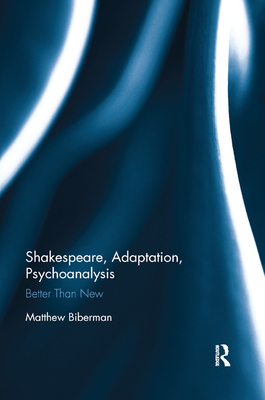
Shakespeare, Adaptation, Psychoanalysis : Better than New
Book Details
Format
Hardback
ISBN-10
1472481534
ISBN-13
9781472481535
Publisher
Taylor & Francis Ltd
Imprint
Routledge
Country of Manufacture
GB
Country of Publication
GB
Publication Date
Jan 16th, 2017
Print length
160 Pages
Weight
360 grams
Dimensions
15.90 x 26.00 x 1.30 cms
KSh 30,950.00
Currently unavailable
0 in stock
Delivery Location
Delivery fee: Select location
Secure
Quality
Fast
In Shakespeare, Adaptation, Psychoanalysis, Matthew Biberman analyzes early adaptations of Shakespeare’s plays in order to identify and illustrate how both social mores and basic human psychology have changed in Anglo-American culture. Biberman contests the received wisdom that Shakespeare’s characters reflect essentially timeless truths about human nature. To the contrary, he points out that Shakespeare’s characters sometimes act and think in ways that have become either stigmatized or simply outmoded. Through his study of the adaptations, Biberman pinpoints aspects of Shakespeare’s thinking about behavior and psychology that no longer ring true because circumstances have changed so dramatically between his time and the time of the adaptation. He shows how the adaptors’ changes reveal key differences between Shakespeare’s culture and the culture that then supplanted it. These changes, once grasped, reveal retroactively some of the ways in which Shakespeare’s characters do not act and think as we might expect them to act and think. Thus Biberman counters Harold Bloom’s claim that Shakespeare fundamentally invents our sense of the human; rather, he argues, our sense of the human is equally bound up in the many ways that modern culture has come to resist or outright reject the behavior we see in Shakespeare’s plays. Ultimately, our current sense of ''the human'' is bound up not with the adoption of Shakespeare’s psychology, perhaps, but its adaption-or, in psychoanalytic terms, its repression and replacement.
Get Shakespeare, Adaptation, Psychoanalysis by Matthew Biberman at the best price and quality guaranteed only at Werezi Africa's largest book ecommerce store. The book was published by Taylor & Francis Ltd and it has 160 pages.
Customers Who Bought This Also Bought
How to Read a Book
KSh 2,000.00
Decolonising the Mind
KSh 4,700.00

How to Read & Why
KSh 2,350.00

Arabian Nights'' Entertainments
KSh 2,950.00
In the Wake
KSh 3,600.00
The Birth of Tragedy
KSh 1,800.00

Against Nature
KSh 1,800.00
The White Album
KSh 3,250.00
Robinson Crusoe
KSh 1,450.00
Metaphysical Poetry
KSh 2,350.00
Reading Lessons
KSh 2,350.00

Literature Book
KSh 4,250.00