
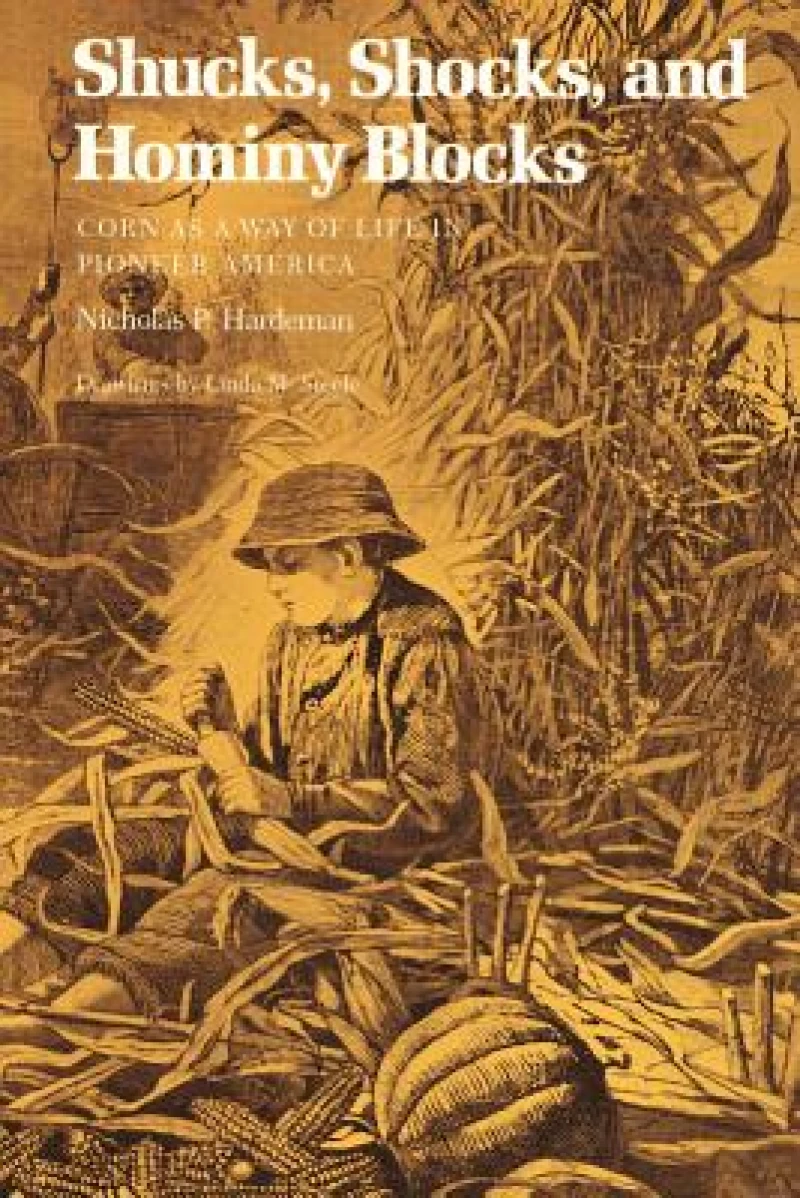
Shucks, Shocks, and Hominy Blocks : Corn As a Way of Life in Pioneer America
Book Details
Format
Paperback / Softback
ISBN-10
0807124249
ISBN-13
9780807124246
Publisher
Louisiana State University Press
Imprint
Louisiana State University Press
Country of Manufacture
US
Country of Publication
GB
Publication Date
Mar 1st, 1999
Print length
277 Pages
Weight
435 grams
Dimensions
23.50 x 15.00 x 1.70 cms
Product Classification:
History of the AmericasHistory of the Americas
Ksh 4,800.00
Werezi Extended Catalogue
0 in stock
Delivery Location
Delivery fee: Select location
Secure
Quality
Fast
History is often measured by records of great leaders and events. Nicholas Hardeman convinces us that American history can be measured but the shaping force of a quiet monarch - corn. Hardeman enthusiastically demonstrates that in order to understand the settling and development of America we must know about corn and its influence.
History is often measured by records of great leaders and events. Nicholas P. Hardeman convinces us that American history can be measured but the shaping force of a quiet monarch- corn. In fact, corn was more than king, it was a way of life, and Hardeman enthusiastically demonstrates that in order to understand the settling and development of America we must know about corn and its influence. Perhaps no volume has come closer to the grass roots of pre-twentieth century America.
The history of American worship of property, love of the land, and the work ethic has its source in this country's discovery of the values of corn. When Hardeman speaks of values, he emphasizes the human as equal to the economic values. He describes corn growing in early America from clearing the land through planting, cultivating, and harvesting, as it was done on the single-family farm, once the mainstay of American agriculture. He talks about the problems and the hard work of corn growing that led to an explosion of agricultural innovation, mostly American in origin, in the nineteenth century. The author gives his attention as well to corn's ancestry and the role of the Indians in developing all six major varieties of corn. He discusses in detail the many uses of corn as food and drink and its scores of nonfood applications.
Overall, Hardeman casts a glow on the ""picturesque, symmetrical, checkered cornfields"" of a time past. Corn was more than a commodity to the pioneer. It was a social phenomenon during every phase of its culture and especially in the husking bee, the most popular event of the entire pioneer era. Corn was integral to nearly all American culture- our language, literature, art, and mythology. ""Frontiers have been erased . . . but in the subconscious of our cultural undergirding, they are with us yet- those phantom shocks in measured rows, the clamorous birds spiraling on set wings to waiting grain fields below, the rhythmic thudding of hominy blocks, the creaking of wheels and crackling of corncob fires.
The history of American worship of property, love of the land, and the work ethic has its source in this country's discovery of the values of corn. When Hardeman speaks of values, he emphasizes the human as equal to the economic values. He describes corn growing in early America from clearing the land through planting, cultivating, and harvesting, as it was done on the single-family farm, once the mainstay of American agriculture. He talks about the problems and the hard work of corn growing that led to an explosion of agricultural innovation, mostly American in origin, in the nineteenth century. The author gives his attention as well to corn's ancestry and the role of the Indians in developing all six major varieties of corn. He discusses in detail the many uses of corn as food and drink and its scores of nonfood applications.
Overall, Hardeman casts a glow on the ""picturesque, symmetrical, checkered cornfields"" of a time past. Corn was more than a commodity to the pioneer. It was a social phenomenon during every phase of its culture and especially in the husking bee, the most popular event of the entire pioneer era. Corn was integral to nearly all American culture- our language, literature, art, and mythology. ""Frontiers have been erased . . . but in the subconscious of our cultural undergirding, they are with us yet- those phantom shocks in measured rows, the clamorous birds spiraling on set wings to waiting grain fields below, the rhythmic thudding of hominy blocks, the creaking of wheels and crackling of corncob fires.
Get Shucks, Shocks, and Hominy Blocks by at the best price and quality guaranteed only at Werezi Africa's largest book ecommerce store. The book was published by Louisiana State University Press and it has pages.

