
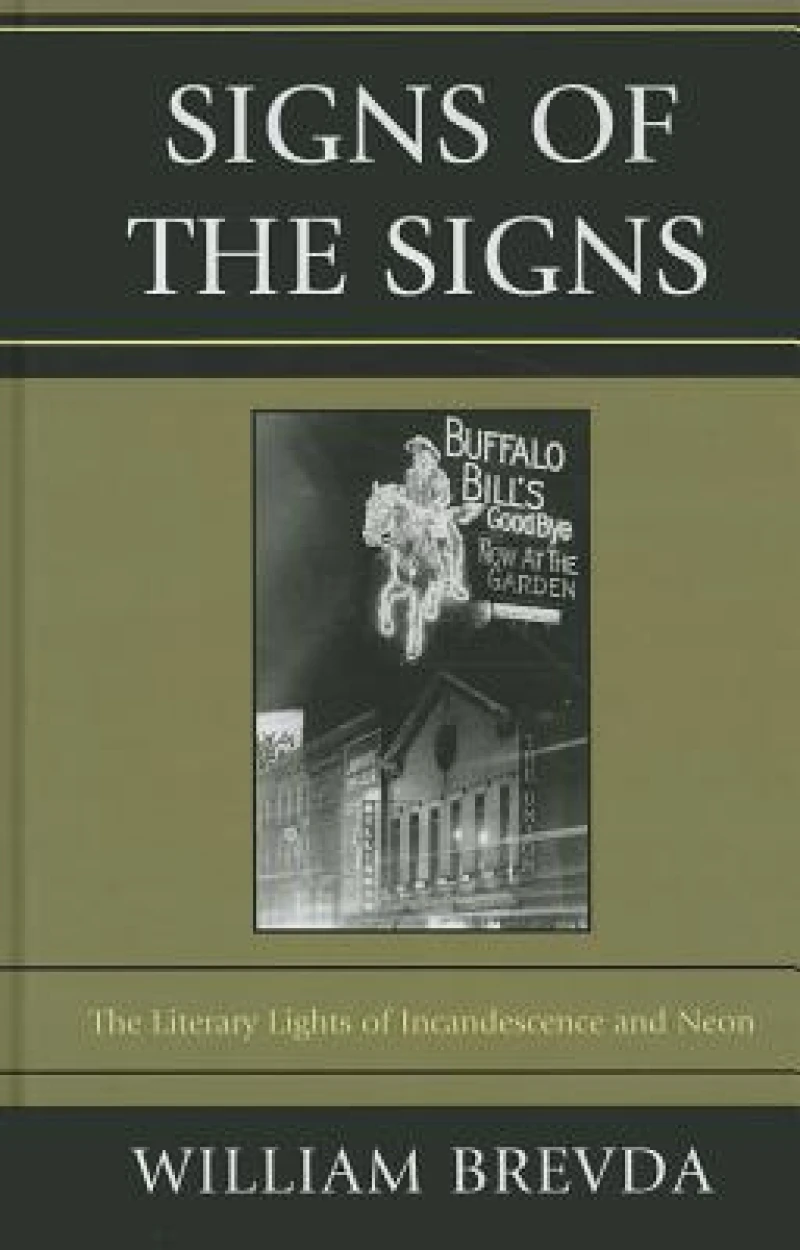
Signs of the Signs : The Literary Lights of Incandescence and Neon
Book Details
Format
Hardback or Cased Book
ISBN-10
1611480426
ISBN-13
9781611480429
Publisher
Bucknell University Press
Imprint
Bucknell University Press
Country of Manufacture
GB
Country of Publication
GB
Publication Date
Jun 24th, 2011
Print length
405 Pages
Weight
794 grams
Dimensions
23.90 x 16.50 x 3.60 cms
Product Classification:
Literary theory
Ksh 21,650.00
Manufactured on Demand
0 in stock
Delivery Location
Delivery fee: Select location
Secure
Quality
Fast
This book is a study of signs in American literature and culture. It is mainly about electric signs, but also deals with non-electric signs and related phenomena, such as movie sets. The "sign" is considered in both the architectural and semiotic senses of the word. It is argued that the drama and spectacle of the electric sign called attention to the semiotic implications of the "sign." In fiction, poetry, and commentary, the electric sign became a "sign" of manifold meanings that this book explores: a sign of the city, a sign of America, a sign of the twentieth century, a sign of modernism, a sign of postmodernism, a sign of noir, a sign of naturalism, a sign of the beats, a sign of signs systems (the Bible to Broadway), a sign of tropes (the Great White way to the neon jungle), a sign of the writers themselves, a sign of the sign itself. If Moby Dick is the great American novel, then it is also the great American novel about signs, as the prologue maintains. The chapters that follow demonstrate that the sign is indeed a "sign" of American literature. After the electric sign was invented, it influenced Stephen Crane to become a nightlight impressionist and Theodore Dreiser to make the "fire sign" his metaphor for the city. An actual Broadway sign might have inspired F. Scott Fitzgerald's The Great Gatsby. In Manhattan Transfer and U.S.A., John Dos Passos portrayed America as just a spectacular sign. William Faulkner's electric signs are full of sound and fury signifying modernity. The Last Tycoon was a sign of Fitzgerald's decline. The signs of noir can be traced to Poe's "The Man of the Crowd." Absence flickers in the neons of Raymond Chandler's Los Angeles. The death of God haunts the neon wilderness of Nelson Algren. Hitler's "empire" was an non-intentional parody of Nathanael West's California. The beats reinvented Times Square in their own image. Jack Kerouac's search for the center of Saturday night was a quest for transcendence.
This book is a study of signs in American literature and culture. It is mainly about electric signs, but also deals with non-electric signs and related phenomena, such as movie sets. The "sign" is considered in both the architectural and semiotic senses of the word. It is argued that the drama and spectacle of the electric sign called attention to the semiotic implications of the "sign." In fiction, poetry, and commentary, the electric sign became a "sign" of manifold meanings that this book explores: a sign of the city, a sign of America, a sign of the twentieth century, a sign of modernism, a sign of postmodernism, a sign of noir, a sign of naturalism, a sign of the beats, a sign of signs systems (the Bible to Broadway), a sign of tropes (the Great White way to the neon jungle), a sign of the writers themselves, a sign of the sign itself.If Moby Dick is the great American novel, then it is also the great American novel about signs, as the prologue maintains. The chapters that follow demonstrate that the sign is indeed a "sign" of American literature. After the electric sign was invented, it influenced Stephen Crane to become a nightlight impressionist and Theodore Dreiser to make the "fire sign" his metaphor for the city. An actual Broadway sign might have inspired F. Scott Fitzgerald''s The Great Gatsby. In Manhattan Transfer and U.S.A., John Dos Passos portrayed America as just a spectacular sign. William Faulkner''s electric signs are full of sound and fury signifying modernity. The Last Tycoon was a sign of Fitzgerald''s decline. The signs of noir can be traced to Poe''s "The Man of the Crowd." Absence flickers in the neons of Raymond Chandler''s Los Angeles. The death of God haunts the neon wilderness of Nelson Algren. Hitler''s "empire" was an non-intentional parody of Nathanael West''s California. The beats reinvented Times Square in their own image. Jack Kerouac''s search for the center of Saturday night was a quest for transcendence.
Get Signs of the Signs by at the best price and quality guaranteed only at Werezi Africa's largest book ecommerce store. The book was published by Bucknell University Press and it has pages.

