
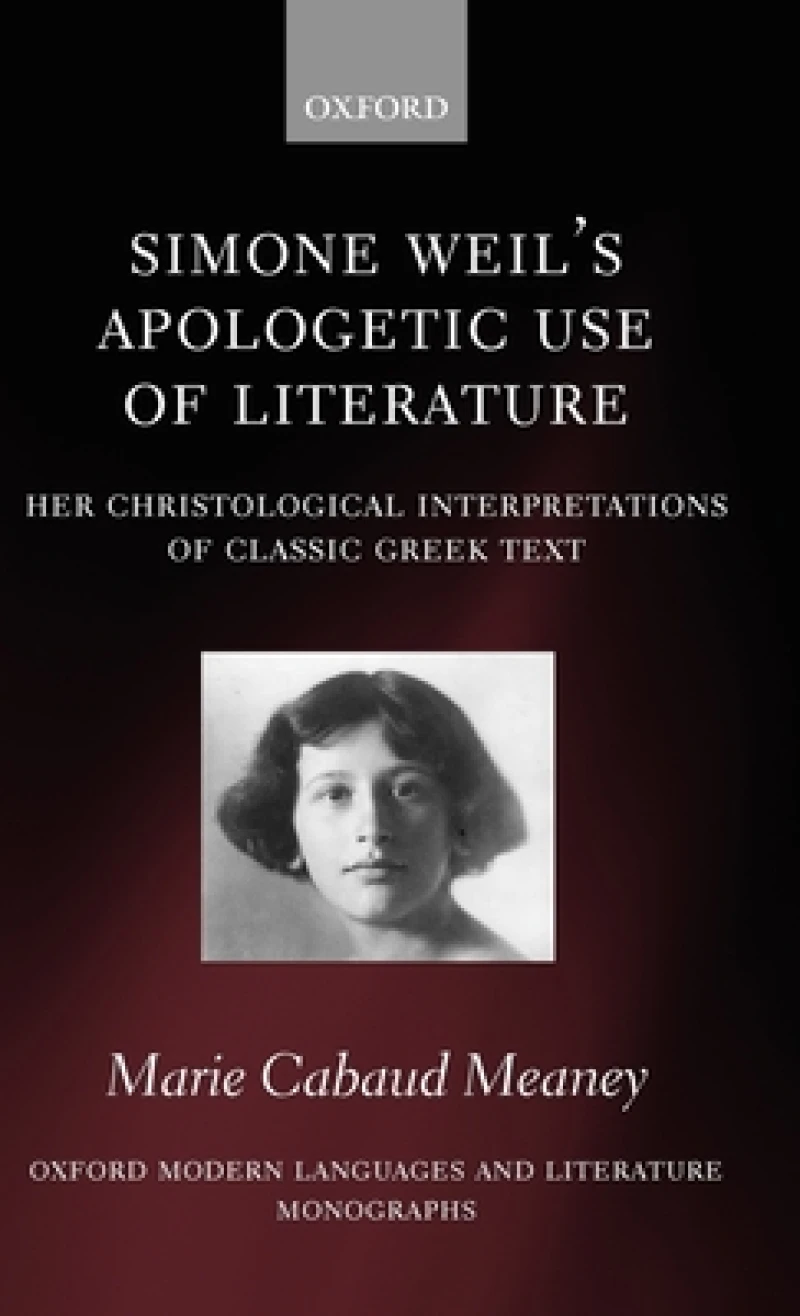
Simone Weil's Apologetic Use of Literature : Her Christological Interpretation of Ancient Greek Texts
Book Details
Format
Hardback or Cased Book
ISBN-10
0199212457
ISBN-13
9780199212453
Publisher
Oxford University Press
Imprint
Oxford University Press
Country of Manufacture
GB
Country of Publication
GB
Publication Date
Dec 6th, 2007
Print length
264 Pages
Weight
461 grams
Dimensions
22.20 x 14.40 x 1.80 cms
Product Classification:
Literary essaysLiterary studies: generalEuropean history20th century history: c 1900 to c 2000
Ksh 25,550.00
Manufactured on Demand
0 in stock
Delivery Location
Delivery fee: Select location
Secure
Quality
Fast
Looks at Simone Weil's Christological interpretations of the Sophoclean "Antigone" and "Electra", the "Iliad" and Aeschylus' "Prometheus Bound". This book traces her apologetic intentions and explains the manner in which she recasts familiar Christian concepts (thereby letting them come alive - something every good apologist should be able to do).
Marie Cabaud Meaney looks at Simone Weil''s Christological interpretations of the Sophoclean Antigone and Electra, the Iliad and Aeschylus'' Prometheus Bound. Apart from her article on the Iliad, Weil''s interpretations are not widely known, probably because they are fragmentary and boldly twist the classics, sometimes even contradicting their literal meaning. Meaney argues that Weil had an apologetic purpose in mind: to the spiritual ills of ideology and fanaticism in World War II she wanted to give a spiritual answer, namely the re-Christianization of Europe to which she (though not baptized herself) wished to contribute in some way. To the intellectual agnostics of her day she intended to show through her interpretations that the texts they cherished so much could only be fully understood in light of Christ; to the Catholics she sought to reveal that Catholicism was much more universal than generally believed, since Greek culture already embodied the Christian spirit - perhaps to a greater extent than the Catholic Church ever had. Despite or perhaps because of this apologetic slant, Weil''s readings uncover new layers of these familiar texts: Antigone is a Christological figure, combating Creon''s ideology of the State by a folly of love that leads her to a Passion in which she experiences an abandonment similar to that of Christ on the Cross. The Iliad depicts a world as yet unredeemed, but which traces objectively the reign of force to which both oppressors and oppressed are subject. Prometheus Bound becomes the vehicle of her theodicy, in which she shows that suffering only makes sense in light of the Cross. But the pinnacle of the spiritual life is described in Electra which, she believes, reflects a mystical experience - something Weil herself had experienced unexpectedly when ''Christ himself came down and took her'' in November 1938. In order to do justice to Weil''s readings, Meaney not only traces her apologetic intentions and explains the manner in which she recasts familiar Christian concepts (thereby letting them come alive - something every good apologist should be able to do), but also situates them among standard approaches used by classicists today, thereby showing that her interpretations truly contribute something new.
Get Simone Weil's Apologetic Use of Literature by at the best price and quality guaranteed only at Werezi Africa's largest book ecommerce store. The book was published by Oxford University Press and it has pages.

