
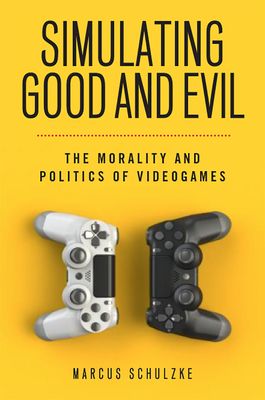
Simulating Good and Evil : The Morality and Politics of Videogames
Book Details
Format
Paperback / softback
ISBN-10
1978818564
ISBN-13
9781978818569
Publisher
Rutgers University Press
Imprint
Rutgers University Press
Country of Manufacture
US
Country of Publication
GB
Publication Date
Sep 17th, 2020
Print length
222 Pages
Weight
338 grams
Dimensions
15.60 x 23.50 x 1.60 cms
KSh 5,050.00
Temporarily out of stock, due soon
0 in stock
Delivery Location
Delivery fee: Select location
Secure
Quality
Fast
Shows that the moral panic surrounding violent videogames is deeply misguided, and often politically motivated, but that games are nevertheless morally important. Simulated actions are morally defensible because they take place outside the real world and do not inflict real harms.
Simulating Good and Evil shows that the moral panic surrounding violent videogames is deeply misguided, and often politically motivated, but that games are nevertheless morally important. Simulated actions are morally defensible because they take place outside the real world and do not inflict real harms. Decades of research purporting to show that videogames are immoral has failed to produce convincing evidence of this. However, games are morally important because they simulate decisions that would have moral weight if they were set in the real world. Videogames should be seen as spaces in which players may experiment with moral reasoning strategies without taking any actions that would themselves be subject to moral evaluation. Some videogame content may be upsetting or offensive, but mere offense does not necessarily indicate a moral problem. Upsetting content is best understood by applying existing theories for evaluating political ideologies and offensive speech.
Get Simulating Good and Evil by Marcus Schulzke at the best price and quality guaranteed only at Werezi Africa's largest book ecommerce store. The book was published by Rutgers University Press and it has 222 pages.
Customers Who Bought This Also Bought

Xmeditations
KSh 700.00

Groundwork for the Metaphysics of Morals
KSh 2,000.00

On the Genealogy of Morals
KSh 2,000.00

Beyond Good and Evil
KSh 2,000.00

The Nicomachean Ethics
KSh 1,600.00

The Sovereignty of Good
KSh 5,400.00

Justice
KSh 2,000.00

Meditations
KSh 1,600.00
What We Owe The Future
KSh 2,000.00

The Analects
KSh 2,350.00

How to Be a Leader – An Ancient Guide to Wise Leadership
KSh 2,800.00

There Are Places in the World Where Rules Are Less Important Than Kindness
KSh 3,600.00
More by Marcus Schulzke

Pursuing Moral Warfare
KSh 25,900.00

The Morality of Drone Warfare and the Politics of Regulation
KSh 21,600.00

The Politics of New Atheism
KSh 30,950.00

Just War Theory and Civilian Casualties
KSh 17,650.00

Pursuing Moral Warfare
KSh 8,650.00

Just War Theory and Civilian Casualties
KSh 6,100.00
The Politics of New Atheism
KSh 8,450.00

Drones and Support for the Use of Force
KSh 10,400.00

Twenty-First Century Military Innovation
KSh 12,050.00
