
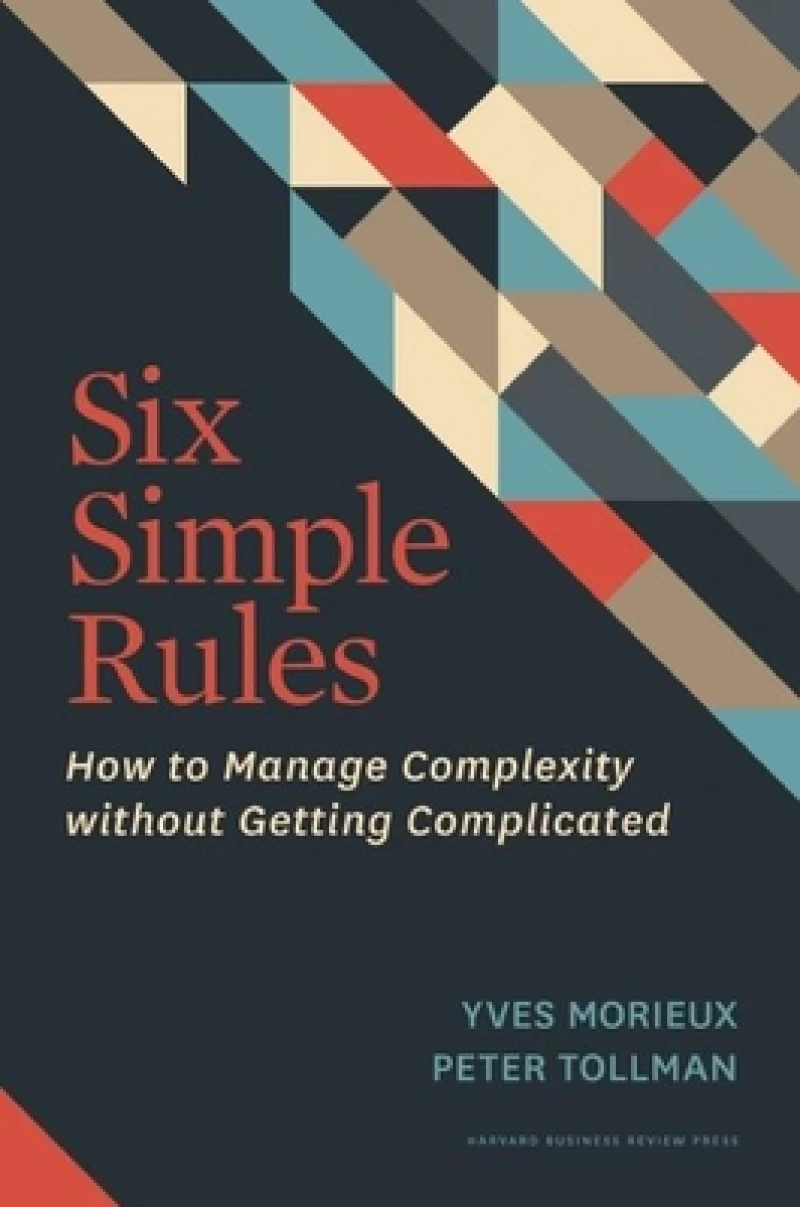
Six Simple Rules : How to Manage Complexity without Getting Complicated
Book Details
Format
Hardback or Cased Book
ISBN-10
1422190552
ISBN-13
9781422190555
Publisher
Harvard Business Press
Imprint
Harvard Business Press
Country of Manufacture
US
Country of Publication
GB
Publication Date
Apr 1st, 2014
Print length
240 Pages
Weight
488 grams
Dimensions
24.20 x 16.20 x 2.20 cms
Ksh 4,500.00
Werezi Extended Catalogue
Delivery in 14 days
2 copies in stock
Delivery Location
Delivery fee: Select location
Delivery in 14 days
Secure
Quality
Fast
New tools for managing complexity
Does your organization manage complexity by making things more complicated? If so, you are not alone.
According to The Boston Consulting Group''s fascinating Complexity Index, business complexity has increased sixfold during the past sixty years. And, all the while, organizational complicatedness—that is, the number of structures, processes, committees, decision-making forums, and systems—has increased by a whopping factor of thirty-five. In their attempt to respond to the increasingly complex performance requirements they face, company leaders have created an organizational labyrinth that makes it more and more difficult to improve productivity and to pursue innovation. It also disengages and demotivates the workforce.
Clearly it’s time for leaders to stop trying to manage complexity with their traditional tools and instead better leverage employees'' intelligence. This book shows you how and explains the implications for designing and leading organizations.
The way to manage complexity, the authors argue, is neither with the hard solutions of another era nor with the soft solutions—such as team building and feel-good “people initiatives"—that often follow in their wake. Based on social sciences (notably economics, game theory, and organizational sociology) and The Boston Consulting Group’s work with more than five hundred companies in more than forty countries and in various industries, authors Yves Morieux and Peter Tollman recommend six simple rules to manage complexity without getting complicated.
Showing why the rules work and how to put them into practice, Morieux and Tollman give managers a much-needed tool to reinvigorate people in the face of seemingly endless complexity. Included are detailed examples from companies that have achieved a multiplicative effect on performance by using them.
It’s time to manage complexity better. Employ these six simple rules to foster autonomy and cooperation and to effectively handle business complexity. As a result, you will improve productivity, innovate more, reengage your workforce, and seize opportunities to create competitive advantage.
Does your organization manage complexity by making things more complicated? If so, you are not alone.
According to The Boston Consulting Group''s fascinating Complexity Index, business complexity has increased sixfold during the past sixty years. And, all the while, organizational complicatedness—that is, the number of structures, processes, committees, decision-making forums, and systems—has increased by a whopping factor of thirty-five. In their attempt to respond to the increasingly complex performance requirements they face, company leaders have created an organizational labyrinth that makes it more and more difficult to improve productivity and to pursue innovation. It also disengages and demotivates the workforce.
Clearly it’s time for leaders to stop trying to manage complexity with their traditional tools and instead better leverage employees'' intelligence. This book shows you how and explains the implications for designing and leading organizations.
The way to manage complexity, the authors argue, is neither with the hard solutions of another era nor with the soft solutions—such as team building and feel-good “people initiatives"—that often follow in their wake. Based on social sciences (notably economics, game theory, and organizational sociology) and The Boston Consulting Group’s work with more than five hundred companies in more than forty countries and in various industries, authors Yves Morieux and Peter Tollman recommend six simple rules to manage complexity without getting complicated.
Showing why the rules work and how to put them into practice, Morieux and Tollman give managers a much-needed tool to reinvigorate people in the face of seemingly endless complexity. Included are detailed examples from companies that have achieved a multiplicative effect on performance by using them.
It’s time to manage complexity better. Employ these six simple rules to foster autonomy and cooperation and to effectively handle business complexity. As a result, you will improve productivity, innovate more, reengage your workforce, and seize opportunities to create competitive advantage.
Get Six Simple Rules by at the best price and quality guaranteed only at Werezi Africa's largest book ecommerce store. The book was published by Harvard Business Press and it has pages.

