
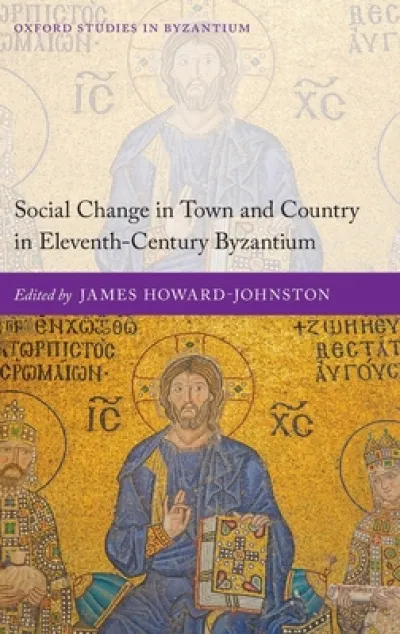
Social Change in Town and Country in Eleventh-Century Byzantium
Book Details
Format
Hardback or Cased Book
Book Series
Oxford Studies in Byzantium
ISBN-10
0198841612
ISBN-13
9780198841616
Publisher
Oxford University Press
Imprint
Oxford University Press
Country of Manufacture
GB
Country of Publication
GB
Publication Date
Sep 10th, 2020
Print length
314 Pages
Weight
686 grams
Dimensions
16.40 x 24.10 x 2.50 cms
Product Classification:
Medieval history
Ksh 18,800.00
Manufactured on Demand
0 in stock
Delivery Location
Delivery fee: Select location
Secure
Quality
Fast
The eleventh century saw both the heyday of Byzantium and its almost immediate subsequent decline following serious military defeats and heavy territorial losses. The papers in this volume view the social order as a prime determinant of change, tracking it through archaeological and documentary evidence to deepen our understanding of the period.
The history of Byzantium pivots around the eleventh century, during which it reached its apogee in terms of power, prestige, and territorial extension, only then to plunge into steep political decline following serious military defeats and extensive territorial losses. The political, economic, and intellectual history of the period is reasonably well understood, but not so what was happening in that crucial intermediary sphere, the social order, which both shaped and was shaped by contemporary ideas and brute economic developments. This volume aims to deepen understanding of Byzantine society by examining material evidence for settlements and production in different regions and by sifting through the far from plentiful literary and documentary sources in order to track what was happening in town and country. There is evidence of significant change: the pattern of landownership continued to shift in favour of those with power and wealth, but there was sustained and effective resistance from peasant villages. Provincial towns prospered in what was an era of sustained economic growth, and, through newly emboldened local elites, took a more active part in public affairs. In the capital the middling classes, comprising much of officialdom and leading traders, gained in importance, while the twin military and civilian elites were merging to form a single governing class. However, despite this social upheaval, careful analysis of these various factors by a range of leading Byzantine historians and archaeologists leads to the overarching conclusion that it was not so much internal structural changes which contributed to the vertiginous decline suffered by Byzantium in the late eleventh century, as the unprecedented combination of dangerous adversaries on different fronts, in the east, north, and west.
Get Social Change in Town and Country in Eleventh-Century Byzantium by at the best price and quality guaranteed only at Werezi Africa's largest book ecommerce store. The book was published by Oxford University Press and it has pages.

