
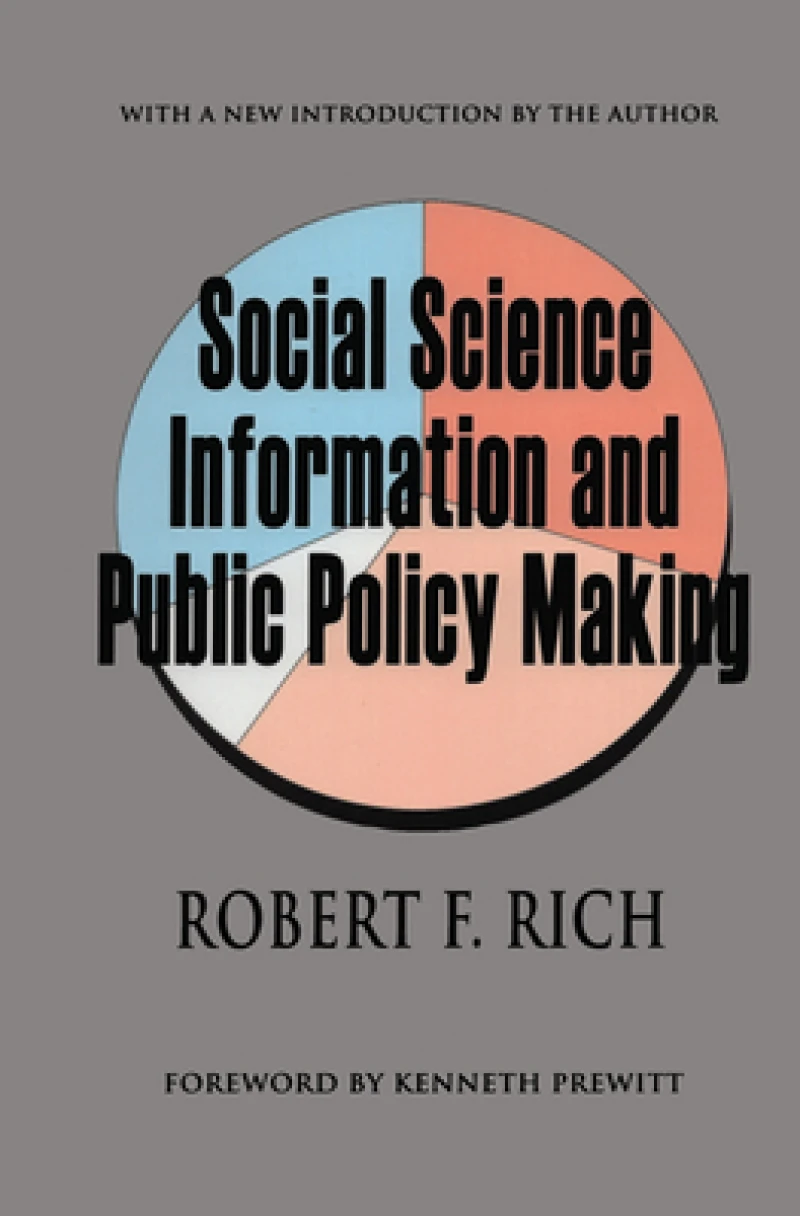
Social Science Information and Public Policy Making
Book Details
Format
Hardback or Cased Book
ISBN-10
1138532967
ISBN-13
9781138532960
Publisher
Taylor & Francis Ltd
Imprint
Routledge
Country of Manufacture
GB
Country of Publication
GB
Publication Date
Mar 15th, 2018
Print length
258 Pages
Weight
453 grams
Product Classification:
Sociology
Ksh 17,450.00
Werezi Extended Catalogue
0 in stock
Delivery Location
Delivery fee: Select location
Secure
Quality
Fast
This volume serves as both an introduction to the field of the sociology of knowledge and an interpretation of the thought of the major figures associated with its development More than a compendium of ideas, Stark seeks here to put order into what he regarded as a diffuse tradition of diverse bodies of thought, in particular the seemingly irreconcilable conflict between the study of the political element in thought identified here with Karl Mannheim and the investigation of the social element in thinking associated with the work of Max Scheler.The sociology of knowledge is primarily directed toward the study of the precise ways that human experience, through the mediation of knowledge, takes on a conscious and communicable shape. While both schools dealt with by Stark assume that the pursuit of truth is not purposeful apart from socially and historically determined structures of meaning, the tradition extending from Marx to Mannheim seeks to expose hidden factors that turn us away from the truth while that of Weber and Scheler attempts to identify social forces that impart a definite direction to our search for itIn order to reconcile opposing theoretical positions, Stark seeks to lay the foundations for a theory of the social determination of thought by directing his inquiry to the philosophical problem of truth in a manner compatible with cultural sociology. Stark''s theoretical legacy to the sociology of knowledge is that social influences operate everywhere through a group''s ethos. From this, many systems of ideas and social categories emanate, revealing partial glimpses of a synthetic whole.The outcome of Stark''s work is a general theory of social determination remarkably consistent with contemporary interests in the broad range of cultural studies, whose focus is best described as the use of philosophical, literary, and historical approaches to study the social construction of meaning. The Sociology of Knowledge will be of grea
A survey of federal officials reveals the belief that government should make the fullest possible use of social science information-and yet most of the information developed by social scientists winds up in specialized libraries or data banks, where it remains unused. Why don''t public officials make greater use of the information social scientists develop? What can social scientists do to ensure that their findings are used? To answer these and related questions, Robert Rich reports the results of a unique experiment designed to facilitate the use of research data by public officials in federal agencies.
Rich interviewed both researchers and users of research data over the two-year life of a Continous National Survey (CNS) experiment to discover the extent to which the CNS mechanism was successful and to record the levels and types of use that officials made of the data provided. Rich reveals that factors such as the timeliness, cost, and relevance of data do not guarantee that information will be used. He examines patterns in the actual use of survey data by agency officials and explores key organizational factors, such as the compatibility of information with various bureaucratic interests. He discusses the preoccupation of public officials with bureaucratic issues regarding the ownership and control of information, identifies the incentives that prompt bureaucrats to pass along new information and the government officials'' difficulties in developing policies and programs for meeting national needs.
Rich notes that studies of knowledge inquiry systems, found in the research literature of many social science disciplines have been dominated by a "rationalistic bias." This "bias" is expressed in terms of the belief that the act of acquiring information will automatically lead to its use, in turn, automatically leading to improved policy or decisions. He contends that empirical studies of how information is actually used do not support the assumptions of rational choice theory. The new chapter also discusses types of information, knowledge, and use; prospects for the development of learning organizations in government; and the politics of expertise. This book will be of interest to social scientists and public policy makers.
Robert F. Rich is professor of law and political science at the University of Illinois at Urbana-Champaign. He is also professor in the Institute of Government and Public Affairs, and was the director of that Institute from 1986-1997. He is the founding editor of Knowledge: Creation, Diffusion, Utilization (now Science Communication).
Rich interviewed both researchers and users of research data over the two-year life of a Continous National Survey (CNS) experiment to discover the extent to which the CNS mechanism was successful and to record the levels and types of use that officials made of the data provided. Rich reveals that factors such as the timeliness, cost, and relevance of data do not guarantee that information will be used. He examines patterns in the actual use of survey data by agency officials and explores key organizational factors, such as the compatibility of information with various bureaucratic interests. He discusses the preoccupation of public officials with bureaucratic issues regarding the ownership and control of information, identifies the incentives that prompt bureaucrats to pass along new information and the government officials'' difficulties in developing policies and programs for meeting national needs.
Rich notes that studies of knowledge inquiry systems, found in the research literature of many social science disciplines have been dominated by a "rationalistic bias." This "bias" is expressed in terms of the belief that the act of acquiring information will automatically lead to its use, in turn, automatically leading to improved policy or decisions. He contends that empirical studies of how information is actually used do not support the assumptions of rational choice theory. The new chapter also discusses types of information, knowledge, and use; prospects for the development of learning organizations in government; and the politics of expertise. This book will be of interest to social scientists and public policy makers.
Robert F. Rich is professor of law and political science at the University of Illinois at Urbana-Champaign. He is also professor in the Institute of Government and Public Affairs, and was the director of that Institute from 1986-1997. He is the founding editor of Knowledge: Creation, Diffusion, Utilization (now Science Communication).
Get Social Science Information and Public Policy Making by at the best price and quality guaranteed only at Werezi Africa's largest book ecommerce store. The book was published by Taylor & Francis Ltd and it has pages.

