
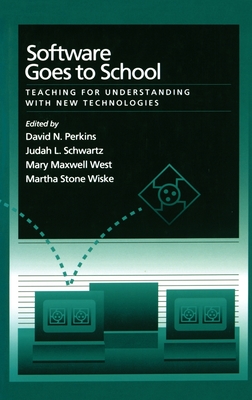
Software Goes to School : Teaching for Understanding with New Technologies
Book Details
Format
Hardback
ISBN-10
0195089383
ISBN-13
9780195089387
Publisher
Oxford University Press Inc
Imprint
Oxford University Press Inc
Country of Manufacture
GB
Country of Publication
GB
Publication Date
Sep 28th, 1995
Print length
304 Pages
Weight
567 grams
Dimensions
24.30 x 16.20 x 2.60 cms
KSh 14,850.00
Temporarily out of stock, due soon
0 in stock
Delivery Location
Delivery fee: Select location
Secure
Quality
Fast
The focus of this book is education in science, mathematics, and computing. Part I explores the nature of understanding; Part II focuses on technology's role in teaching for understanding, examining in particular the way software can construct "ramps" from the concrete to the abstract; Part III connects educational research to practice.
Declining test scores, burgeoning drop-out rates, poor showings in international comparisons--the malaise of public education seems to grow everyday. In this context, technology has emerged as one of the hopes of a renewed educational enterprise. Yet modern information-processing technologies have proved far from a panacea for the ills of education. Software Goes to School describes why that is the case in its consideration of three broad themes. The first part of the book addresses the question of what it means to understand. What constitutes understanding something? What are our principle resources in teaching for understanding? The second part of the book focuses front and centre on what technology can offer in teaching for understanding. Individual chapters examine how technologies afford new ways of representing complex concepts and make available new means by which students can manipulate abstract entities in a "hands-on" way. The last part of the book discusses the complexities of realistic educational settings, explores what happens when technology-based innovations are introduced, and examines the means by which a pedagogy of understanding can take root and thrive. Authored by an eminent group of researchers, this book offers numerous practical guidelines on how computers and software can work together for the betterment of the teaching process. Students and professionals in educational psychology, developmental psychology, and educational computing--as well as concerned parents--will want to read this stimulating new work.
Get Software Goes to School by David N. Perkins at the best price and quality guaranteed only at Werezi Africa's largest book ecommerce store. The book was published by Oxford University Press Inc and it has 304 pages.
Customers Who Bought This Also Bought

The Anxious Generation
KSh 2,000.00

Restoring Childhood
KSh 3,050.00

Bible old testament bindup_8x8
KSh 2,450.00
The Einstein Syndrome
KSh 3,200.00

Restoring Childhood
KSh 4,500.00
Free to Learn
KSh 3,050.00

Key Issues in Childhood and Youth Studies
KSh 8,000.00

Key Issues in Childhood and Youth Studies
KSh 30,950.00

Outsmart Anxiety
KSh 4,700.00
How Children Succeed
KSh 3,400.00
Helping Children Succeed
KSh 3,050.00

The Life and Creative Works of Paulo Coelho
KSh 21,600.00
