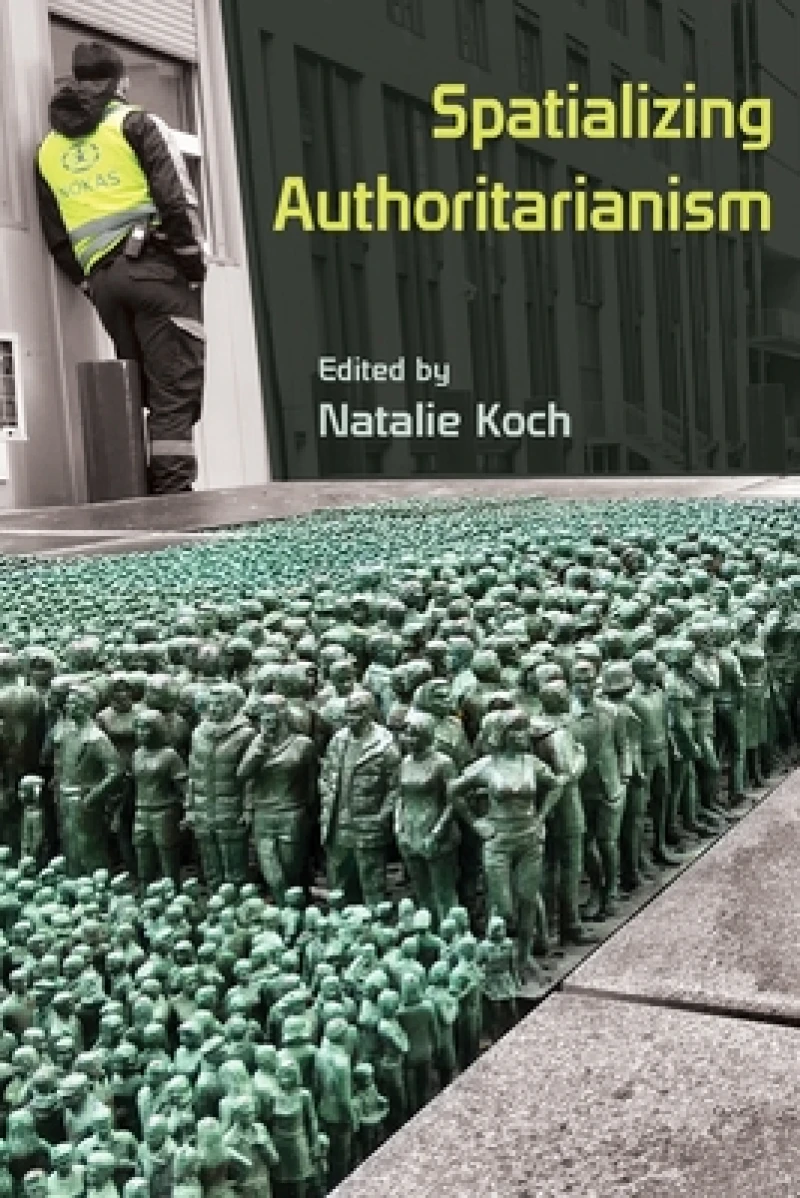
Spatializing Authoritarianism
Book Details
Format
Hardback or Cased Book
Book Series
Syracuse Studies in Geography
ISBN-10
0815637640
ISBN-13
9780815637646
Publisher
Syracuse University Press
Imprint
Syracuse University Press
Country of Manufacture
GB
Country of Publication
GB
Publication Date
Jun 30th, 2022
Print length
416 Pages
Weight
333 grams
Dimensions
22.80 x 15.20 x 2.30 cms
Ksh 12,950.00
Werezi Extended Catalogue
0 in stock
Delivery Location
Delivery fee: Select location
Secure
Quality
Fast
Builds on recent research to show that even when conceptualized as a set of practices rather than as a simple territorial label, authoritarianism has a spatiality: both drawing from and producing political space and scale in many often surprising ways.
Authoritarianism has emerged as a prominent theme in popular and academic discussions of politics since the 2016 US presidential election and the coinciding expansion of authoritarian rhetoric and ideals across Europe, Asia, and beyond. Until recently, however, academic geographers have not focused squarely on the concept of authoritarianism. Its longstanding absence from the field is noteworthy as geographers have made extensive contributions to theorizing structural inequalities, injustice, and other expressions of oppressive or illiberal power relations and their diverse spatialities. Identifying this void, Spatializing Authoritarianism builds upon recent research to show that even when conceptualized as a set of practices rather than as a simple territorial label, authoritarianism has a spatiality: both drawing from and producing political space and scale in many often surprising ways. This volume advances the argument that authoritarianism must be investigated by accounting for the many scales at which it is produced, enacted, and imagined.
Including a diverse array of theoretical perspectives and empirical cases drawn from the Global South and North, this collection illustrates the analytical power of attending to authoritarianism’s diverse scalar and spatial expressions, and how intimately connected it is with identity narratives, built landscapes, borders, legal systems, markets, and other territorial and extraterritorial expressions of power.
Including a diverse array of theoretical perspectives and empirical cases drawn from the Global South and North, this collection illustrates the analytical power of attending to authoritarianism’s diverse scalar and spatial expressions, and how intimately connected it is with identity narratives, built landscapes, borders, legal systems, markets, and other territorial and extraterritorial expressions of power.
Get Spatializing Authoritarianism by at the best price and quality guaranteed only at Werezi Africa's largest book ecommerce store. The book was published by Syracuse University Press and it has pages.