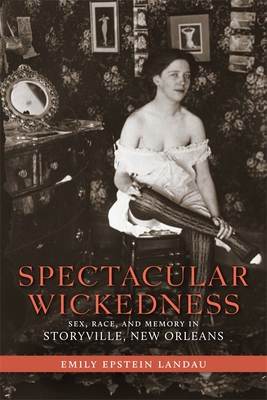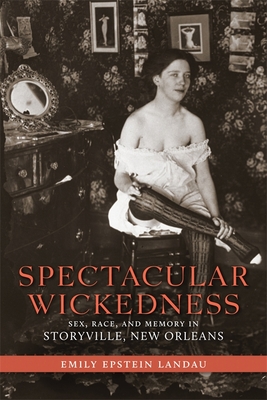
Spectacular Wickedness : Sex, Race, and Memory in Storyville, New Orleans
Book Details
Format
Hardback
ISBN-10
0807150142
ISBN-13
9780807150146
Publisher
Louisiana State University Press
Imprint
Louisiana State University Press
Country of Manufacture
US
Country of Publication
GB
Publication Date
Jan 14th, 2013
Print length
336 Pages
Weight
635 grams
Dimensions
22.80 x 16.00 x 3.00 cms
KSh 7,550.00
Temporarily out of stock, due soon
0 in stock
Delivery Location
Delivery fee: Select location
Secure
Quality
Fast
From 1897 to 1917 the red-light district of Storyville commercialized and thrived on New Orleans's longstanding reputation for sin and sexual excess. In Spectacular Wickedness, Emily Epstein Landau examines the social history of this famed district within the cultural context of developing racial, sexual, and gender ideologies and practices.
From 1897 to 1917 the red-light district of Storyville commercialized and even thrived on New Orleans's longstanding reputation for sin and sexual excess. This notorious neighborhood, located just outside of the French Quarter, hosted a diverse cast of characters who reflected the cultural milieu and complex social structure of turn-of-the-century New Orleans, a city infamous for both prostitution and interracial intimacy. In particular, Lulu White- a mixed-race prostitute and madam- created an image of herself and marketed it profitably to sell sex with light-skinned women to white men of means. In Spectacular Wickedness, Emily Epstein Landau examines the social history of this famed district within the cultural context of developing racial, sexual, and gender ideologies and practices.
Storyville's founding was envisioned as a reform measure, an effort by the city's business elite to curb and contain prostitution- namely, to segregate it. In 1890, the Louisiana legislature passed the Separate Car Act, which, when challenged by New Orleans's Creoles of color, led to the landmark Plessy v. Ferguson decision in 1896, constitutionally sanctioning the enactment of ""separate but equal"" laws. The concurrent partitioning of both prostitutes and blacks worked only to reinforce Storyville's libidinous license and turned sex across the color line into a more lucrative commodity.
By looking at prostitution through the lens of patriarchy and demonstrating how gendered racial ideologies proved crucial to the remaking of southern society in the aftermath of the Civil War, Landau reveals how Storyville's salacious and eccentric subculture played a significant role in the way New Orleans constructed itself during the New South era.
Storyville's founding was envisioned as a reform measure, an effort by the city's business elite to curb and contain prostitution- namely, to segregate it. In 1890, the Louisiana legislature passed the Separate Car Act, which, when challenged by New Orleans's Creoles of color, led to the landmark Plessy v. Ferguson decision in 1896, constitutionally sanctioning the enactment of ""separate but equal"" laws. The concurrent partitioning of both prostitutes and blacks worked only to reinforce Storyville's libidinous license and turned sex across the color line into a more lucrative commodity.
By looking at prostitution through the lens of patriarchy and demonstrating how gendered racial ideologies proved crucial to the remaking of southern society in the aftermath of the Civil War, Landau reveals how Storyville's salacious and eccentric subculture played a significant role in the way New Orleans constructed itself during the New South era.
Get Spectacular Wickedness by Emily Epstein Landau at the best price and quality guaranteed only at Werezi Africa's largest book ecommerce store. The book was published by Louisiana State University Press and it has 336 pages.
Customers Who Bought This Also Bought
A Modern History of the Somali
KSh 5,300.00
Sapiens
KSh 2,350.00

Rise Fall Great Powers
KSh 3,050.00

Legacy of Violence
KSh 3,150.00

Chip War
KSh 2,000.00
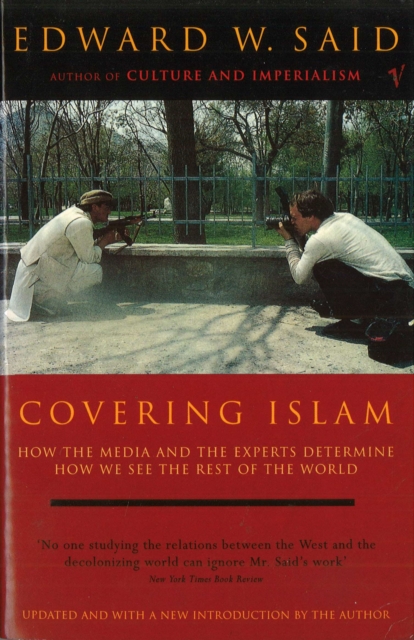
Covering Islam
KSh 2,350.00
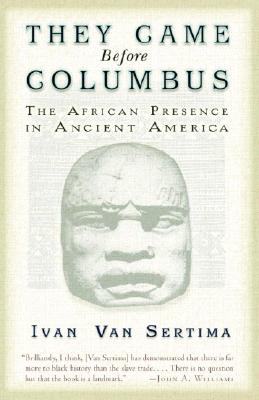
They Came Before Columbus
KSh 3,400.00

Hiroshima
KSh 2,000.00

Guns, Germs and Steel
KSh 2,400.00

Silk Roads
KSh 3,050.00

Empire
KSh 2,700.00
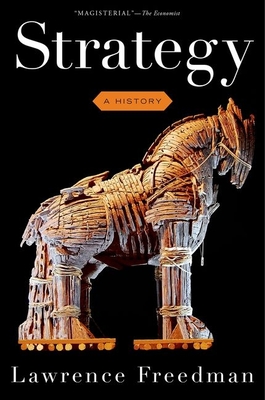
Strategy
KSh 4,350.00