
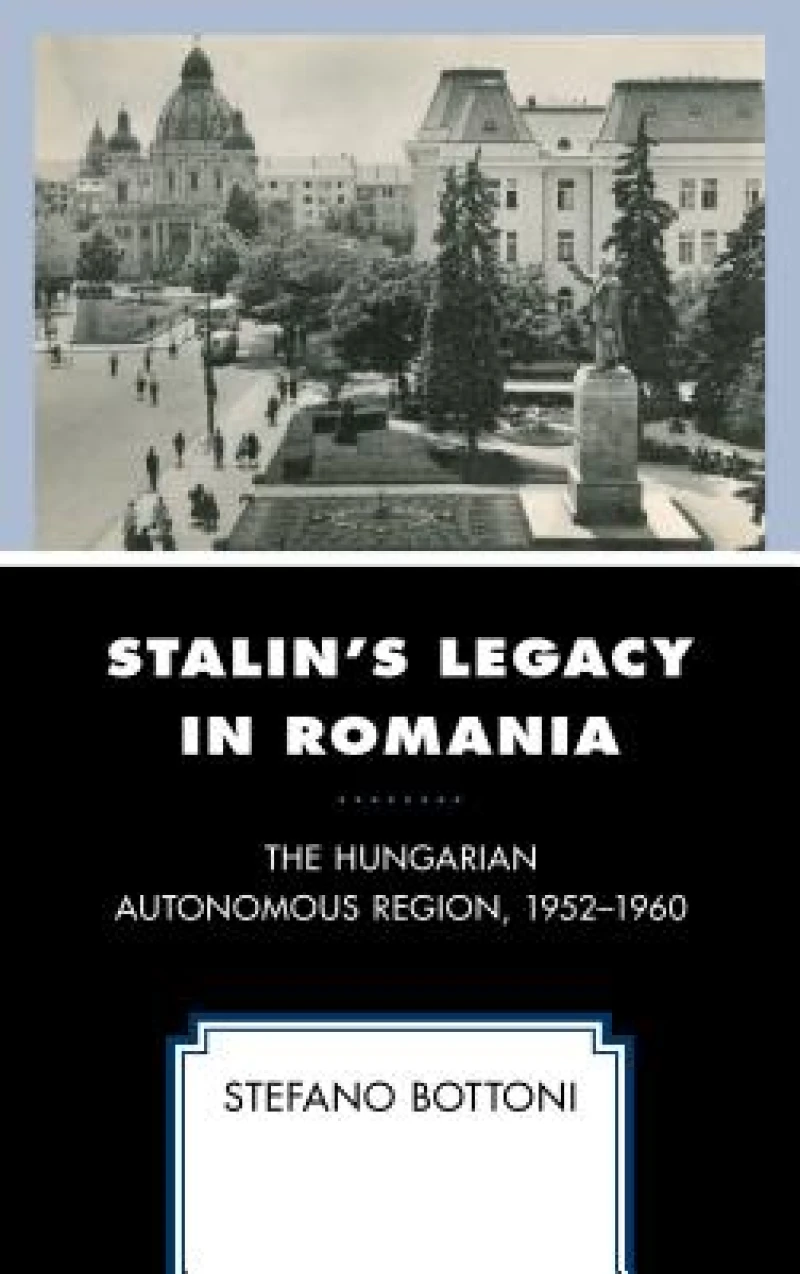
Stalin's Legacy in Romania : The Hungarian Autonomous Region, 1952–1960
Book Details
Format
Hardback or Cased Book
Book Series
The Harvard Cold War Studies Book Series
ISBN-10
1498551211
ISBN-13
9781498551212
Publisher
Bloomsbury Publishing Plc
Imprint
Lexington Books
Country of Manufacture
US
Country of Publication
GB
Publication Date
May 29th, 2018
Print length
422 Pages
Weight
778 grams
Dimensions
17.00 x 23.70 x 2.90 cms
Product Classification:
European historyPostwar 20th century history, from c 1945 to c 2000
Ksh 23,450.00
Manufactured on Demand
0 in stock
Delivery Location
Delivery fee: Select location
Secure
Quality
Fast
This study examines the creation and subsequent dismantling of the Hungarian Autonomous Region in the 1950s. The author analyzes the influence of Soviet aid and the ways in which the Romanian Communist Party dealt with the country’s various ethnic and national groups.
This study explores the little-known history of the Hungarian Autonomous Region (HAR), a Soviet-style territorial autonomy that was granted in Romania on Stalin’s personal advice to the Hungarian Székely community in the summer of 1952. Since 1945, a complex mechanism of ethnic balance and power-sharing helped the Romanian Communist Party (RCP) to strengthen—with Soviet assistance—its political legitimacy among different national and social groups. The communist national policy followed an integrative approach toward most minority communities, with the relevant exception of Germans, who were declared collectively responsible for the German occupation and were denied political and even civil rights until 1948. The Hungarians of Transylvania were provided with full civil, political, cultural, and linguistic rights to encourage political integration. The ideological premises of the Hungarian Autonomous Region followed the Bolshevik pattern of territorial autonomy elaborated by Lenin and Stalin in the early 1920s. The Hungarians of Székely Land would become a “titular nationality” provided with extensive cultural rights. Yet, on the other hand, the Romanian central power used the region as an instrument of political and social integration for the Hungarian minority into the communist state. The management of ethnic conflicts increased the ability of the PCR to control the territory and, at the same time, provided the ruling party with a useful precedent for the far larger “nationalization” of the Romanian communist regime which, starting from the late 1950s, resulted in “ethnicized” communism, an aim achieved without making use of pre-war nationalist discourse. After the Hungarian revolution of 1956, repression affected a great number of Hungarian individuals accused of nationalism and irredentism. In 1960 the HAR also suffered territorial reshaping, its Hungarian-born political leadership being replaced by ethnic Romanian cadres. The decisive shift from a class dictatorship toward an ethnicized totalitarian regime was the product of the Gheorghiu-Dej era and, as such, it represented the logical outcome of a long-standing ideological fouling of Romanian communism and more traditional state-building ideologies.
Get Stalin's Legacy in Romania by at the best price and quality guaranteed only at Werezi Africa's largest book ecommerce store. The book was published by Bloomsbury Publishing Plc and it has pages.

