
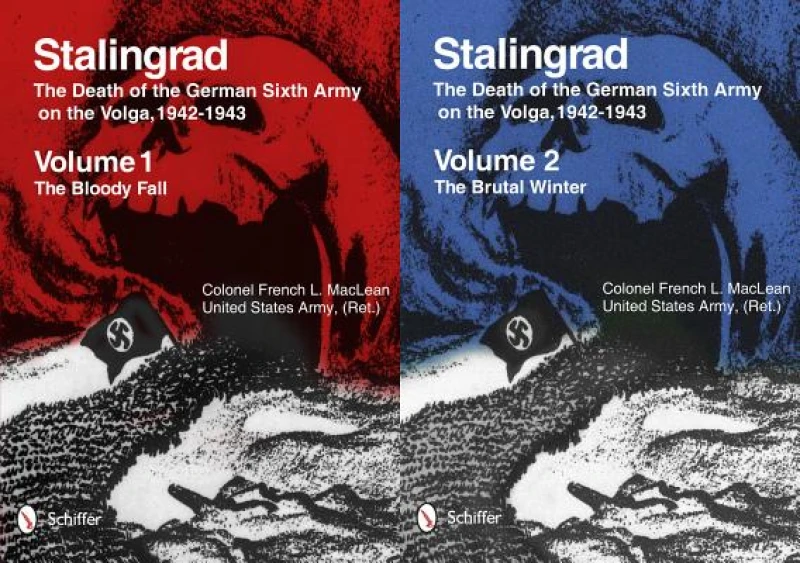
Stalingrad: The Death of the German Sixth Army on the Volga, 1942-1943 : Volume 1: The Bloody Fall • Volume 2: The Brutal Winter
Book Details
Format
Hardback or Cased Book
ISBN-10
0764343432
ISBN-13
9780764343438
Publisher
Schiffer Publishing Ltd
Imprint
Schiffer Publishing Ltd
Country of Manufacture
CN
Country of Publication
GB
Publication Date
Oct 28th, 2013
Print length
640 Pages
Weight
2,454 grams
Dimensions
26.90 x 19.40 x 6.70 cms
Product Classification:
Second World War
Ksh 12,250.00
Temporarily out of stock, due soon
0 in stock
Delivery Location
Delivery fee: Select location
Secure
Quality
Fast
Stalingrad: The Death of the German Sixth Army on the Volga, 1942-1943, is the first published work to detail the situation of every German corps and division for every day of the six-month Stalingrad campaign. Derived from the Sixth Army daily operation reports and the German Army High Command (OKH) situation maps (Lage Ost), this two-volume set presents the situation on the flanks of the army, as well as the combat in the city itself, a level of detail never before attempted. Stalingrad was the perfect storm that would lead to the death of an army – the German Sixth Army. Led by Field Marshal Friedrich Paulus, but micromanaged by Adolf Hitler, who insisted that his forces fight to the last man and bullet, the Sixth Army became fixated on an objective that continued to be just past their grasp. Believing that Stalingrad would be theirs “if only” one more attack against the urban rubble was mounted, the Sixth Army did not see that it was in a situation where if something did go wrong, it would not “see” impending doom until it was too late. That something was the massive Soviet attack that broke through both flanks of the Sixth Army in such a violent manner and to such a great operational depth that any hope of relieving the surrounded pocket from the outside in such horrible winter conditions was probably illusionary. Thus, defeat was in order for the Sixth Army, but it would not end there. Adolf Hitler had insisted that this would be a fight between the supermen of Aryan Germany against the sub-humans of Slavic Russia. In this fight, according to Nazi ideology, the sub-humans had no right to live. Given the polar ideological differences of Fascism and Communism, combined with this racial antagonism, when the Red Army did gain the upper hand and isolate the German forces around Stalingrad in November 1942, the situation guaranteed that the Sixth Army would not only be defeated, but that it and most of its soldiers were headed for annihilation.
Stalingrad: The Death of the German Sixth Army on the Volga, 1942-1943, is the first published work to detail the situation of every German corps and division for every day of the six-month Stalingrad campaign. Derived from the Sixth Army daily operation reports and the German Army High Command (OKH) situation maps (Lage Ost), this two-volume set presents the situation on the flanks of the army, as well as the combat in the city itself, a level of detail never before attempted. Stalingrad was the perfect storm that would lead to the death of an army – the German Sixth Army. Led by Field Marshal Friedrich Paulus, but micromanaged by Adolf Hitler, who insisted that his forces fight to the last man and bullet, the Sixth Army became fixated on an objective that continued to be just past their grasp. Believing that Stalingrad would be theirs “if only” one more attack against the urban rubble was mounted, the Sixth Army did not see that it was in a situation where if something did go wrong, it would not “see” impending doom until it was too late. That something was the massive Soviet attack that broke through both flanks of the Sixth Army in such a violent manner and to such a great operational depth that any hope of relieving the surrounded pocket from the outside in such horrible winter conditions was probably illusionary. Thus, defeat was in order for the Sixth Army, but it would not end there. Adolf Hitler had insisted that this would be a fight between the supermen of Aryan Germany against the sub-humans of Slavic Russia. In this fight, according to Nazi ideology, the sub-humans had no right to live. Given the polar ideological differences of Fascism and Communism, combined with this racial antagonism, when the Red Army did gain the upper hand and isolate the German forces around Stalingrad in November 1942, the situation guaranteed that the Sixth Army would not only be defeated, but that it and most of its soldiers were headed for annihilation.
Get Stalingrad: The Death of the German Sixth Army on the Volga, 1942-1943 by at the best price and quality guaranteed only at Werezi Africa's largest book ecommerce store. The book was published by Schiffer Publishing Ltd and it has pages.

