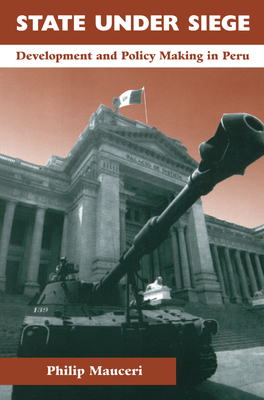
State Under Siege : Development And Policy Making In Peru
Book Details
Format
Paperback / softback
ISBN-10
0813336074
ISBN-13
9780813336077
Publisher
Taylor & Francis Inc
Imprint
Westview Press Inc
Country of Manufacture
GB
Country of Publication
GB
Publication Date
Oct 16th, 1998
Print length
192 Pages
Weight
310 grams
KSh 5,600.00
Currently unavailable
0 in stock
Delivery Location
Delivery fee: Select location
Secure
Quality
Fast
This book shows how Peru emerged as the most violent and unstable country in the region in the wake of the debt crisis and how policy choices made by diverse political leaders over time have affected state capabilities. It examines the shift from develop-mentalist to neoliberal economic policies.
Using a framework that highlights how societal and international factors have shaped state capacities, Philip Mauceri examines the volatile politics in Peru from the Velasco through the Fujimori regimes as the country has moved from a ?developmentalist? state to neoliberalism.Dr. Mauceri begins by reassessing the reformist experiment of the Peruvian military regime (1968?1980), arguing that it led to the development of unexpected challenges to state authority, both from new social actors and international financial organizations. During the 1980s, these challenges intensified, made even worse by poor planning and limited policy choices. The author then argues that the attempt by the Fujimori regime, backed by a neoliberal coalition, to ?retool? the state indicates the degree to which state capacities are determined by social and international conditions. Mauceri also gives special attention to the relation between changing state power and social control. Separate chapters on the evolution of a Lima shantytown and the Shining Path examine how changes in state-society relations have had impacts at the grassroots level.
Get State Under Siege by Philip Mauceri at the best price and quality guaranteed only at Werezi Africa's largest book ecommerce store. The book was published by Taylor & Francis Inc and it has 192 pages.
Customers Who Bought This Also Bought

How Africa Works
KSh 3,050.00
Development as Freedom
KSh 2,900.00

How Africa Works
KSh 4,500.00

Anti-Politics Machine
KSh 3,750.00

We Are Not Able to Live in the Sky
KSh 3,400.00
Apostles of Development
KSh 5,600.00
The Bottom Billion
KSh 2,500.00
Indigenous Knowledge Inquiries
KSh 6,600.00

Why Africa is poor
KSh 2,350.00

Historical Dictionary of Aid and Development Organizations
KSh 12,050.00

Contemporary Latin American Architecture
KSh 7,900.00
The Poverty of Growth
KSh 2,900.00