
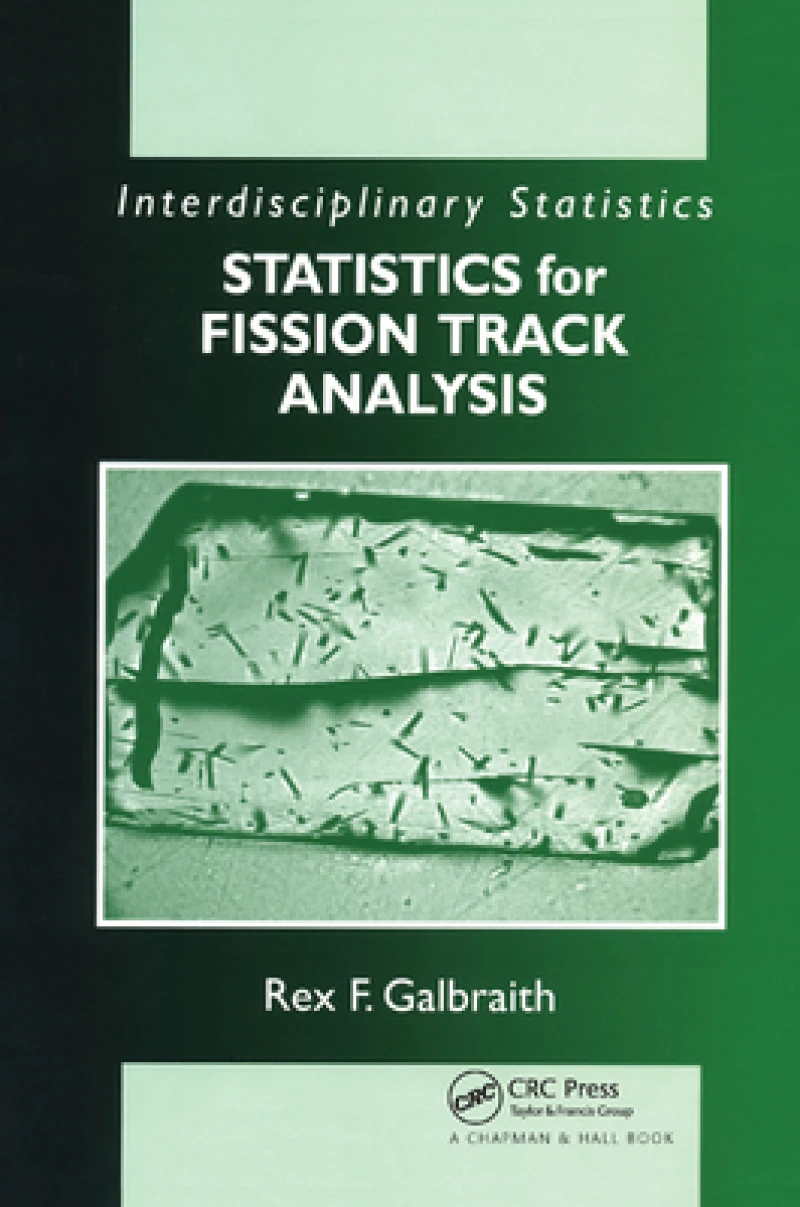
Statistics for Fission Track Analysis
Book Details
Format
Paperback / Softback
Book Series
Chapman & Hall/CRC Interdisciplinary Statistics
ISBN-10
0367392798
ISBN-13
9780367392796
Publisher
Taylor & Francis Ltd
Imprint
Chapman & Hall/CRC
Country of Manufacture
GB
Country of Publication
GB
Publication Date
Mar 4th, 2020
Print length
240 Pages
Weight
384 grams
Dimensions
15.50 x 23.50 x 2.40 cms
Ksh 12,800.00
Werezi Extended Catalogue
0 in stock
Delivery Location
Delivery fee: Select location
Secure
Quality
Fast
Statistical analyses of the numbers, lengths, and orientations of fission tracks etched in minerals yield dating and thermal history information valuable in geological and geoscience applications, particularly in oil exploration. Fission tracks can be represented mathematically by a stochastic process of randomly oriented line segments in three dimensions, and this "line segment" model can describe and explain the essential statistical features of the data, providing a rigorous foundation for quantitative modelling and simulation studies.
Statistics for Fission Track Analysis explores the line segment model and its consequences for the analysis and interpretation of data. The author derives the equations for fission track data and the theoretical probability distributions for the number, orientation, and length measurements of the tracks. He sets out the theory of fission track dating and through numerical examples, presents methods for analyzing and interpreting fission track counts. Later chapters address statistical models for situations in which samples contain mixtures of fission track ages. These methods, along with observation features of the various measurements, are illustrated by real examples. Finally, the author brings together the theoretical and observation aspects to formulate a joint likelihood function of counts, lengths, and angles as a basis for parametric thermal history modelling. An appendix provides general notes on statistical concepts and methods.
Designed for broad accessibility, this is the first book to fully cover the statistical foundations of fission track analysis. Whether you work in a fission track lab, in archaeological, geological, or geochronological research, or in geological applications of statistics, you will find the background material and practical tools you need to optimize the use of fission track analysis in your work and to make further advances in the field.
Statistics for Fission Track Analysis explores the line segment model and its consequences for the analysis and interpretation of data. The author derives the equations for fission track data and the theoretical probability distributions for the number, orientation, and length measurements of the tracks. He sets out the theory of fission track dating and through numerical examples, presents methods for analyzing and interpreting fission track counts. Later chapters address statistical models for situations in which samples contain mixtures of fission track ages. These methods, along with observation features of the various measurements, are illustrated by real examples. Finally, the author brings together the theoretical and observation aspects to formulate a joint likelihood function of counts, lengths, and angles as a basis for parametric thermal history modelling. An appendix provides general notes on statistical concepts and methods.
Designed for broad accessibility, this is the first book to fully cover the statistical foundations of fission track analysis. Whether you work in a fission track lab, in archaeological, geological, or geochronological research, or in geological applications of statistics, you will find the background material and practical tools you need to optimize the use of fission track analysis in your work and to make further advances in the field.
Get Statistics for Fission Track Analysis by at the best price and quality guaranteed only at Werezi Africa's largest book ecommerce store. The book was published by Taylor & Francis Ltd and it has pages.

