
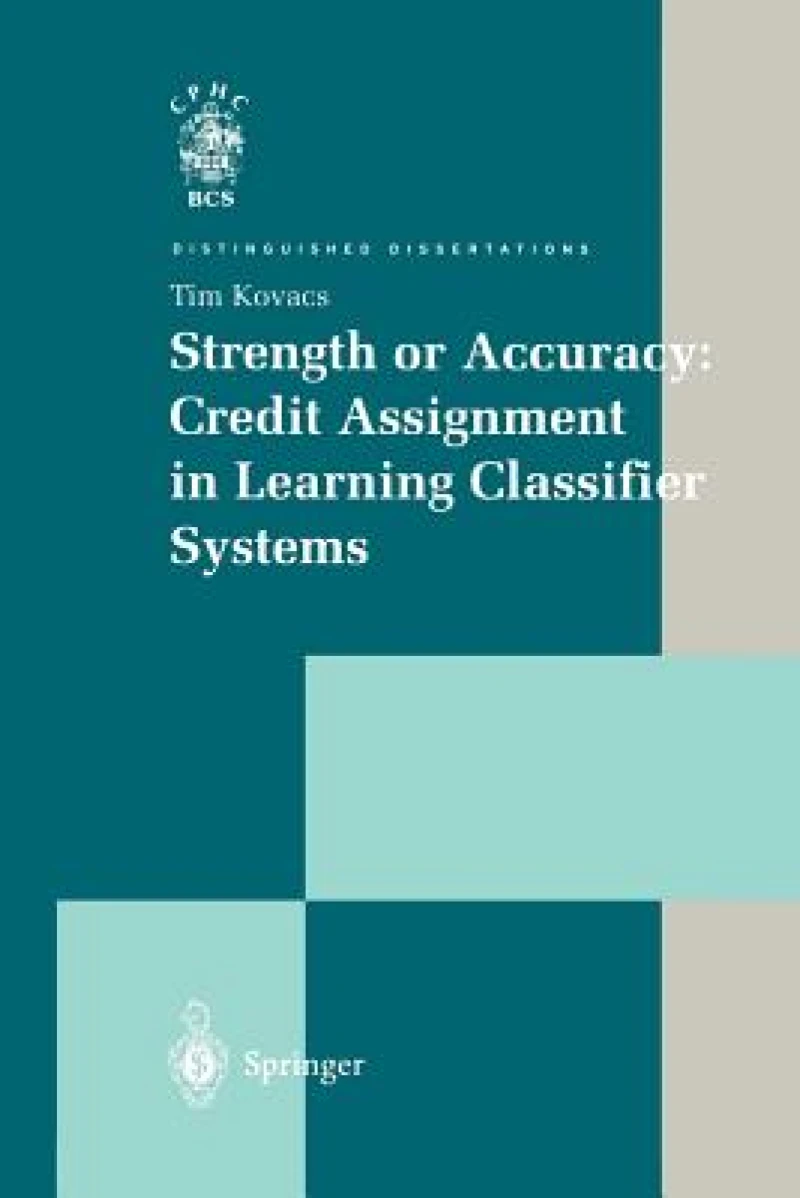
Strength or Accuracy: Credit Assignment in Learning Classifier Systems
Softcover reprint of the original 1st ed. 2004
by
Tim Kovacs
Book Details
Format
Paperback / Softback
Book Series
Distinguished Dissertations
ISBN-10
1447110587
ISBN-13
9781447110583
Edition
Softcover reprint of the original 1st ed. 2004
Publisher
Springer London Ltd
Imprint
Springer London Ltd
Country of Manufacture
GB
Country of Publication
GB
Publication Date
Oct 4th, 2012
Print length
307 Pages
Weight
470 grams
Dimensions
23.40 x 15.60 x 1.70 cms
Product Classification:
Business applicationsAlgorithms & data structuresArtificial intelligence
Ksh 23,400.00
Werezi Extended Catalogue
0 in stock
Delivery Location
Delivery fee: Select location
Secure
Quality
Fast
Classifier systems are an intriguing approach to a broad range of machine learning problems, based on automated generation and evaluation of condi tion/action rules.
Classifier systems are an intriguing approach to a broad range of machine learning problems, based on automated generation and evaluation of condi tion/action rules. Inreinforcement learning tasks they simultaneously address the two major problems of learning a policy and generalising over it (and re lated objects, such as value functions). Despite over 20 years of research, however, classifier systems have met with mixed success, for reasons which were often unclear. Finally, in 1995 Stewart Wilson claimed a long-awaited breakthrough with his XCS system, which differs from earlier classifier sys tems in a number of respects, the most significant of which is the way in which it calculates the value of rules for use by the rule generation system. Specifically, XCS (like most classifiersystems) employs a genetic algorithm for rule generation, and the way in whichit calculates rule fitness differsfrom earlier systems. Wilson described XCS as an accuracy-based classifiersystem and earlier systems as strength-based. The two differin that in strength-based systems the fitness of a rule is proportional to the return (reward/payoff) it receives, whereas in XCS it is a function of the accuracy with which return is predicted. The difference is thus one of credit assignment, that is, of how a rule''s contribution to the system''s performance is estimated. XCS is a Q learning system; in fact, it is a proper generalisation of tabular Q-learning, in which rules aggregate states and actions. In XCS, as in other Q-learners, Q-valuesare used to weightaction selection.
Get Strength or Accuracy: Credit Assignment in Learning Classifier Systems by at the best price and quality guaranteed only at Werezi Africa's largest book ecommerce store. The book was published by Springer London Ltd and it has pages.

