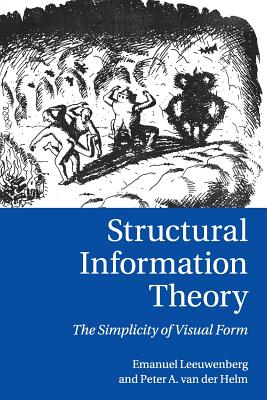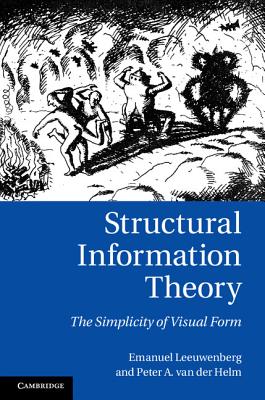
Structural Information Theory : The Simplicity of Visual Form
Book Details
Format
Hardback
ISBN-10
1107029600
ISBN-13
9781107029606
Publisher
Cambridge University Press
Imprint
Cambridge University Press
Country of Manufacture
GB
Country of Publication
GB
Publication Date
Nov 22nd, 2012
Print length
333 Pages
Weight
62 grams
Dimensions
23.40 x 15.40 x 2.20 cms
Product Classification:
Information theoryCognition and cognitive psychologyPerceptionNeurosciences
KSh 19,600.00
Currently unavailable
0 in stock
Delivery Location
Delivery fee: Select location
Secure
Quality
Fast
This highly accessible and richly illustrated book on visual pattern classification is unique in that it presents not only many visual phenomena but also a coherent and comprehensive theory with quantitative models, verifiable predictions and extensive empirical evidence. It will appeal to both academic specialists and other students of perception.
Structural information theory is a coherent theory about the way the human visual system organises a raw visual stimulus into objects and object parts. To humans, a visual stimulus usually has one clear interpretation even though, in theory, any stimulus can be interpreted in numerous ways. To explain this, the theory focuses on the nature of perceptual interpretations rather than on underlying process mechanisms and adopts the simplicity principle which promotes efficiency of internal resources rather than the likelihood principle which promotes veridicality in the external world. This theoretically underpinned starting point gives rise to quantitative models and verifiable predictions for many visual phenomena, including amodal completion, subjective contours, transparency, brightness contrast, brightness assimilation and neon illusions. It also explains phenomena such as induced temporal order, temporal context effects and hierarchical dominance effects, and extends to evaluative pattern qualities such as distinctiveness, interestingness and beauty.
Get Structural Information Theory by Emanuel Leeuwenberg, Peter A. van der Helm at the best price and quality guaranteed only at Werezi Africa's largest book ecommerce store. The book was published by Cambridge University Press and it has 333 pages.
Customers Who Bought This Also Bought

Nexus
KSh 2,350.00

Black Swan
KSh 2,700.00

Nexus
KSh 5,050.00
White Noise Analysis and Quantum Information
KSh 15,500.00
Elements of Information Theory
KSh 18,550.00

The Literary Guide to the Bible (Paper) (COBE)
KSh 6,300.00

A Mind at Play
KSh 3,600.00
Cryptographic Engineering
KSh 39,600.00

Responding to Crises in the Modern Infrastructure
KSh 8,100.00
Theory of Information (V1)
KSh 39,600.00

Technological Innovation for Life Improvement
KSh 16,200.00

Information Processing and Management of Uncertainty in Knowledge-Based Systems
KSh 19,800.00