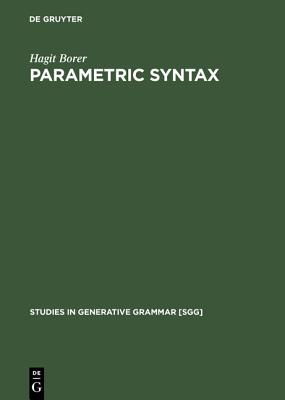

Structuring Sense: Volume 1: In Name Only
by
Hagit Borer
Book Details
Format
Hardback
Book Series
Structuring Sense
ISBN-10
0199263892
ISBN-13
9780199263899
Publisher
Oxford University Press
Imprint
Oxford University Press
Country of Manufacture
GB
Country of Publication
GB
Publication Date
Jan 20th, 2005
Print length
328 Pages
Weight
639 grams
Dimensions
24.20 x 16.30 x 2.40 cms
KSh 22,750.00
Temporarily out of stock, due soon
0 in stock
Delivery Location
Delivery fee: Select location
Secure
Quality
Fast
Exploring the difference between words however defined and structures however constructed, this book sets out to demonstrate over three volumes, of which this is the first, that the explanation of linguistic competence should be shifted from lexical entry to syntactic structure, from memory of words to manipulation of rules.
Structuring Sense explores the difference between words however defined and structures however constructed. It sets out to demonstrate over three volumes, of which this is the first, that the explanation of linguistic competence should be shifted from lexical entry to syntactic structure, from memory of words to manipulation of rules. Its reformulation of how grammar and lexicon interact has profound implications for linguistic, philosophical, and psychological theories about human mind and language.Hagit Borer departs from both language specific constructional approaches and lexicalist approaches to argue that universal hierarchical structures determine interpretation, and that language variation emerges from the morphological and phonological properties of inflectional material.In Name Only applies this radical approach to nominal structure. Integrating research in syntax, semantics, and morphology, the author argues that nominal structure is based on the syntactic realization of semantic notions such as classifier, quantity, and reference. In the process she seeks to do away with lexical ambiguity and type-shifting. Among the topics she considers are the interpretation of proper names, the mass-count distinction, the weak-strong interpretation of quantifiers, partitive and measure phrases, and the structural representation of the definite article. In the process she explores inter-language variation through the properties of the morpho-phonological system. The languages discussed include English, Chinese, Italian, and Hebrew.
Get Structuring Sense: Volume 1: In Name Only by Hagit Borer at the best price and quality guaranteed only at Werezi Africa's largest book ecommerce store. The book was published by Oxford University Press and it has 328 pages.
Customers Who Bought This Also Bought

Recognising the Stranger
KSh 1,800.00
The Origin of Language
KSh 4,500.00
Sharing Thoughts
KSh 17,000.00

An Inquiry Into Meaning and Truth
KSh 3,750.00
Semiotics and the Philosophy of Language
KSh 3,400.00
An Introduction to Logic
KSh 6,650.00

Walker Percy''s Search for Community
KSh 5,950.00
Film Figures
KSh 16,450.00

The Tacit Dimensions of Language and Logic
KSh 15,800.00

Metaphors in Action
KSh 21,600.00
Frontiers in Semiotics
KSh 3,000.00

A Theory of Death
KSh 11,900.00