
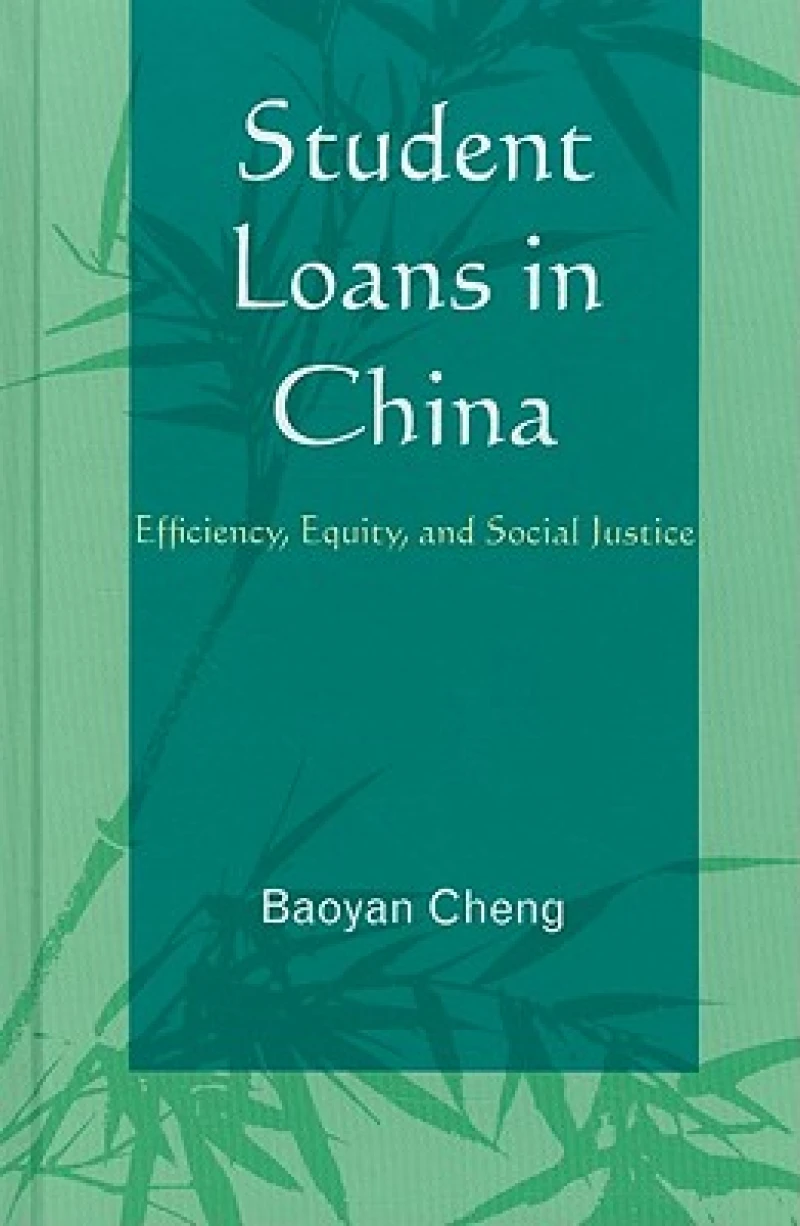
Student Loans in China : Efficiency, Equity, and Social Justice
by
Baoyan Cheng
Book Details
Format
Hardback or Cased Book
Book Series
Emerging Perspectives on Education in China
ISBN-10
0739145509
ISBN-13
9780739145500
Publisher
Bloomsbury Publishing Plc
Imprint
Lexington Books
Country of Manufacture
GB
Country of Publication
GB
Publication Date
Mar 24th, 2011
Print length
168 Pages
Weight
422 grams
Dimensions
24.10 x 16.20 x 1.70 cms
Product Classification:
Asian historyEducationHigher & further education, tertiary education
Ksh 18,300.00
Manufactured on Demand
0 in stock
Delivery Location
Delivery fee: Select location
Secure
Quality
Fast
In 1989, China started charging tuition on a very small scale at a number of universities as a result of the global trend of cost-recovery policies, thus ending the free higher education era in China. It was not until 1997 that all higher education institutions in China started charging tuition and fees. Both the expansion of higher education and the wide gap between income and tuition and fees have created an increasingly high proportion of students who are academically qualified but cannot afford to go to college. To address the problem of the increasing number of financially needy students, in 1999, China launched the pilot Government-subsidized Student Loan Program (GSSLP) in eight cities. This program was extended to full-time students at all of the 1,942 public higher education institutions in 2000, and has been undergoing revisions ever since, including major ones in 2004 and 2007. As of 2009, the number of financially needy students in China reached 5.27 million, accounting for 23.06 percent of the total enrollment of 22.85 million at higher education institutions in China. Behind those statistics are young people who suffer in many ways. This book provides multiple perspectives, namely, global, comparative, empirical, practical and philosophical ones, on the GSSLP, the largest financial aid program in current China. It not only provides information on financial aid policies, especially the GSSLP, in China, but also offers a comparative perspective by examining student loan programs in the United States and Australia, which are more mature and better developed. Using original dataset, the empirical and practical perspectives examine the effect of the GSSLP on students' behavior, and look into the different aspects of the GSSLP, including students' perceptions of and attitudes toward the program, as well as its implementation. In addition to these technical aspects of the GSSLP, this book also examines the larger concepts of equality and social justice from a philosophical perspective, and argues
In 1989, China started charging tuition on a very small scale at a number of universities as a result of the global trend of cost-recovery policies, thus ending the free higher education era in China. It was not until 1997 that all higher education institutions in China started charging tuition and fees. Both the expansion of higher education and the wide gap between income and tuition and fees have created an increasingly high proportion of students who are academically qualified but cannot afford to go to college. To address the problem of the increasing number of financially needy students, in 1999, China launched the pilot Government-subsidized Student Loan Program (GSSLP) in eight cities. This program was extended to full-time students at all of the 1,942 public higher education institutions in 2000, and has been undergoing revisions ever since, including major ones in 2004 and 2007. As of 2009, the number of financially needy students in China reached 5.27 million, accounting for 23.06 percent of the total enrollment of 22.85 million at higher education institutions in China. Behind those statistics are young people who suffer in many ways. This book provides multiple perspectives, namely, global, comparative, empirical, practical and philosophical ones, on the GSSLP, the largest financial aid program in current China. It not only provides information on financial aid policies, especially the GSSLP, in China, but also offers a comparative perspective by examining student loan programs in the United States and Australia, which are more mature and better developed. Using original dataset, the empirical and practical perspectives examine the effect of the GSSLP on students'' behavior, and look into the different aspects of the GSSLP, including students'' perceptions of and attitudes toward the program, as well as its implementation. In addition to these technical aspects of the GSSLP, this book also examines the larger concepts of equality and social justice from a philosophical perspective, and argues
Get Student Loans in China by at the best price and quality guaranteed only at Werezi Africa's largest book ecommerce store. The book was published by Bloomsbury Publishing Plc and it has pages.

