
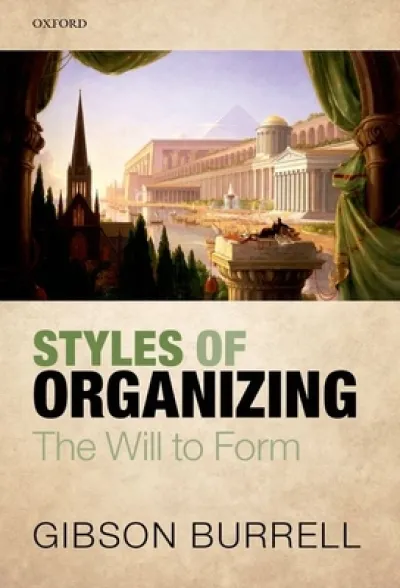
Styles of Organizing : The Will to Form
Book Details
Format
Hardback or Cased Book
ISBN-10
0199671621
ISBN-13
9780199671625
Publisher
Oxford University Press
Imprint
Oxford University Press
Country of Manufacture
GB
Country of Publication
GB
Publication Date
Jun 27th, 2013
Print length
292 Pages
Weight
596 grams
Dimensions
24.00 x 16.30 x 2.10 cms
Ksh 9,800.00
Manufactured on Demand
0 in stock
Delivery Location
Delivery fee: Select location
Secure
Quality
Fast
The book is a provocative and challenging approach to the study of organizations by one of the UK's leading organization theorists, who uses various ideas and metaphors from economics, architecture, and design to move beyond the two-dimensionality of much organizational thinking to present more complex 3-D models.
In this book, leading organization theorist Gibson Burrell presents a provocative and challenging approach to the study of organizations, aiming to move beyond the two-dimensionality of much organizational thinking and present more complex 3-D models, which allow for the ''intractions'' of apparently disparate perspectives. The book aims to illuminate organization theory by discussing its interrelationship with key features of economics, architecture, aesthetics, design of the built environment, and associated artwork. He argues that by their shared ''definitions'', these areas of social science and the humanities are struggling with the same issue - ''the will to form''.The author suggests that, whilst there are a huge number of possibilities for the process of organizing, the constraints of the human body, our cognitive limitations in space and time, and our relationship to nature, mean that these are necessarily limited to an ''envelope'' of possibilities. He then outlines the basic parameters of the ''design envelope'', analysing it through discussion of ''styles'', and examines the hidden assumptions of these styles with regards the origins and potentialities of human knowledge. Burrell argues that the envelope of organizational, politico-economic, and architectural design possibilities may be seen as a cube, thus taking forward the geometrical notions of ''lines'' of fight, ''points'' of difference, and ''planes'' of agreement to discuss the huge range of, and massive constraints upon, human organizing that are reflected in the ''will to form''. Key differences in assumptions demarcate distinct ''styles of organizing'' which every reader possesses - whether they are aware of them or not.
Get Styles of Organizing by at the best price and quality guaranteed only at Werezi Africa's largest book ecommerce store. The book was published by Oxford University Press and it has pages.

