
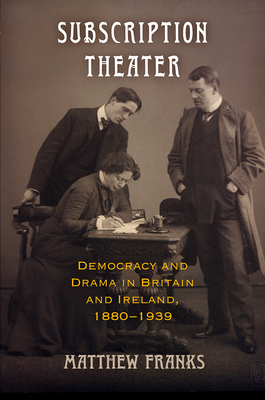
Subscription Theater : Democracy and Drama in Britain and Ireland, 1880-1939
Book Details
Format
Hardback
Book Series
Material Texts
ISBN-10
0812252470
ISBN-13
9780812252477
Publisher
University of Pennsylvania Press
Imprint
University of Pennsylvania Press
Country of Manufacture
US
Country of Publication
GB
Publication Date
Sep 25th, 2020
Print length
296 Pages
Product Classification:
Theatre studies
KSh 12,950.00
Currently unavailable
0 in stock
Delivery Location
Delivery fee: Select location
Secure
Quality
Fast
Subscription Theater asks why turn-of-the-century British and Irish citizens spent so much time, money, and effort adding their names to subscription lists. Shining a spotlight on private play-producing clubs, public repertory theaters, amateur drama groups, and theatrical magazines, Matthew Franks locates subscription theaters in a vast constellation of civic subscription initiatives, ranging from voluntary schools and workers' hospitals to soldiers' memorials and Diamond Jubilee funds. Across these enterprises, Franks argues, subscribers created their own spaces for performing social roles from which they had long been excluded. Whether by undermining the authority of the Lord Chamberlain's Examiner of Plays and London's commercial theater producers, or by extending rights to disenfranchised women and property-less men, a diverse cast of subscribers including typists, plumbers, and maids acted as political representatives for their fellow citizens, both inside the theater and far beyond it. Citizens prized a "democratic" or "representative" subscription list as an end in itself, and such lists set the stage for the eventual public subsidy of subscription endeavors. Subscription Theater points to the importance of printed ephemera such as programs, tickets, and prospectuses in questioning any assumption that theatrical collectivity is confined to the live performance event. Drawing on new media as well as old, Franks uses a database of over 23,000 stage productions to reveal that subscribers introduced nearly a third of the plays that were most frequently revived between 1890 and the mid-twentieth century, as well as nearly half of all new translations, and they were instrumental in staging the work of such writers as Shaw and Ibsen, whose plays featured subscription lists as a plot point or prop. Although subscribers often are blamed for being a conservative force in theater, Franks demonstrates that they have been responsible for how we value audience and repertoire today, and their history offers a new account of the relationship between ephemera, drama, and democracy.
Get Subscription Theater by Matthew Franks at the best price and quality guaranteed only at Werezi Africa's largest book ecommerce store. The book was published by University of Pennsylvania Press and it has 296 pages.
Customers Who Bought This Also Bought
Three Sisters
KSh 2,350.00

Lin-Manuel Miranda
KSh 3,600.00

Theater Kid
KSh 3,600.00

Streetcar Named Desire
KSh 1,800.00

Tennessee Williams
KSh 3,400.00

Empty Space
KSh 2,000.00

Samuel Beckett''s Lyric Failure
KSh 5,400.00
The Girl On The Train
KSh 2,150.00

The Theatre Artist''s Guide to Consent-Based Pedagogy
KSh 7,200.00

Staging Haiti in Nineteenth-Century America
KSh 4,300.00

Off Headset: Essays on Stage Management Work, Life, and Career
KSh 6,500.00

Samuel Beckett''s Lyric Failure
KSh 16,600.00
