
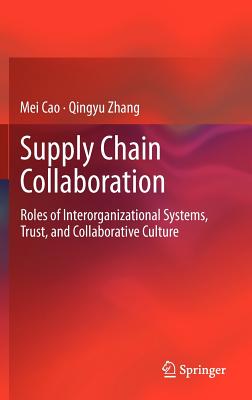
Supply Chain Collaboration : Roles of Interorganizational Systems, Trust, and Collaborative Culture
2013 ed.
Book Details
Format
Hardback
ISBN-10
1447145909
ISBN-13
9781447145905
Edition
2013 ed.
Publisher
Springer London Ltd
Imprint
Springer London Ltd
Country of Manufacture
GB
Country of Publication
GB
Publication Date
Oct 5th, 2012
Print length
198 Pages
Weight
446 grams
Dimensions
24.50 x 15.70 x 1.80 cms
KSh 16,200.00
Currently unavailable
0 in stock
Delivery Location
Delivery fee: Select location
Secure
Quality
Fast
This book conceptualizes supply chain collaboration as seven interconnecting elements including information sharing, incentive alignment, goal congruence, decision synchronization, resource sharing, as well as communication and joint knowledge creation.
To survive and thrive in the competition, firms have strived to achieve greater supply chain collaboration to leverage the resources and knowledge of suppliers and customers. Internet based technologies, particularly interorganizational systems, further extend the firms’ opportunities to strengthen their supply chain partnerships and share real-time information to optimize their operations. Supply Chain Collaboration: Roles of Interorganizational Systems, Trust, and Collaborative Culture explores the nature and characteristics, antecedents, and consequences of supply chain collaboration from multiple theoretical perspectives. Supply Chain Collaboration: Roles of Interorganizational Systems, Trust, and Collaborative Culture conceptualizes supply chain collaboration as seven interconnecting elements including information sharing, incentive alignment, goal congruence, decision synchronization, resource sharing, as well as communication and joint knowledge creation. These seven components define the occurrence of collaborative efforts and allow us to explain supply chain collaboration more precisely. Collaborative advantages are also divided into five components to capture the joint competitive advantages and benefits among supply chain partners. The definitions and measures developed here examine some central issue surrounding supply chain development but this is also followed up with real-life managerial practicalities. This balance of theory and practical application makes Supply Chain Collaboration: Roles of Interorganizational Systems, Trust, and Collaborative Culture a strong resource for industry practitioners and researchers alike.
Get Supply Chain Collaboration by Mei Cao, Qingyu Zhang at the best price and quality guaranteed only at Werezi Africa's largest book ecommerce store. The book was published by Springer London Ltd and it has 198 pages.
Customers Who Bought This Also Bought

Thinking in Systems
KSh 3,050.00

The 12 Week Year – Get More Done in 12 Weeks than Others Do in 12 Months
KSh 3,400.00

Escaping the Build Trap
KSh 5,750.00

How Boards Work
KSh 2,350.00

Turning Goals into Results
KSh 1,250.00

Build Like A Woman
KSh 4,700.00

Prediction Machines
KSh 3,950.00

Overcoming the Five Dysfunctions of a Team – A Field Guide for Leaders, Managers and Facilitators
KSh 3,950.00

Give and Take
KSh 2,350.00

HBR Classics Boxed Set (16 Books)
KSh 17,800.00

Good to Great and the Social Sectors
KSh 1,600.00

How to Be a Leader
KSh 2,150.00
