
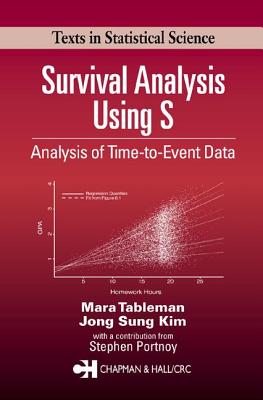
Survival Analysis Using S : Analysis of Time-to-Event Data
Book Details
Format
Hardback
Book Series
Chapman & Hall/CRC Texts in Statistical Science
ISBN-10
1584884088
ISBN-13
9781584884088
Publisher
Taylor & Francis Inc
Imprint
Chapman & Hall/CRC
Country of Manufacture
GB
Country of Publication
GB
Publication Date
Jul 28th, 2003
Print length
280 Pages
Weight
536 grams
Dimensions
24.00 x 15.90 x 2.00 cms
Product Classification:
Probability & statisticsProbability and statistics
KSh 26,300.00
Currently unavailable
0 in stock
Delivery Location
Delivery fee: Select location
Secure
Quality
Fast
Suitable for a one-semester class in survival analysis for upper-level or graduate students in statistics, biostatistics, and epidemiology, this title emphasize parametric models and the advantages of hazard plots over survivor plots. It includes easy-to-follow S programs.
Survival Analysis Using S: Analysis of Time-to-Event Data is designed as a text for a one-semester or one-quarter course in survival analysis for upper-level or graduate students in statistics, biostatistics, and epidemiology. Prerequisites are a standard pre-calculus first course in probability and statistics, and a course in applied linear regression models. No prior knowledge of S or R is assumed. A wide choice of exercises is included, some intended for more advanced students with a first course in mathematical statistics.
The authors emphasize parametric log-linear models, while also detailing nonparametric procedures along with model building and data diagnostics. Medical and public health researchers will find the discussion of cut point analysis with bootstrap validation, competing risks and the cumulative incidence estimator, and the analysis of left-truncated and right-censored data invaluable. The bootstrap procedure checks robustness of cut point analysis and determines cut point(s).
In a chapter written by Stephen Portnoy, censored regression quantiles - a new nonparametric regression methodology (2003) - is developed to identify important forms of population heterogeneity and to detect departures from traditional Cox models. By generalizing the Kaplan-Meier estimator to regression models for conditional quantiles, this methods provides a valuable complement to traditional Cox proportional hazards approaches.
The authors emphasize parametric log-linear models, while also detailing nonparametric procedures along with model building and data diagnostics. Medical and public health researchers will find the discussion of cut point analysis with bootstrap validation, competing risks and the cumulative incidence estimator, and the analysis of left-truncated and right-censored data invaluable. The bootstrap procedure checks robustness of cut point analysis and determines cut point(s).
In a chapter written by Stephen Portnoy, censored regression quantiles - a new nonparametric regression methodology (2003) - is developed to identify important forms of population heterogeneity and to detect departures from traditional Cox models. By generalizing the Kaplan-Meier estimator to regression models for conditional quantiles, this methods provides a valuable complement to traditional Cox proportional hazards approaches.
Get Survival Analysis Using S by Jong Sung Kim, Mara Tableman at the best price and quality guaranteed only at Werezi Africa's largest book ecommerce store. The book was published by Taylor & Francis Inc and it has 280 pages.
Customers Who Bought This Also Bought

How to Lie with Statistics
KSh 2,350.00
Pearson Edexcel International A Level Mathematics Statistics 1 Student Book
KSh 5,900.00
White Noise Distribution Theory
KSh 9,750.00
Pearson Edexcel International A Level Mathematics Statistics 3 Student Book
KSh 5,700.00

Pearson Edexcel International A Level Mathematics Statistics 2 Student Book
KSh 5,700.00
Caie Al Maths - Prob 1
KSh 4,500.00
Scouting and Scoring – How We Know What We Know about Baseball
KSh 3,050.00
Caie Al Maths - Prob 2
KSh 4,450.00

Modeling Cancer Progression and the Effects of Treatment
KSh 21,950.00

Introduction to Data Science
KSh 9,900.00

Stochastic Differential Equations
KSh 13,150.00

The Evidential Foundations of Probalistic Reasoning
KSh 6,850.00
More in This Genre
How to Lie with Statistics
KSh 2,350.00
Pearson Edexcel International A Level Mathematics Statistics 1 Student Book
KSh 5,900.00
White Noise Distribution Theory
KSh 9,750.00
Pearson Edexcel International A Level Mathematics Statistics 3 Student Book
KSh 5,700.00
Pearson Edexcel International A Level Mathematics Statistics 2 Student Book
KSh 5,700.00
Caie Al Maths - Prob 1
KSh 4,500.00
