
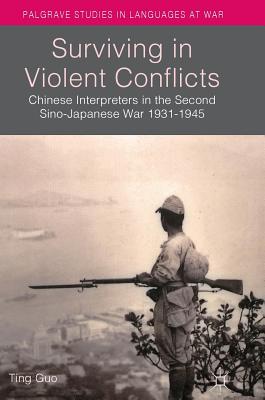
Surviving in Violent Conflicts : Chinese Interpreters in the Second Sino-Japanese War 1931–1945
1st ed. 2016
by
Ting Guo
Book Details
Format
Hardback
Book Series
Palgrave Studies in Languages at War
ISBN-10
1137461187
ISBN-13
9781137461186
Edition
1st ed. 2016
Publisher
Palgrave Macmillan
Imprint
Palgrave Macmillan
Country of Manufacture
GB
Country of Publication
GB
Publication Date
Oct 18th, 2016
Print length
200 Pages
Weight
414 grams
Dimensions
16.00 x 22.00 x 1.80 cms
KSh 8,100.00
Currently unavailable
0 in stock
Delivery Location
Delivery fee: Select location
Secure
Quality
Fast
This book examines the relatively little-known history of interpreting in the Second Sino-Japanese War (1931-45). Chapters within explore how Chinese interpreters were trained and deployed as an important military and political asset by competing domestic and international powers, including the Chinese Nationalist Government (Kuomingtang), the Chinese Communist Party and Japanese forces. Drawing from a wide range of sources, including archives in mainland China and Taiwan, memoirs and interviews with former military interpreters, it discusses how the interpreting profession was affected by shifts of foreign policy and how interpreters'' professional habitus was formed through their training and interaction with other social agents and institutions. By investigating individual interpreters'' career development and border-crossing strategies, it questions the assumption of interpreting as an exclusive profession and highlights interpreters'' active position-taking as a strategy of self-protection, a route to power, or just a chance of a better life.
Get Surviving in Violent Conflicts by Ting Guo at the best price and quality guaranteed only at Werezi Africa's largest book ecommerce store. The book was published by Palgrave Macmillan and it has 200 pages.
Customers Who Bought This Also Bought

Mansi
KSh 1,800.00

Hearing the Message of Ecclesiastes
KSh 2,350.00

How to Study the Bible''s Use of the Bible
KSh 5,400.00

NKJV Study Bible, Leathersoft, Purple, Full-Color, Thumb Indexed, Comfort Print
KSh 14,750.00
Experiences in Translation
KSh 3,600.00

The Gruffalo Latin Edition
KSh 2,700.00
Thinking Through Translation
KSh 5,050.00

The Mirror of Death
KSh 5,400.00

Ethics of Generative AI in Translation
KSh 30,950.00

The Impossible Teachings of Jesus
KSh 3,600.00

Research Methods in Interpreting
KSh 18,000.00

Modern Game Localization
KSh 9,900.00
More by Ting Guo

X-ray Nanochemistry
KSh 21,600.00

X-ray Nanochemistry
KSh 16,200.00

Religion, Secularism, and Love as a Political Discourse in Modern China
KSh 8,650.00

Data Analytics for Smart Infrastructure
KSh 9,900.00

Religion, Secularism, and Love as a Political Discourse in Modern China
KSh 22,500.00

Data Analytics for Smart Infrastructure
KSh 12,400.00
