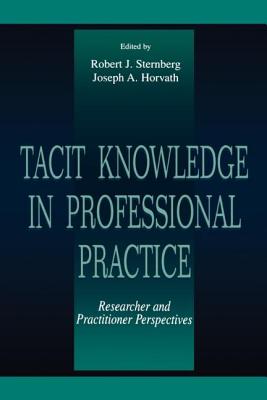
Tacit Knowledge in Professional Practice : Researcher and Practitioner Perspectives
Book Details
Format
Paperback / Softback
ISBN-10
0805824367
ISBN-13
9780805824360
Publisher
Taylor & Francis Inc
Imprint
Psychology Press
Country of Manufacture
GB
Country of Publication
GB
Publication Date
Feb 1st, 1999
Print length
268 Pages
Weight
374 grams
Dimensions
23.10 x 15.30 x 2.10 cms
Product Classification:
LearningIndustrial or vocational training
Ksh 9,550.00
Werezi Extended Catalogue
Delivery in 28 days
Delivery Location
Delivery fee: Select location
Delivery in 28 days
Secure
Quality
Fast
This book, which pairs theoretical and applied perspectives on a variety of professions, reveals just how much successful professionals rely on largely unarticulated knowledge. For business, education, and psychology professionals and students.
Those responsible for professional development in public and private-sector organizations have long had to deal with an uncomfortable reality. Billions of dollars are spent on formal education and training directed toward the development of job incumbents, yet the recipients of this training spend all but a fraction of their working life outside the training room--in meetings, on the shop floor, on the road, or in their offices. Faced with the need to promote "continuous learning" in a cost-effective manner, trainers, consultants, and educators have sought to develop ways to enrich the instructional and developmental potential of job assignments--to understand and facilitate the "lessons of experience."
Not surprisingly, social and behavioral scientists have weighed in on the subject of on-the-job learning, and one message of their research is quite clear. This message is that much of the knowledge people use to succeed on the job is acquired implicitly--without intention to learn or awareness of having learned. The common language of the workplace reflects an awareness of this fact as people speak of learning "by doing" or "by osmosis" and of professional "instinct" or "intuition." Psychologists, more careful if not clearer in their choice of words, refer to learning without intention or awareness as "implicit learning" and refer to the knowledge that results from this learning as "tacit knowledge."
Tacit Knowledge in Professional Practice explores implicit learning and tacit knowledge as they manifest themselves in the practice of six knowledge-intensive professions, and considers the implications of a tacit-knowledge approach for increasing the instructional and developmental impact of work experiences. This volume brings together distinguished practitioners and researchers in each of the six disciplines to discuss their own research and/or professional experience and to engage each other''s views. It addresses professional practice in its totality -- from the technical to the interpersonal to the crassly commercial -- not simply a few aspects of practice that lend themselves to controlled study. Finally, this edited volume seeks to go beyond the enumeration of critical experiences to an understanding of the psychological mechanisms that underlie learning from experience in professional disciplines and, in so doing, to lay a foundation for innovations in professional education and training.
Not surprisingly, social and behavioral scientists have weighed in on the subject of on-the-job learning, and one message of their research is quite clear. This message is that much of the knowledge people use to succeed on the job is acquired implicitly--without intention to learn or awareness of having learned. The common language of the workplace reflects an awareness of this fact as people speak of learning "by doing" or "by osmosis" and of professional "instinct" or "intuition." Psychologists, more careful if not clearer in their choice of words, refer to learning without intention or awareness as "implicit learning" and refer to the knowledge that results from this learning as "tacit knowledge."
Tacit Knowledge in Professional Practice explores implicit learning and tacit knowledge as they manifest themselves in the practice of six knowledge-intensive professions, and considers the implications of a tacit-knowledge approach for increasing the instructional and developmental impact of work experiences. This volume brings together distinguished practitioners and researchers in each of the six disciplines to discuss their own research and/or professional experience and to engage each other''s views. It addresses professional practice in its totality -- from the technical to the interpersonal to the crassly commercial -- not simply a few aspects of practice that lend themselves to controlled study. Finally, this edited volume seeks to go beyond the enumeration of critical experiences to an understanding of the psychological mechanisms that underlie learning from experience in professional disciplines and, in so doing, to lay a foundation for innovations in professional education and training.
Get Tacit Knowledge in Professional Practice by at the best price and quality guaranteed only at Werezi Africa's largest book ecommerce store. The book was published by Taylor & Francis Inc and it has pages.