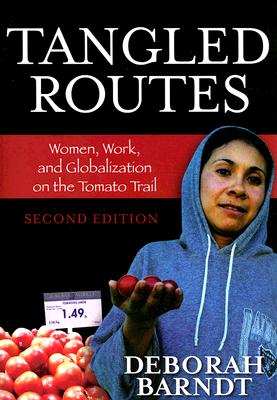
Tangled Routes : Women, Work, and Globalization on the Tomato Trail
Book Details
Format
Paperback / softback
ISBN-10
0742555577
ISBN-13
9780742555570
Publisher
Bloomsbury Publishing Plc
Imprint
Rowman & Littlefield
Country of Manufacture
GB
Country of Publication
GB
Publication Date
Dec 6th, 2007
Print length
360 Pages
Weight
670 grams
Dimensions
25.50 x 17.80 x 2.70 cms
Product Classification:
GlobalizationGender studies: women and girlsGlobalizationGender studies: women
KSh 9,900.00
Currently unavailable
0 in stock
Delivery Location
Delivery fee: Select location
Secure
Quality
Fast
Now in a thoroughly revised and updated edition, Tangled Routes offers a vivid interdisciplinary examination of the global food system through the journey of a corporate tomato. Through case studies in the three NAFTA countries-Mexico, the United States, and Canada-Deborah Barndt examines the dynamic relationships between production and consumption, work and technology, biodiversity and cultural diversity, and health and environment. The compelling stories of women workers along the tomato trail humanize her analysis of globalization, taking into account the intersections of gender, race, class, family status, and north-south relations.
What consumers have both an obligation and a right to know about where their food comes from and what it means.
This book is an original contribution to the vast literature on globalization, providing a timely, relevant analysis as well as a set of creative and concrete strategies to challenge industrial agricultural practices. Activists and students alike will gain much from it.
The author examines concepts old and new in an innovative, creative, and thoroughly engaging manner by mixing a strong writing style with a series of contextualising photographs. . . . An excellent interdisciplinary text that is equally useful inside and outside the classroom.
Describes in vivid detail the intricate path of the commodified tomato from the agricultural fields of the South to the fast-food restaurants and supermarkets of the North.
This is a detailed, ethnographically rich text for undergraduates. The feminist and ecological perspectives are clear and compelling. The book also fits nicely as a case study for the world capitalist system and food as commodity. This is the final work I assign in my food and culture class because it summarizes and applies so many of the course theories and concepts in a single case that students are able to use to discuss a variety of issues.
Who could believe that the story of a tomato''s northward journey could reveal the true heart of corporate globalization? Women, that''s who. Women whose toil speeds the journey and whose stories leap off the page to touch our hearts and our consciousness. Deborah Barndt''s Tangled Routes is a wonderful and important book.
The life histories of the women workers are insightful and compelling, and . . . the photographs are superb.
Tangled Routes caught my attention when I decided that I really needed to add a more global perspective to my course. It offers the unique opportunity to follow a single product across space and time and introduces globalization from above and below. This approach allows both sides to be seen clearly, demonstrating that some of the issues do not have simple answers. The connection of women to globalization, not only through agriculture but through world production in general, is also a real plus. The photographs are wonderful, and the activist pieces at the ends of the chapters offer students some concrete examples for responding to a corporate world.
With Tangled Routes, Deborah Barndt pioneers a method for demystifying the technologies of globalization with an extraordinarily well-crafted and lively ethnography of the transnational tomato chain. Along the way, we encounter not only the women working the fields, factories, and fast-food outlets but also the variety of survival practices and resistances that constitute ''globalization from below.'' These compelling stories counterpoint the spatial and social abstractions of the genetically engineered corporate tomato, its neoliberal trade regime, and its flexible workplaces. Barndt''s coherent framing of a series of situational accounts models an understanding of the underside of globalization that is instructive, empowering, and richly textured.
The strengths of this book are its organization and clarity, its skillful interweaving of global processes and local realities, and its attention to methodology. I definitely plan to use it again in my international studies course.
Get Tangled Routes by Deborah Barndt at the best price and quality guaranteed only at Werezi Africa's largest book ecommerce store. The book was published by Bloomsbury Publishing Plc and it has 360 pages.
Customers Who Bought This Also Bought

Age of Revolutions
KSh 2,350.00

New Confessions of an Economic Hit Man
KSh 2,700.00

Good Economics for Hard Times
KSh 2,350.00

Winners Take All
KSh 2,350.00

Progress
KSh 3,950.00

No Logo
KSh 2,000.00

World is Flat
KSh 3,050.00

Mouth Full of Blood
KSh 2,350.00

Straight Talk on Trade – Ideas for a Sane World Economy
KSh 2,900.00
Globalization and Its Discontents
KSh 2,500.00

Globalisation, Democracy And Terrorism
KSh 2,350.00

Decolonising My Body
KSh 2,350.00