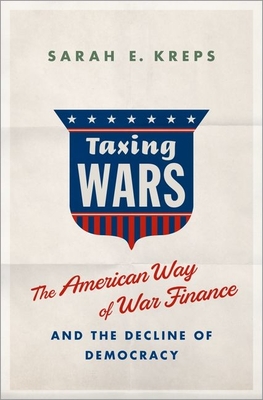
Taxing Wars : The American Way of War Finance and the Decline of Democracy
by
Sarah Kreps
Book Details
Format
Hardback
ISBN-10
019086530X
ISBN-13
9780190865306
Publisher
Oxford University Press Inc
Imprint
Oxford University Press Inc
Country of Manufacture
US
Country of Publication
GB
Publication Date
Jul 26th, 2018
Print length
336 Pages
Weight
590 grams
Dimensions
16.70 x 24.20 x 3.20 cms
Product Classification:
Political science & theoryTerrorism, armed struggleArmed conflictWarfare & defencePublic finance
KSh 7,500.00
Currently unavailable
0 in stock
Delivery Location
Delivery fee: Select location
Secure
Quality
Fast
In Taxing Wars, Sarah Kreps identifies that the deterioration of decision-making accountability with regard to war in the second half of the twentieth century has allowed leaders to wage increasingly costly and protracted wars. And because the health of a democracy can be measured by how responsive leaders are to an informed and attentive public in times of war, our current practices suggest that we are edging ever closer to how non-democracies conduct war.
Shortly after speaking with a bullhorn amidst the still-smoking wreckage at the World Trade Center site, President George W. Bush urged Americans to ''get down to Disney World in Florida...take your families and enjoy life, the way we want it to be enjoyed.'' Americans, he implied, should not merely offer sacrifices but return to normalcy. Consistent with this anecdote, his administration cut taxes, and held of efforts by a renegade group of anti-war Congress members to introduce a ''share the sacrifice'' war tax for Iraq in 2007. According to the tax''s opponents, Americans were already being ''taxed to death.'' The ultimate result of all of this is that the government has financed the wars in Iraq and Afghanistan entirely through borrowing. As Sarah Kreps shows in Taxing Wars, the type of debt financing for war that we have seen since 9/11 could not have been more different from earlier experiences when wars meant taxation. For instance, in 1914-three years before America''s direct involvement in World War I-President Wilson urged war taxes as a way to fund defense preparations. Indeed, the Wilson Administration levied a series of war taxes before, during, and after the war, amounting to about one-third of the war''s costs. Why, when Wilson was aiming to recruit rather than repel support for the war, did he introduce measures such as a hefty war tax that recent leaders have considered politically toxic? Why was the public so magnanimous in its willingness to contribute its own resources? By contrast, why did leaders not use the crisis of war, often used as entrées for introducing war taxes in the past, in the aftermath of 9/11 to extract resources from the populace in a way that been customary in the past? More generally, what explains shifting attitudes towards bearing the financial burden of war and the move away from war taxes, and the consequences of that shift? Kreps argues that the starkly different approaches are the result of public attitudes towards wartime fiscal sacrifice that vary depending on the underlying type of war and state-society relations. The public accepted the sacrifices that the state demanded during the two world wars, an effect of both the nature of those wars and the public''s more favorable views toward government in that era. However, when these factors combine to make the public cost sensitive, leaders have pursued forms of war finance that anticipate opposition and minimize constraints on the way they use force. In post-1945 wars, the public has become almost uniformly unforgiving of fiscal sacrifice, which explains leaders'' increased tendency to rely on less visible forms of finance such as borrowing. The lack of visibility has had an important knock-on effect too: Leaders have been able to increasingly operate without the type of decision-making constraints that were present in earlier war efforts which depended upon broader levels of public support. Her ultimate conclusion is both sobering and extremely important: the deterioration of decision-making accountability with regard to war in the second half of the twentieth century has allowed leaders to wage increasingly costly and protracted wars. And because the health of a democracy can be measured by how responsive leaders are to an informed and attentive public in times of war, our current practices suggest that we are edging ever closer to how non-democracies conduct war.
Get Taxing Wars by Sarah Kreps at the best price and quality guaranteed only at Werezi Africa's largest book ecommerce store. The book was published by Oxford University Press Inc and it has 336 pages.
Customers Who Bought This Also Bought
Message
KSh 3,400.00

Corruptible
KSh 2,350.00

On War
KSh 1,200.00

Abundance
KSh 2,150.00

The Republic
KSh 2,350.00
What Happened to Liberal Democracy?
KSh 3,050.00

Pedagogy of the Oppressed
KSh 2,000.00

Great Ideas Social Contract
KSh 1,450.00

Fire Next Time; Nobody Knows My Name ; No Name In The Street; The Devil Finds Work
KSh 3,400.00

The Body Politic
KSh 700.00

The Prince The Original Classic
KSh 2,150.00
The Fourth Turning Is Here
KSh 2,600.00