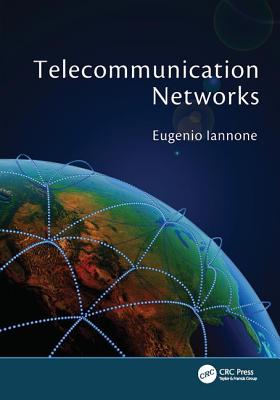
Telecommunication Networks
Book Details
Delivery Location
Delivery fee: Select location
Many argue that telecommunications network infrastructure is the most impressive and important technology ever developed. Analyzing the telecom market’s constantly evolving trends, research directions, infrastructure, and vital needs, Telecommunication Networks responds with revolutionized engineering strategies to optimize network construction.
Omnipresent in society, telecom networks integrate a wide range of technologies. These include quantum field theory for the study of optical amplifiers, software architectures for network control, abstract algebra required to design error correction codes, and network, thermal, and mechanical modeling for equipment platform design.
Illustrating how and why network developers make technical decisions, this book takes a practical engineering approach to systematically assess the network as a whole—from transmission to switching. Emphasizing a uniform bibliography and description of standards, it explores existing technical developments and the potential for projected alternative architectural paths, based on current market indicators.
The author characterizes new device and equipment advances not just as quality improvements, but as specific responses to particular technical market necessities. Analyzing design problems to identify potential links and commonalities between different parts of the system, the book addresses interdependence of these elements and their individual influence on network evolution. It also considers power consumption and real estate, which sometimes outweigh engineering performance data in determining a product’s success.
To clarify the potential and limitations of each presented technology and system analysis, the book includes quantitative data inspired by real products and prototypes. Whenever possible, it applies mathematical modeling to present measured data, enabling the reader to apply demonstrated concepts in real-world situations. Covering everything from high-level architectural elements to more basic component physics, its focus is to solve a problem from different perspectives, and bridge descriptions of well-consolidated solutions with newer research trends.
Get Telecommunication Networks by Eugenio Iannone at the best price and quality guaranteed only at Werezi Africa's largest book ecommerce store. The book was published by Taylor & Francis Inc and it has 918 pages.
Customers Who Bought This Also Bought

Quantum Optics
KSh 10,800.00

Principles of Diffuse Light Propagation
KSh 20,700.00

Light Spectroscopy
KSh 10,450.00

3D Spectroscopy in Astronomy
KSh 24,650.00

Optics in the Age of Euler
KSh 17,100.00

Electromagnetic Noise and Quantum Optical Measurements
KSh 18,000.00

Light Scattering by Ice Crystals
KSh 26,450.00

Ceramics, Glass and Glass-Ceramics
KSh 25,200.00
Schrödinger’s Web
KSh 37,800.00

Observation and Control of Magnetic Order Dynamics by Terahertz Magnetic Nearfield
KSh 25,200.00

Non-perturbative Renormalization Group Approach to Some Out-of-Equilibrium Systems
KSh 16,200.00
Electromagnetic Optics of Thin-Film Coatings
KSh 13,550.00