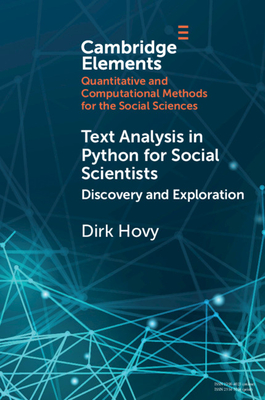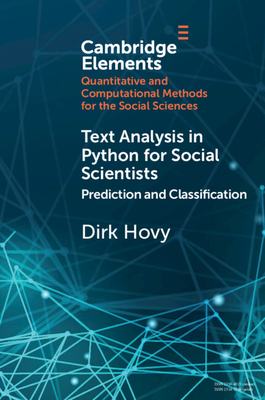
Text Analysis in Python for Social Scientists : Prediction and Classification
by
Dirk Hovy
Book Details
Format
Paperback / softback
ISBN-10
1108958508
ISBN-13
9781108958509
Publisher
Cambridge University Press
Imprint
Cambridge University Press
Country of Manufacture
GB
Country of Publication
GB
Publication Date
Mar 17th, 2022
Print length
102 Pages
Weight
160 grams
Dimensions
15.20 x 22.70 x 1.00 cms
Product Classification:
Data capture & analysisData capture and analysis
KSh 3,250.00
Currently unavailable
0 in stock
Delivery Location
Delivery fee: Select location
Secure
Quality
Fast
This Element provides the working social scientist with an overview of the most common methods for text classification, an intuition of their applicability, and Python code to execute them. It covers both the ethical foundations of such work as well as the emerging potential of neural network methods.
Text contains a wealth of information about about a wide variety of sociocultural constructs. Automated prediction methods can infer these quantities (sentiment analysis is probably the most well-known application). However, there is virtually no limit to the kinds of things we can predict from text: power, trust, misogyny, are all signaled in language. These algorithms easily scale to corpus sizes infeasible for manual analysis. Prediction algorithms have become steadily more powerful, especially with the advent of neural network methods. However, applying these techniques usually requires profound programming knowledge and machine learning expertise. As a result, many social scientists do not apply them. This Element provides the working social scientist with an overview of the most common methods for text classification, an intuition of their applicability, and Python code to execute them. It covers both the ethical foundations of such work as well as the emerging potential of neural network methods.
Get Text Analysis in Python for Social Scientists by Dirk Hovy at the best price and quality guaranteed only at Werezi Africa's largest book ecommerce store. The book was published by Cambridge University Press and it has 102 pages.
Customers Who Bought This Also Bought

Product Operations
KSh 4,500.00
Analyzing Sensory Data With R
KSh 26,300.00

Data Clustering in C++
KSh 30,950.00

Elementary Statistics
KSh 20,350.00
Spark – The Definitive Guide
KSh 10,100.00

Francese-italiano, italiano-«patois»: il bilinguismo in Valle d’Aosta fra realtà e ideologia
KSh 15,500.00

Proceedings of the 2nd International Conference on Green Communications and Networks 2012 (GCN 2012)
KSh 45,000.00

Linear and Integer Programming Made Easy
KSh 9,900.00
Formal SQL Tuning for Oracle Databases
KSh 9,000.00

Innovations in Data Analytics
KSh 32,400.00

Beobachtungsmoglichkeiten im Domain Name System
KSh 9,900.00

The Palgrave Handbook of Survey Research
KSh 36,000.00