
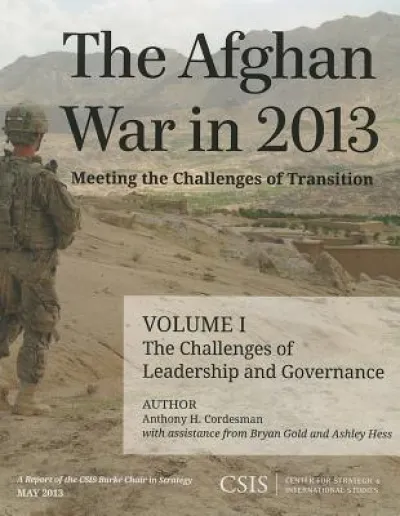
The Afghan War in 2013: Meeting the Challenges of Transition : The Challenges of Leadership and Governance
Book Details
Format
Paperback / Softback
Book Series
CSIS Reports
ISBN-10
1442224975
ISBN-13
9781442224971
Publisher
Centre for Strategic & International Studies,U.S.
Imprint
Centre for Strategic & International Studies,U.S.
Country of Manufacture
US
Country of Publication
GB
Publication Date
May 28th, 2013
Print length
56 Pages
Weight
191 grams
Dimensions
28.10 x 21.30 x 0.40 cms
Product Classification:
Afghan WarInternational relationsTerrorism, armed struggle
Ksh 10,600.00
Re-Printing
0 in stock
Delivery Location
Delivery fee: Select location
Secure
Quality
Fast
After more than a decade of fighting in Afghanistan, the United States and its allies are set to transfer security responsibilities to Afghan forces in 2014. This transition poses many challenges, and much will depend on the future of Afghan politics, governance, corruption, development, security, and economics. How the United States manages the transition is vital for any hopes of creating a secure Afghanistan, as well as preventing the reemergence of the Taliban and other terrorist groups. The Afghan War in 2013 honestly assesses the benefits, costs, and risks involved in transition. It is essential reading for an in-depth understanding of the complex forces and intricacies of the United States’ role in Afghanistan and the difficulties involved in creating a stable Afghanistan in 2014 and beyond. Afghanistan is still at war and will probably be at war long after 2014. At the same time, the coming cuts in the International Security Assistance Force (ISAF) and cuts in military and civil aid, along with the country’s fractious politics and insecurity, will interact with a wide range of additional factors that threaten to derail the transition. These factors, examined in this three-volume study, highlight the need to make the internal political, governmental, economic, and security dimensions of the transition as effective as possible. This will require a new degree of realism about what the Afghans can and cannot accomplish, about the best approaches to shaping the Afghan National Security Forces (ANSF), and the need for better planned and managed outside aid.
After more than a decade of fighting in Afghanistan, the United States and its allies are set to transfer security responsibilities to Afghan forces in 2014. This transition poses many challenges, and much will depend on the future of Afghan politics, governance, corruption, development, security, and economics. How the United States manages the transition is vital for any hopes of creating a secure Afghanistan, as well as preventing the reemergence of the Taliban and other terrorist groups. The Afghan War in 2013 honestly assesses the benefits, costs, and risks involved in transition. It is essential reading for an in-depth understanding of the complex forces and intricacies of the United States’ role in Afghanistan and the difficulties involved in creating a stable Afghanistan in 2014 and beyond. Afghanistan is still at war and will probably be at war long after 2014. At the same time, the coming cuts in the International Security Assistance Force (ISAF) and cuts in military and civil aid, along with the country’s fractious politics and insecurity, will interact with a wide range of additional factors that threaten to derail the transition. These factors, examined in this three-volume study, highlight the need to make the internal political, governmental, economic, and security dimensions of the transition as effective as possible. This will require a new degree of realism about what the Afghans can and cannot accomplish, about the best approaches to shaping the Afghan National Security Forces (ANSF), and the need for better planned and managed outside aid.
Get The Afghan War in 2013: Meeting the Challenges of Transition by at the best price and quality guaranteed only at Werezi Africa's largest book ecommerce store. The book was published by Centre for Strategic & International Studies,U.S. and it has pages.

