
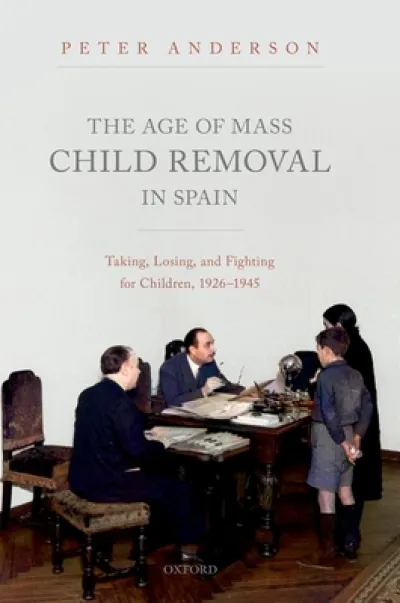
The Age of Mass Child Removal in Spain : Taking, Losing, and Fighting for Children, 1926-1945
Book Details
Format
Hardback or Cased Book
ISBN-10
0192844571
ISBN-13
9780192844576
Publisher
Oxford University Press
Imprint
Oxford University Press
Country of Manufacture
GB
Country of Publication
GB
Publication Date
Nov 23rd, 2021
Print length
284 Pages
Weight
632 grams
Dimensions
16.40 x 24.00 x 2.80 cms
Product Classification:
European history20th century history: c 1900 to c 2000Social & cultural history
Ksh 20,950.00
Werezi Extended Catalogue
0 in stock
Delivery Location
Delivery fee: Select location
Secure
Quality
Fast
This book examines the ideas and practices underpinning state removal of children. Early twentieth century Spanish juvenile courts were involved in taking children from poor families, families displaced by war, and from political opponents. This study captures the voice and agency of the marginalized children and parents affected by mass removals.
The Age of Mass Child Removal in Spain analyses the ideas and practices that underpinned the age of mass child removal. This era emerged from growing criticisms across the world of ''dangerous'' parents and the developing belief in the nineteenth century that the state could provide superior guardianship to ''unfit'' parents. In the late nineteenth century, the juvenile-court movement led the way in forging a new and more efficient system of child removal that severely curtailed the previously highly protected sovereignty of guardians deemed dangerous. This transnational movement rapidly established courts across the world and used them to train the personnel and create the systems that frequently lay behind mass child removal. Spaniards formed a significant part of this transnational movement and the country''s juvenile courts became involved in the three main areas of removal that characterize the age: the taking of children from poor families, from families displaced by war, and from political opponents. The study of Spanish case files reveals much about how the removal process worked in practice across time and across democratic regimes and dictatorships. These cases also afford an insight into the rich array of child-removal practices that lay between the poles of coercion and victimhood. Accordingly, the study offers a history of some of most marginalized parents and children and recaptures their voice, agency, and experience. Peter Anderson also analyses the removal of tens of thousands of children from General Franco''s political opponents, sometimes referred to as the lost children of Francoism, through the history and practice of the juvenile courts.
Get The Age of Mass Child Removal in Spain by at the best price and quality guaranteed only at Werezi Africa's largest book ecommerce store. The book was published by Oxford University Press and it has pages.

