
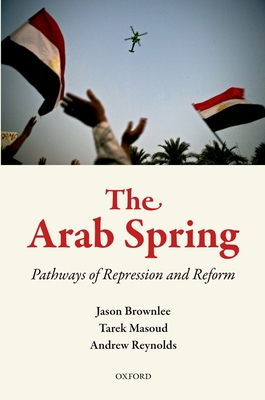
The Arab Spring : Pathways of Repression and Reform
Book Details
Format
Paperback / softback
ISBN-10
0199660077
ISBN-13
9780199660070
Publisher
Oxford University Press
Imprint
Oxford University Press
Country of Manufacture
GB
Country of Publication
GB
Publication Date
Feb 19th, 2015
Print length
340 Pages
Weight
532 grams
Dimensions
23.60 x 15.50 x 2.40 cms
KSh 7,400.00
Currently unavailable
0 in stock
Delivery Location
Delivery fee: Select location
Secure
Quality
Fast
Several years after the Arab Spring began, democracy remains elusive in the Middle East. While Tunisia has made progress towards democracy, other countries that overthrew their rulers - Egypt, Yemen, and Libya - remain in authoritarianism and instability. This volume provides a foundational exploration of the Arab Spring's successes and failures.
Several years after the Arab Spring began, democracy remains elusive in the Middle East. The Arab Spring that resides in the popular imagination is one in which a wave of mass mobilization swept the broader Middle East, toppled dictators, and cleared the way for democracy. The reality is that few Arab countries have experienced anything of the sort. While Tunisia made progress towards some type of constitutionally entrenched participatory rule, the other countries that overthrew their rulersEgypt, Yemen, and Libyaremain mired in authoritarianism and instability. Elsewhere in the Arab world uprisings were suppressed, subsided or never materialized. The Arab Springs modest harvest cries out for explanation. Why did regime change take place in only four Arab countries and why has democratic change proved so elusive in the countries that made attempts? This book attempts to answer those questions. First, by accounting for the full range of variance: from the absence or failure of uprisings in such places as Algeria and Saudi Arabia at one end to Tunisias rocky but hopeful transition at the other. Second, by examining the deep historical and structure variables that determined the balance of power between incumbents and opposition. Brownlee, Masoud, and Reynolds find that the success of domestic uprisings depended on the absence of a hereditary executive and a dearth of oil rents. Structural factors also cast a shadow over the transition process. Even when opposition forces toppled dictators, prior levels of socioeconomic development and state strength shaped whether nascent democracy, resurgent authoritarianism, or unbridled civil war would follow.
Get The Arab Spring by Andrew Reynolds, Jason Brownlee at the best price and quality guaranteed only at Werezi Africa's largest book ecommerce store. The book was published by Oxford University Press and it has 340 pages.
Customers Who Bought This Also Bought

History of the Arab Peoples
KSh 2,700.00

Black Wave
KSh 2,700.00

My Promised Land
KSh 3,400.00

The Hundred Years'' War on Palestine
KSh 2,150.00

The Ethnic Cleansing of Palestine
KSh 2,350.00

Letters to My Palestinian Neighbor
KSh 3,400.00

Question of Palestine
KSh 2,700.00

Palestine
KSh 2,400.00

King of Kings
KSh 4,500.00

Recognising the Stranger
KSh 1,800.00

The Idea of Israel
KSh 2,700.00

Israel on the Brink
KSh 2,350.00
More by Andrew Reynolds, Jason Brownlee

Los Llaneros
KSh 7,000.00

Force Without Authority
KSh 3,750.00

Authoritarianism in an Age of Democratization
KSh 4,950.00

Later Anglo-Saxon England
KSh 2,900.00

Counting Islam
KSh 5,100.00

Electoral Systems and Conflict in Divided Societies
KSh 20,150.00
The Arab Spring
KSh 25,600.00

Democracy Prevention
KSh 5,100.00

The Spanish American Cronica Modernista, Temporality and Material Culture
KSh 18,350.00

Life and Landscape in Later Anglo-Saxon England
KSh 3,600.00

The Children of Harvey Milk
KSh 12,650.00

The Children of Harvey Milk
KSh 3,050.00
