
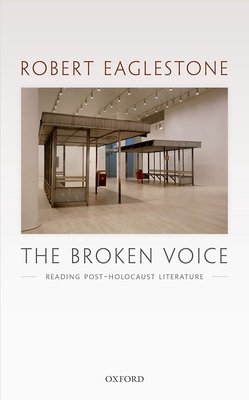
The Broken Voice : Reading Post-Holocaust Literature
Book Details
Format
Hardback
ISBN-10
0198778368
ISBN-13
9780198778363
Publisher
Oxford University Press
Imprint
Oxford University Press
Country of Manufacture
GB
Country of Publication
GB
Publication Date
Jun 8th, 2017
Print length
196 Pages
Weight
382 grams
Dimensions
14.50 x 22.30 x 2.10 cms
Product Classification:
Literary studies: from c 1900 -Literary studies: fiction, novelists & prose writersThe Holocaust
KSh 14,400.00
Currently unavailable
0 in stock
Delivery Location
Delivery fee: Select location
Secure
Quality
Fast
Robert Eaglestone explores the interweaving of complicity, responsibility, temporality, and the often problematic powers of narrative which make up some part of the legacy of the Holocaust. He examines a range of texts by significant writers, as well as work by victims and perpetrators of the Holocaust and of atrocities in Africa.
''Which writer today is not a writer of the Holocaust?'' asked the late Imre Kertész, Hungarian survivor and novelist, in his Nobel acceptance speech: ''one does not have to choose the Holocaust as one''s subject to detect the broken voice that has dominated modern European art for decades''. Robert Eaglestone attends to this broken voice in literature in order to explore the meaning of the Holocaust in the contemporary world, arguing, again following Kertész, that the Holocaust will ''remain through culture, which is really the vessel of memory''. Drawing on the thought of Hannah Arendt, Eaglestone identifies and develops five concepts--the public secret, evil, stasis, disorientalism, and kitsch--in a range of texts by significant writers (including Kazuo Ishiguro, Jonathan Littell, Imre Kertész, W. G. Sebald, and Joseph Conrad) as well as in work by victims and perpetrators of the Holocaust and of atrocities in Africa. He explores the interweaving of complicity, responsibility, temporality, and the often problematic powers of narrative which make up some part of the legacy of the Holocaust.
Get The Broken Voice by Robert Eaglestone at the best price and quality guaranteed only at Werezi Africa's largest book ecommerce store. The book was published by Oxford University Press and it has 196 pages.
Customers Who Bought This Also Bought
Dreams in a Time of War
KSh 3,050.00
Modern Classics Penguin Essays of George Orwell
KSh 2,700.00
On Writing
KSh 2,000.00

To the Lighthouse
KSh 1,450.00
On Morrison
KSh 4,500.00

Africa''s Tarnished Name
KSh 700.00
C. S. Lewis
KSh 1,800.00

Life in Letters
KSh 5,400.00

By Grand Central Station I
KSh 1,800.00
Wide Sargasso Sea
KSh 1,800.00

Mom and Me and Mom
KSh 2,000.00
Jorge Luis Borges
KSh 1,800.00
More by Robert Eaglestone
Literature – Why It Matters
KSh 6,300.00
Ethical Criticism
KSh 6,100.00

Classical Philosophers on Literature
KSh 3,350.00
The Holocaust and the Postmodern
KSh 9,650.00
Studying English
KSh 26,300.00
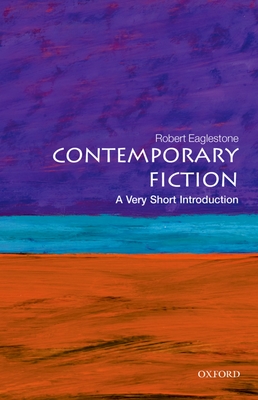
Contemporary Fiction
KSh 1,800.00
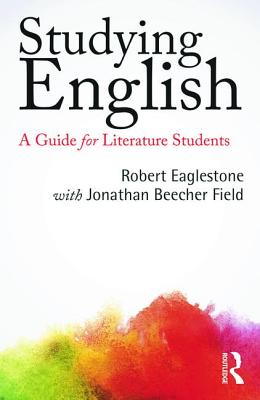
Studying English
KSh 5,750.00
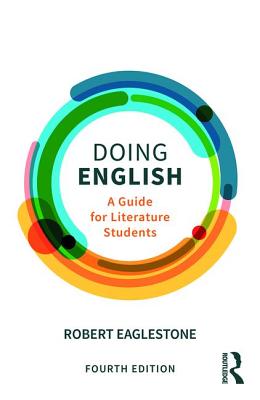
Doing English
KSh 4,500.00
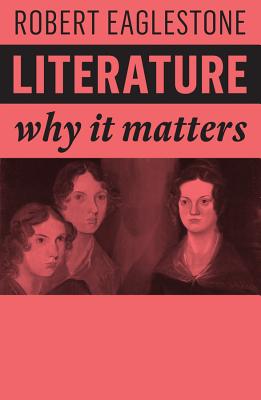
Literature – Why It Matters
KSh 1,800.00

Classical Philosophers on Literature
KSh 12,600.00
Truth and Wonder
KSh 30,950.00
Doing English
KSh 30,950.00
