
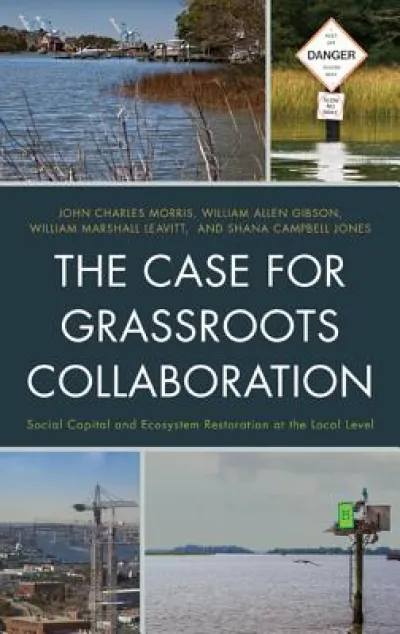
The Case for Grassroots Collaboration : Social Capital and Ecosystem Restoration at the Local Level
Book Details
Format
Paperback / Softback
ISBN-10
1498515339
ISBN-13
9781498515337
Publisher
Bloomsbury Publishing Plc
Imprint
Lexington Books
Country of Manufacture
GB
Country of Publication
GB
Publication Date
Mar 24th, 2015
Print length
284 Pages
Weight
418 grams
Dimensions
23.00 x 15.20 x 2.40 cms
Product Classification:
Central government policiesEnvironmental policy & protocolsConservation of the environment
Ksh 9,000.00
Manufactured on Demand
0 in stock
Delivery Location
Delivery fee: Select location
Secure
Quality
Fast
This book addresses the activities of three grassroots environmental collaborations in the Chesapeake Bay region. Citizen-based collaboration can be effective in ecosystem restoration when applied at the proper scale with appropriate levels of social capital and skilled conveners with well-defined goals.
The nation’s approach to managing environmental policy and protecting natural resources has shifted from the national government’s top down, command and control, regulatory approach, used almost exclusively in the 1970s, to collaborative, multi-sector approaches used in recent decades to manage problems that are generally too complex, too expensive,, and too politically divisive for one agency to manage or resolve on its own. Governments have organized multi-sector collaborations as a way to achieve better results for the past two decades. We know much about why collaboration occurs. We know a good deal about how collaborative processes work. Collaborations organized, led, and managed by grassroots organizations are rarer, though becoming more common. We do not as yet have a clear understanding of how they might differ from government led collaborations.Hampton Roads, Virginia, located at the southern end of the Chesapeake Bay, offers an unusual opportunity to study and draw comparative lessons from three grassroots environmental collaborations to restore three rivers in the watershed, in terms of how they build, organize and distribute social capital, deepen democratic values, and succeed in meeting ecosystem restoration goals and benchmarks. This is relevant for the entire Chesapeake Bay watershed, but is also relevant for understanding grassroots collaborative options for managing, protecting, and restoring watersheds throughout the U.S. It may also provide useful information for developing grassroots collaborations in other policy sectors.The premise underlying this work is that to continue making progress toward achieving substantive environmental outcomes in a world where the problems are complex, expensive, and politically divisive, more non-state stakeholders must be actively involved in defining the problems and developing solutions. This will require more multi-sector collaborations of the type that governments have increasingly relied on for the past two decades. Our approach examines one subset of environmental collaboration, those driven and managed by grassroots organizations that were established to address specific environmental problems and provide implementable solutions to those problems, so that we may draw lessons that inform other grassroots collaborative efforts.
Get The Case for Grassroots Collaboration by at the best price and quality guaranteed only at Werezi Africa's largest book ecommerce store. The book was published by Bloomsbury Publishing Plc and it has pages.

