
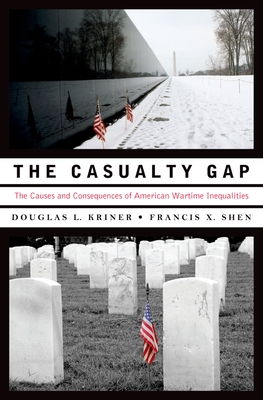
The Casualty Gap : The Causes and Consequences of American Wartime Inequalities
Book Details
Format
Hardback
ISBN-10
0195390962
ISBN-13
9780195390964
Publisher
Oxford University Press Inc
Imprint
Oxford University Press Inc
Country of Manufacture
GB
Country of Publication
GB
Publication Date
May 27th, 2010
Print length
320 Pages
Weight
596 grams
Dimensions
24.50 x 16.50 x 2.30 cms
KSh 8,150.00
Temporarily out of stock, due soon
0 in stock
Delivery Location
Delivery fee: Select location
Secure
Quality
Fast
Many have long suspected that when America takes up arms it is a rich man''s war, but a poor man''s fight. Despite these concerns about social inequality in military sacrifice, the hard data to validate such claims has been kept out of public view. In The Casualty Gap Douglas Kriner and Francis Shen renew the debate over unequal sacrifice by bringing to light mountains of new evidence on the inequality dimensions of American wartime casualties. They demonstrate unequivocally that since the conclusion of World War II communities at the lower end of the socioeconomic ladder have borne a disproportionate share of the human costs of war. Moreover, they show for the first time that when Americans are explicitly confronted with evidence of this inequality, they become markedly less supportive of the nation''s war efforts
Many have long suspected that when America takes up arms it is a rich man''s war, but a poor man''s fight. Despite these concerns about social inequality in military sacrifice, the hard data to validate such claims has been kept out of public view. In The Casualty Gap Douglas Kriner and Francis Shen renew the debate over unequal sacrifice by bringing to light mountains of new evidence on the inequality dimensions of American wartime casualties. They demonstrate unequivocally that since the conclusion of World War II communities at the lower end of the socioeconomic ladder have borne a disproportionate share of the human costs of war. Moreover, they show for the first time that when Americans are explicitly confronted with evidence of this inequality, they become markedly less supportive of the nation''s war efforts. The Casualty Gap also uncovers how wartime deaths affect entire communities. Citizens who see the high price war exacts on friends and neighbors become more likely to oppose war and to vote against the political leaders waging it than residents of low-casualty communities. Moreover, extensive empirical evidence connects higher community casualty rates in Korea and Vietnam to lower levels of trust in government, interest in politics, and electoral and non-electoral participation. In this way, the casualty gap threatens the very vibrancy of American democracy by depressing civic engagement in high-casualty communities for years after the last gun falls silent. The Casualty Gap should be read by all who care about bringing to light inequalities in military sacrifice and understanding the effects of war on society and democracy.
Get The Casualty Gap by Douglas Kriner, Francis Shen at the best price and quality guaranteed only at Werezi Africa's largest book ecommerce store. The book was published by Oxford University Press Inc and it has 320 pages.
Customers Who Bought This Also Bought
Message
KSh 3,400.00
Corruptible
KSh 2,350.00

On War
KSh 1,200.00

Abundance
KSh 2,150.00

The Republic
KSh 2,350.00
What Happened to Liberal Democracy?
KSh 3,050.00

Pedagogy of the Oppressed
KSh 2,000.00

Great Ideas Social Contract
KSh 1,450.00

Fire Next Time; Nobody Knows My Name ; No Name In The Street; The Devil Finds Work
KSh 3,400.00

The Body Politic
KSh 700.00

The Prince The Original Classic
KSh 2,150.00
The Fourth Turning Is Here
KSh 2,600.00
