
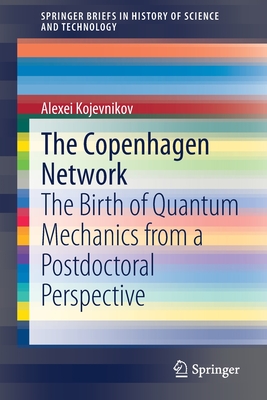
The Copenhagen Network : The Birth of Quantum Mechanics from a Postdoctoral Perspective
1st ed. 2020
Book Details
Format
Paperback / softback
ISBN-10
3030591875
ISBN-13
9783030591878
Edition
1st ed. 2020
Publisher
Springer Nature Switzerland AG
Imprint
Springer Nature Switzerland AG
Country of Manufacture
GB
Country of Publication
GB
Publication Date
Dec 3rd, 2020
Print length
126 Pages
KSh 9,000.00
Currently unavailable
0 in stock
Delivery Location
Delivery fee: Select location
Secure
Quality
Fast
This book is a historical analysis of the quantum mechanical revolution and the emergence of a new discipline from the perspective, not of a professor, but of a recent or actual Ph.D. student just embarking on an uncertain academic career in economically hard times. Quantum mechanics exploded on to the intellectual scene between 1925 and 1927, with more than 200 publications across the world, the majority of them authored by young scientists under the age of 30, graduate students or postdoctoral fellows. The resulting theory was a collective product that no single authority could claim, but it had a major geographical nod – the Copenhagen Institute of Theoretical Physics – where most of the informal, pre-published exchange of ideas occurred and where every participant of the new community aspired to visit. A rare combination of circumstances and resources – political, diplomatic, financial, and intellectual – allowed Niels Bohr to establish this “Mecca” of quantum theory outside of traditional and more powerful centres of science. Transitory international postdoctoral fellows, rather than established professors, developed a culture of research that became the source of major innovations in the field. Temporary assistantships, postdoctoral positions, and their equivalents were the chief mode of existence for young academics during the period of economic crisis and post-WWI international tensions. Insecure career trajectories and unpredictable moves through non-stable temporary positions contributed to their general outlook and interpretations of the emerging theory of quantum mechanics. This book is part of a four-volume collection addressing the beginnings of quantum physics research at the major European centres of Göttingen, Copenhagen, Berlin, and Munich; these works emerged from an expansive study on the quantum revolution as a major transformation of physical knowledge undertaken by the Max Planck Institute for the History of Science and the Fritz HaberInstitute (2006–2012). For more on this project, see the dedicated Feature Story, The Networks of Early Quantum Theory, at the Max Planck Institute for the History of Science, https://www.mpiwg-berlin.mpg.de/feature-story/networks-early-quantum-theory
This book is a historical analysis of the quantum mechanical revolution and the emergence of a new discipline from the perspective, not of a professor, but of a recent or actual Ph.D. student just embarking on an uncertain academic career in economically hard times. Quantum mechanics exploded on to the intellectual scene between 1925 and 1927, with more than 200 publications across the world, the majority of them authored by young scientists under the age of 30, graduate students or postdoctoral fellows. The resulting theory was a collective product that no single authority could claim, but it had a major geographical nod - the Copenhagen Institute of Theoretical Physics - where most of the informal, pre-published exchange of ideas occurred and where every participant of the new community aspired to visit. A rare combination of circumstances and resources - political, diplomatic, financial, and intellectual - allowed Niels Bohr to establish this "Mecca" of quantum theory outside of traditional and more powerful centres of science. Transitory international postdoctoral fellows, rather than established professors, developed a culture of research that became the source of major innovations in the field. Temporary assistantships, postdoctoral positions, and their equivalents were the chief mode of existence for young academics during the period of economic crisis and post-WWI international tensions. Insecure career trajectories and unpredictable moves through non-stable temporary positions contributed to their general outlook and interpretations of the emerging theory of quantum mechanics.This book is part of a four-volume collection addressing the beginnings of quantum physics research at the major European centres of Göttingen, Copenhagen, Berlin, and Munich; these works emerged from an expansive study on the quantum revolution as a major transformation of physical knowledge undertaken by the Max Planck Institute for the History of Science and the Fritz Haber Institute (2006-2012). For more on this project, see the dedicated Feature Story, The Networks of Early Quantum Theory, at the Max Planck Institute for the History of Science, https://www.mpiwg-berlin.mpg.de/feature-story/networks-early-quantum-theory
Get The Copenhagen Network by Alexei Kojevnikov at the best price and quality guaranteed only at Werezi Africa's largest book ecommerce store. The book was published by Springer Nature Switzerland AG and it has 126 pages.
Customers Who Bought This Also Bought
The Poetics of Space
KSh 2,700.00

Origin of Species
KSh 1,850.00

Arrogant Ape
KSh 3,050.00

Classics Origin of Species
KSh 1,100.00
The Structure of Scientific Revolutions – 50th Anniversary Edition
KSh 2,850.00

Xrepublic
KSh 850.00

Xrepublic
KSh 1,450.00

Theory of Scientific Method
KSh 4,300.00

Vocation Lectures
KSh 2,900.00

Kinship: Vol. 5 Practice
KSh 3,250.00

Thinking Beyond Materialism
KSh 3,400.00

Thinking Beyond Materialism
KSh 15,550.00
