
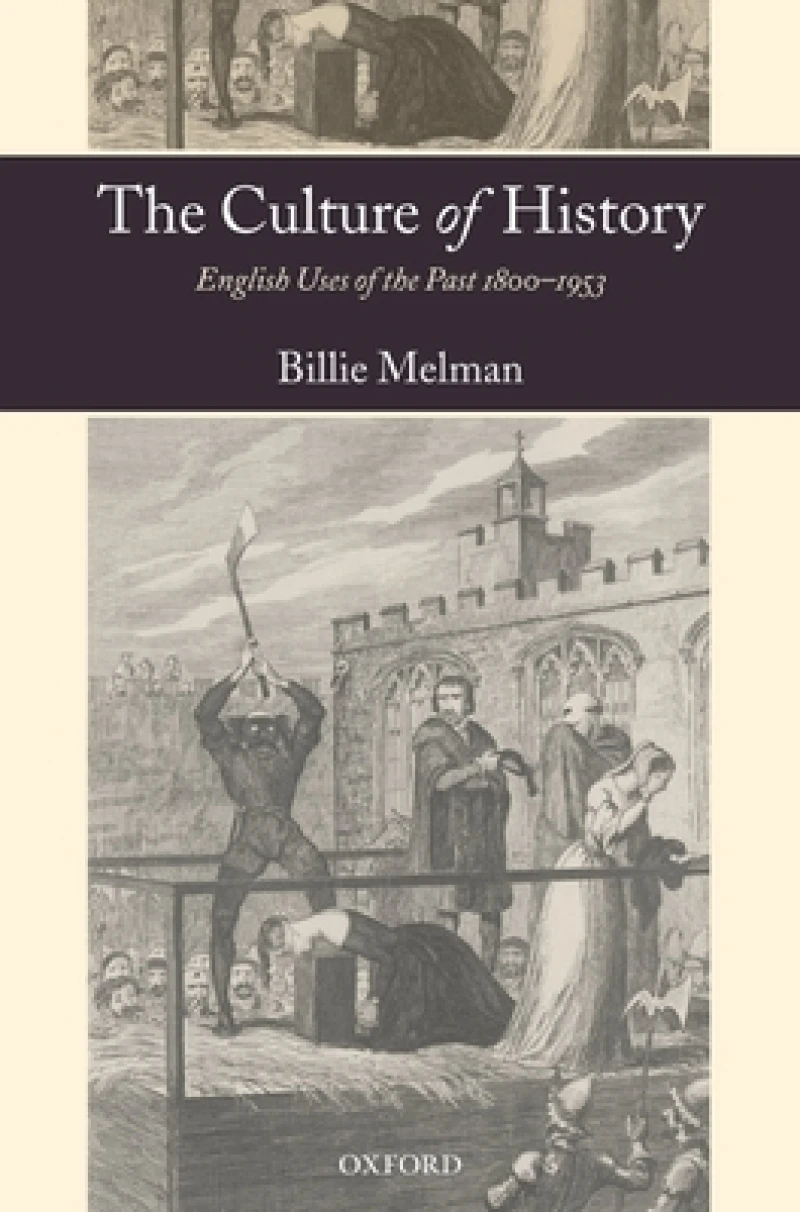
The Culture of History : English Uses of the Past 1800-1953
Book Details
Format
Hardback or Cased Book
ISBN-10
019929688X
ISBN-13
9780199296880
Publisher
Oxford University Press
Imprint
Oxford University Press
Country of Manufacture
GB
Country of Publication
GB
Publication Date
Jun 22nd, 2006
Print length
378 Pages
Weight
771 grams
Dimensions
24.20 x 16.30 x 2.50 cms
Ksh 36,450.00
Manufactured on Demand
0 in stock
Delivery Location
Delivery fee: Select location
Secure
Quality
Fast
Billie Melman takes us on a panoramic voyage of the 'culture of history' which developed in England after the French Revolution. She vividly recovers unexplored aspects of popular history, and unpicks notions of the uncosy past, a place of pleasurable horror and sensationalism, which survived into the 1950s.
In this original and widely researched book, Billie Melman explores the culture of history during the age of modernity. Her book is about the production of English pasts, the multiplicity of their representations and the myriad ways in which the English looked at history (sometimes in the most literal sense of ''looking'') and made use of it in a social and material urban world, and in their imagination. Covering the period between the Napoleonic Wars and the Coronation of 1953, Melman recoups the work of antiquarians, historians, novelists and publishers, wax modellers, cartoonists and illustrators, painters, playwrights and actors, reformers and educationalists, film stars and their fans, musicians and composers, opera-fans, and radio listeners. Avoiding a separation between ''high'' and ''low'' culture, Melman analyses nineteenth-century plebeian culture and twentieth-century mass-culture and their venues - like Madame Tussaud''s Chamber of Horrors, panoramas, national monuments like the Tower of London, and films - as well as studying forms of ''minority'' art - notably opera. She demonstrates how history was produced and how it circulated from texts, visual images, and sounds, to people and places and back to a variety of texts and images. While paying attention to individuals'' making-do with culture, Melman considers constrictions of class, gender, the state, and the market-place on the consumption of history.Focusing on two privileged pasts, the Tudor monarchy and the French Revolution, the latter seen as an English event and as the framework for narrating and comprehending history, Melman shows that during the nineteenth century, the most popular, longest-enduring, and most highly commercialized images of the past represented it not as cosy and secure, but rather as dangerous, disorderly, and violent. The past was also imagined as an urban place, rather than as rural. In Melman''s account, City not green Country, is the centre of a popular version of the past whose central Images are the dungeon, the gallows, and the guillotine.
Get The Culture of History by at the best price and quality guaranteed only at Werezi Africa's largest book ecommerce store. The book was published by Oxford University Press and it has pages.

