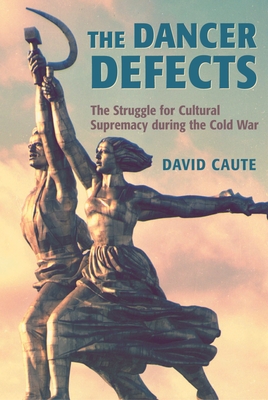
The Dancer Defects : The Struggle for Cultural Supremacy during the Cold War
by
David Caute
Book Details
Format
Paperback / softback
ISBN-10
0199278830
ISBN-13
9780199278831
Publisher
Oxford University Press
Imprint
Oxford University Press
Country of Manufacture
GB
Country of Publication
GB
Publication Date
Jul 21st, 2005
Print length
818 Pages
Weight
1,168 grams
Dimensions
23.20 x 15.90 x 4.30 cms
Product Classification:
RussiaUnited States of America, USALater 20th century c 1950 to c 1999The arts: general issuesThe arts: general topicsGeneral & world historyPostwar 20th century history, from c 1945 to c 2000Social & cultural historyHistoryGeneral and world historySocial and cultural history
KSh 15,400.00
Currently unavailable
0 in stock
Delivery Location
Delivery fee: Select location
Secure
Quality
Fast
With the onset of the Cold War, cultural competition flared up between Moscow and the West. It rapidly penetrated theatre, film, music, ballet, painting, and sculpture. Artists such as Miller, Picasso, Eisenstein, Shostakovich, and Stravinsky became involved in this fierce cultural competition through which each of the major Cold War protagonists sought to establish their supremacy.
The cultural Cold War between the Soviet Union and the West was without precedent. At the outset of this original and wide-ranging historical survey, David Caute establishes the nature of the extraordinary cultural competition set up post-1945 between Moscow, New York, London, and Paris, with the most intimate frontier war staged in the city of Berlin. Using sources in four languages, the author of The Fellow-Travellers and The Great Fear explores the cultural Cold War as it rapidly penetrated theatre, film, classical music, popular music, ballet, painting, and sculpture, as well as propaganda by exhibition. Major figures central to Cold War conflict in the theatre include Brecht, Miller, Sartre, Camus, Havel, Ionesco, Stoppard, and Konstantin Simonov. Among leading film directors involved were Eisenstein, Romm, Chiarueli, Aleksandrov, Kazan, Tarkovsky, and Wajda. In the field of music, the Soviet Union in the Zhdanov era vigorously condemned ''modernism'', ''formalism'', and the avant-garde. A chapter is devoted to the intriguing case of Dmitri Shostakovich, and the disputed authenticity of his ''autobiography'' Testimony. Meanwhile in the West the Congress for Cultural Freedom was sponsoring the modernist composers most vehemently condemned by Soviet music critics, notably Stravinsky. The Soviet Party was unable to check the appeal of jazz on the Voice of America, then rock music, to young Russians. Visits to the West by the Bolshoi and Kirov ballet companines, the pride of the USSR, were fraught with threats of cancellation and the danger of defection. Caute dampens overheated speculations about KGB plots to injure Rudolf Nureyev and other defecting dancers.Turning to painting, where socialist realism prevailed in the USSR and dissident art was often brutally repressed, Caute explores the paradox of Picasso''s membership of the French Communist Party. Re-assessing the extent of covert CIA patronage of abstract expressionist artists like Jackson Pollock, Caute finds that the CIA''s role has been much exaggerated.Caute also challenges some recent accounts of ''Cold War culture'', which virtually ignore the Soviet performance and cultural activity outside the USA. Soviet artistic standards and teaching levels were exceptionally high, but the regime''s endemic fear of free innovation finally accelerated its collapse.
Get The Dancer Defects by David Caute at the best price and quality guaranteed only at Werezi Africa's largest book ecommerce store. The book was published by Oxford University Press and it has 818 pages.
Customers Who Bought This Also Bought

On Freedom
KSh 2,350.00
How To Live An Artful Life
KSh 3,050.00

Photography
KSh 7,350.00

Fail Better
KSh 6,200.00

First Person Singular
KSh 1,800.00

Rosarita
KSh 1,800.00
The Art of Diremption – On the Powerlessness of Art
KSh 3,300.00
Languages of Truth
KSh 2,350.00

Fish Out of Water
KSh 2,700.00
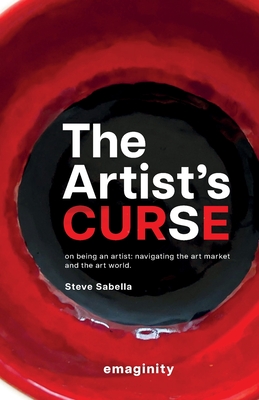
The Artist's Curse
KSh 2,900.00
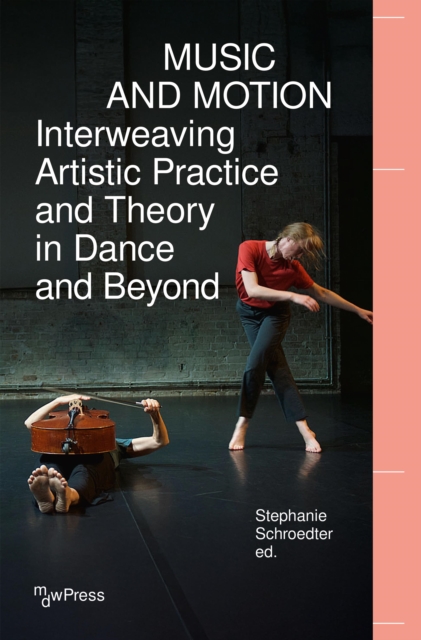
Music and Motion – Interweaving Artistic Practice and Theory in Dance and Beyond
KSh 13,150.00
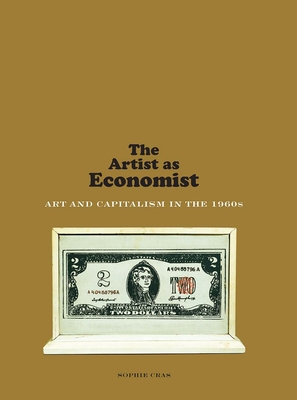
The Artist as Economist – Art and Capitalism in the 1960s
KSh 10,450.00