
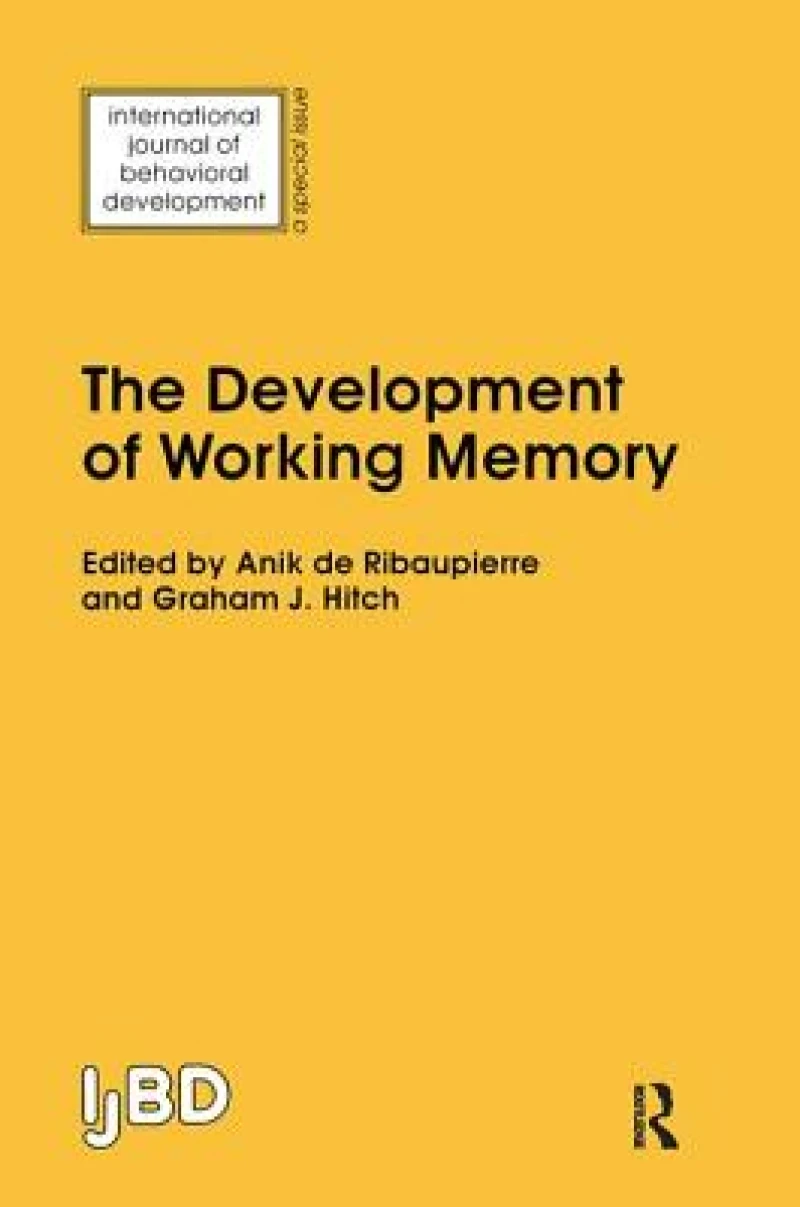
The Development of Working Memory : A Special Issue of the International Journal of Behavioural Development
Book Details
Format
Paperback / Softback
ISBN-10
113887731X
ISBN-13
9781138877313
Publisher
Taylor & Francis Ltd
Imprint
Routledge
Country of Manufacture
GB
Country of Publication
GB
Publication Date
Feb 4th, 2019
Print length
212 Pages
Weight
318 grams
Dimensions
15.50 x 22.80 x 1.70 cms
Ksh 5,600.00
Werezi Extended Catalogue
0 in stock
Delivery Location
Delivery fee: Select location
Secure
Quality
Fast
This Special Issue of the International Journal of Behavioral Development brings together research on the development of working memory that arises within two quite different approaches.
Working memory refers to the temporary storage and manipulation of information that is being processed in a wide range of cognitive tasks.
This Special Issue of the International Journal of Behavioral Development brings together research on the development of working memory that arises within two quite different approaches. The first is the neo-Piagetian perspective, which proposes that working memory limitations play an important role in the development of cognitive abilities. Accordingly, a major goal of neo-Piagetian research has been to develop techniques for measuring the capacity of working memory and to chart its development. Papers by Alp, de Ribaupierre and Bailleux, Morra, and Pascual-Leone, illustrate different facets of this approach.
The second approach stems from the study of working memory and information-processing in mainstream cognitive psychology, which has suggested the need to distinguish relatively peripheral phonological and visuo-spatial subsystems from central resources. Since these subsystems are currently better understood than the central component of adult working memory, they have tended to be the focus of related developmental studies. This tendency is illustrated in papers on visuo-spatial working memory by Longoni and by Walker and Hitch, and on phonological working memory by Henry.
A further significant strand of research in both approaches, is to investigate links between the development of working memory and various aspects of cognitive development; this type of work is illustrated in the papers by Blake on language acquisition and by Siegel on reading. Although the two approaches have tended to remain rather separate, their complementarity is fairly obvious: one has tended to emphasise central aspects of working memory, the other more peripheral aspects.
This special issue is intended to promote the exchange of ideas, methods and data between researchers using the two approaches, and to identify areas of conflicts and agreements.
This Special Issue of the International Journal of Behavioral Development brings together research on the development of working memory that arises within two quite different approaches. The first is the neo-Piagetian perspective, which proposes that working memory limitations play an important role in the development of cognitive abilities. Accordingly, a major goal of neo-Piagetian research has been to develop techniques for measuring the capacity of working memory and to chart its development. Papers by Alp, de Ribaupierre and Bailleux, Morra, and Pascual-Leone, illustrate different facets of this approach.
The second approach stems from the study of working memory and information-processing in mainstream cognitive psychology, which has suggested the need to distinguish relatively peripheral phonological and visuo-spatial subsystems from central resources. Since these subsystems are currently better understood than the central component of adult working memory, they have tended to be the focus of related developmental studies. This tendency is illustrated in papers on visuo-spatial working memory by Longoni and by Walker and Hitch, and on phonological working memory by Henry.
A further significant strand of research in both approaches, is to investigate links between the development of working memory and various aspects of cognitive development; this type of work is illustrated in the papers by Blake on language acquisition and by Siegel on reading. Although the two approaches have tended to remain rather separate, their complementarity is fairly obvious: one has tended to emphasise central aspects of working memory, the other more peripheral aspects.
This special issue is intended to promote the exchange of ideas, methods and data between researchers using the two approaches, and to identify areas of conflicts and agreements.
Get The Development of Working Memory by at the best price and quality guaranteed only at Werezi Africa's largest book ecommerce store. The book was published by Taylor & Francis Ltd and it has pages.

